
3rd century·Feast December 18
St. Gatianus of Tours
Founding bishop of Tours and apostle of Gaul
Overview
Gatianus, called in French Gatien and in older lists also Catianus, Gratianus, or Cassien, was in the third century the first bishop of Tours. Christian historians report that in the year 250, during the consulship of the emperor Decius and Vettius Gratus, Pope Fabian sent seven bishops from Rome to evangelize Gaul, and to Gatianus fell Tours, together with Trophimus at Arles, Paul at Narbonne, Saturnin at Toulouse, Denis at Paris, Austromoine at Clermont, and Martial at Limoges. He found few Christians in the city on the Loire. Tradition tells that in a year of trouble he went into hiding in a cavern above the river, on the ground where the great abbey of Marmoutier later rose, venturing into the city only when chances to preach came. Gregory of Tours, writing in the sixth century, preserves the few dependable details, including a half-century spent winning the city to the gospel. He founded a shelter for the destitute beyond the ramparts, and there, worn out by fifty years of fasting and labor, he received a vision of Christ promising his crown. At his death the diocese of Tours stood securely founded, though persecution soon left the see empty for thirty-six years.
The Complete Life
A Man Whose Origins Were Lost
Almost nothing certain survives of Gatianus before his mission to Gaul. His name reaches the modern reader in a cluster of forms, Catianus, Gatianus, Gratianus, Cassien, Gatien, and Gratien among them, and even in antiquity his figure was veiled in pious conjecture. Later Christian imagination, confounding him with the seventy-two disciples of Christ, asserted that he had been sent into Gaul in the first century by Saint Peter himself, a legend shared with other founders of the Gallic churches, especially Saint Martial; other details of his biography, while not so easily disprovable, are likewise largely legendary. The dependable outline rests on earlier authorities: Christian historians record that during the consulship of the emperor Decius and Vettius Gratus, in the year 250, Pope Fabian dispatched seven bishops from Rome to preach the gospel across Gaul, and that the lot of Tours fell to Gatianus. Gregory of Tours, writing in the sixth century, is the more trustworthy witness for the few personal details concerning the founder of his own see. According to the historian Louis Duchesne, what Gregory learned from Tours amounted to little more than the saint's name and perhaps the fifty-year length of his episcopate, the rest he reconstructed by comparison with the early life of Saturninus of Toulouse.
§ Life
One of the Seven Apostles of Gaul
Gatianus belongs to the heroic generation of missionaries whom tradition calls the seven apostles of Gaul. In 250 Pope Fabian sent them out from a Rome then entering the storm of Decius' persecution, each to his allotted city: Gatianus took Tours; Trophimus, Arles; Paul, Narbonne; Saturnin, Toulouse; Denis, Paris; Austromoine, Clermont; and Martial, Limoges. Each became the father of a great see, and the constellation of their missions marks the systematic evangelization of the Gallic provinces in the middle of the third century. Gatianus' own field was perhaps the least prepared of them all, for when he reached the city on the Loire there were few Christians in Tours, and the countryside around was largely pagan. A community of believers had long existed at Lyon, where Irenaeus had been bishop, but Tours lay beyond the old Christian centers, among peoples for whom the gospel was an unfamiliar word. Later ages, watching the greatness of the church of Tours under Saint Martin, attributed to its founder a dignity ever higher, until he was reckoned a direct disciple of the apostolic age; the soberer tradition keeps him where the evidence places him, a Roman-appointed bishop who carried the faith to an unpromising city and stayed with it for half a century.
§ Life
Half a Century Among an Unbelieving People
The mission of Gatianus at Tours was a work of extraordinary endurance. Gregory of Tours, drawing on the traditions of the city, attests that he gave fifty years to the winning of the city through hardship without number, and that when he died the church of Tours stood firm. The city was not easy ground: Mithraism, according to Léon Jaud, was a dominating force among the legions of the region, and the Christian flock was small. Tradition relates that in a year of danger the bishop took refuge for a while in a cavern by the Loire, on the ground where the great abbey of Marmoutier later rose; there, Jaud reports, he retreated into the grotto and celebrated the mystical banquet, the Christian liturgy, while Gregory says he entered the town solely when a chance to preach offered itself. Two chambers hollowed from the limestone heights overlooking the water, facing Tours at the ruined abbey of Marmoutier, are still designated as the first sites where Gatianus celebrated the mysteries, and artists often showed him presiding over the rites within a cave. Out of that hidden and patient labor came a securely founded church.
§ Life
The Mysteries in the Grotto
The spirituality that the traditions ascribe to Gatianus is one of hiddenness, penance, and sacramental fidelity. A bishop of a nearly empty diocese, he learned to serve God without visible success, preaching when the city opened a door and praying in the cliff when it closed. The grotto on the bank of the Loire became his sanctuary: there he lay concealed in time of trouble, and there, in Jaud's telling, he celebrated the holy mysteries, a Christian banquet kept in the same hills where the legions honored Mithras in their own cave shrines. The image of Gatianus presiding over the rites within a cave preserves the memory of a liturgy kept alive under pressure. To this the traditions add asceticism of a severe kind: the vision at his death followed upon fifty years of fasting, penance, and labor, and it found him not in a palace but at the shelter he had raised for the destitute beyond the ramparts of the city, sinking under exhaustion. His last recorded act was the corporal work of mercy with which he had crowned his episcopate. In the gallery of missionary saints, Gatianus represents the vocation of those who sow for a harvest they will scarcely see.
§ Life
The Hospice Beyond the Walls
Gatianus closed his long life in the place his charity had built. Beyond the ramparts of Tours he had raised a hospice for the destitute, and there, after fifty years of fasting, penance, and labor, he lay worn out with weariness. It was there, according to the account of Léon Jaud, that Jesus appeared to him with the words of promise, that he should not fear, for his crown was readied and the saints awaited his arrival in heaven. He died in the late third century, and his death was followed by a catastrophe for the church he had founded: under a new outburst of persecution the bishop's throne stood vacant for six and thirty years, the faithful were scattered, and every living link with the historical founder was lost beyond recall. Gregory of Tours names as second bishop of the city Litorius, to whom legend ascribes the building that preceded the present cathedral and who held the see for thirty-three years until about the time Saint Martin arrived at Tours in 371. Even Martin found few Christians in the city, yet local lore had kept the founder's memory alive through the long silence, and it was Martin who sought out and honored his grave.
§ Veneration
Honored by Martin, Remembered by the Church
Gatianus was never the subject of a formal canonization; his sanctity was ratified by the unbroken memory of the church of Tours and by the veneration of the saints themselves. When Saint Martin came to the city in 371, he found few Christians, but he found the legend of the founder, and he sought out the burial site of his predecessor in the faith and always venerated Gatianus. Thus the greatest of the bishops of Tours knelt at the grave of the first, binding the two apostles of the Loire into a single tradition. The cult grew with the city. Tours' cathedral, first dedicated to Saint Maurice, received the founder's own name when it was rebuilt in the thirteenth century, and so the metropolitan church bore the apostle of Tours into the modern age. His feast was kept on the eighteenth of December, and the Roman Martyrology of 1961 recorded under that day that Gatianus, ordained first bishop of the city by Pope Fabian, fell asleep in the Lord famous for many miracles. His relics, preserved through the medieval centuries, were destroyed in 1793 during the French Revolution, leaving only the churches and the feast to testify to the apostle of Tours.
§ Veneration
A Name Woven into France
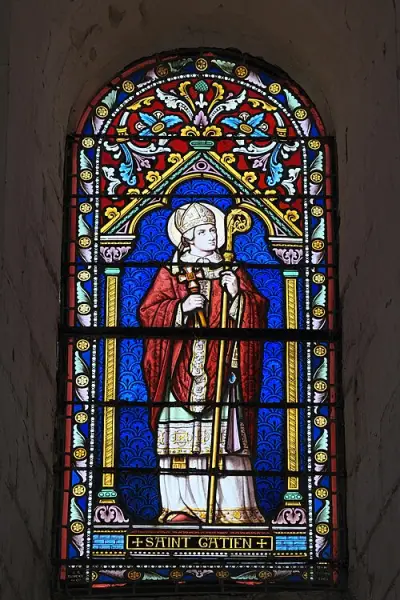
The legacy of Gatianus is written into the ecclesiastical and civic geography of France. As one of the seven apostles of Gaul he belongs to the founding generation of the French church, and the see he planted at Tours became, under Saint Martin, one of the great centers of Western Christendom and a foremost goal of medieval pilgrimage. The cathedral of Tours bore his name from the thirteenth-century rebuilding onward, and as the importance of Paris grew, tradition increasingly described him as a disciple of Saint Denis, the martyr-bishop of that city, a description repeated on many modern Catholic websites. His memory scattered itself across the landscape: the commune of Saint-Gatien-des-Bois in Lower Normandy, in Calvados, bears his name, as do schools and other institutions, even the Deauville aerodrome and its neighboring golf links. Literature took notice of him in unexpected quarters; Honoré de Balzac set the petty ambitions and small tragedies of mid-nineteenth-century provincial life around the cathedral of Tours in his novel Le Curé de Tours, and Henry James, touring the grottos of Marmoutier, left a graceful account of the cliff where Gatianus and Martin retired to pray. The stained-glass windows of the countryside, as at La Celle-Guenand, still show the founder at his liturgy.
§ Veneration
Timeline
- 250
Sent by Pope Fabian from Rome in the consulship of Decius and Vettius Gratus, becoming the first bishop of Tours.
§ Life
- 371
Saint Martin arrived at Tours, found the burial site of his predecessor, and always venerated Gatianus.
§ Veneration
- 1793
His relics were destroyed during the French Revolution.
§ Veneration
In Their Own Words
Fear not! Thy crown is readied and the Saints await thy arrival in Heaven.
The Record
- Major works
- Founded the see of Tours, among the seven churches of Gaul·Established a hospice for the poor outside the walls of Tours
- Patron of
- Patron of Tours
- Canonization
- Pre-congregation; venerated as a saint since the earliest centuries of the Gallic church
Prayer
Bibliography
Show 6 sources
- Clugnet, Léon. "St. Gatianus." The Catholic Encyclopedia. Vol. 6. New York: Robert Appleton Company, 1909.
- Jaud, Léon. Vie des Saints pour tous les jours de l'année, (Tours) 1950.
- James, Henry. A Little Tour in France, Ch. III (1883).
- Gregory of Tours. History of the Franks, 1.30; 10.31.
- The Vetus Martyrologium Romanum (1961), Die 18 Decembris.
- "Book of Saints – Gratian". CatholicSaints.Info. 2013-07-25. Retrieved 2020-08-20.
Profile text adapted from the Wikipedia article, licensed CC BY-SA 4.0.
Pray with this saint every day
Save St. Gatianus of Tours to your favorites, read the full profile, and get feast-day reminders in the Saints app.
Get the Saints AppFree on the App Store for iPhone and iPad