
1060 – 1140·Feast April 9
St. Gaucherius
Hermit and Founder of the Canons Regular of Aureil
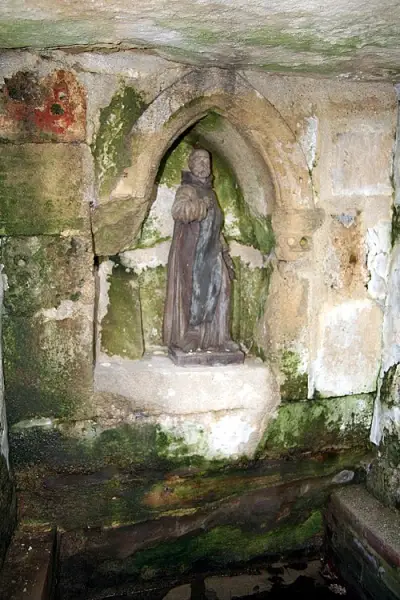
Overview
Gaucherius was born at Meulan-sur-Seine in France in 1060 and educated in the classical letters before his ordination to the priesthood. Outwardly successful, he felt an increasingly urgent desire for solitude, and after keeping a night of prayer at the tomb of Leonard of Limoges he withdrew into the wild forest country of the Limousin and raised a hermitage there. With his companion Germond he gave himself wholly to the eremitical life; other seekers gathered around their example and built cells nearby. In time Gaucherius raised a monastery at Aureil served by twin houses, one of men and one of women, both governed by Augustine's rule. Aureil became a notable instance of the Ordo Novus, the new order of canons regular through which hermits passed over into the canonical life during the eleventh and twelfth centuries. Among those who shaped their discipleship on his were Lambert of Angoulême and Faucherus, and Stephen Muret, who would later found Grandmont. Gaucherius lived among his brethren as a living pattern of holiness until his death in 1140 at about eighty years of age, from injuries received in a fall from horseback. He was canonized in 1194 by Pope Clement III, and his feast is kept on April 9.
The Complete Life
Early Life
Gaucherius first appears in the record at Meulan-sur-Seine, a town on the Seine in the France of the late eleventh century, where he was born in the year 1060. His family gave him what the age considered a complete formation: a classical education in the inherited letters of antiquity, followed by ordination to the priesthood. By every outward measure he was a man of the established Church, learned, ordained, and settled. Yet the sources preserve a striking detail of his interior state: beneath the clerical career ran a deep and persistent longing for solitude, an ache for the desert that neither office nor learning could quiet. The turning point came at the tomb of Leonard of Limoges, one of the most visited shrines of the Limousin. There Gaucherius spent an entire night in prayer, and the night decided his life. He left almost at once for the wild forest region of the surrounding country and constructed a hermitage with his own hands, exchanging the secured appointments of a priest for the uncertainty of the woods. Nothing in his early years had announced a founder; the classical pupil and young priest of Meulan would become, by one night's resolve at a saint's grave, a hermit whose example would draw an entire movement of canons regular after him.
§ Biography
Vocation to the Solitary Life
The vocation of Gaucherius matured in company rather than in isolation. Having built his hermitage in the forest country near Limoges, he devoted his life to God as a hermit and was joined by his friend Germond, with whom he took up residence in the area. The two formed the small nucleus from which something larger would grow: their example attracted others, who raised hermitages of their own close by, until a scattered colony of solitaries had gathered in the woods around the first cell. This pattern, in which a single hermitage becomes the seed of a communal settlement, was among the characteristic ways the religious life developed in eleventh-century France. For Gaucherius it marked a decisive passage: the man who had fled to solitude found himself at the head of a growing family of disciples. His response was not to scatter the flock but to give it structure. His answer was Aureil: he determined to erect a monastery there and to found within it two houses, one of men and another of women, both placed under Augustine's rule. The eremitical impulse thus came to rest in the canonical life, with Aureil as its lasting monument and the vowed community as the form his love of solitude finally assumed.
§ Biography
Founder of Aureil and the New Canons
The monastery of Aureil stands at the centre of Gaucherius's achievement and illustrates one of the principal channels by which the canons regular grew in the eleventh and twelfth centuries: the transit of a hermit colony into the canonical state. Aureil stands as a representative case of these communities, the so-called Ordo Novus, in which the desert longing of hermits was joined to the common discipline, liturgical praise, and pastoral service of canons following Augustine's rule. The foundation was double, embracing a house for men and a parallel community for women, a structure that made Aureil a spiritual home for both sexes of the seeking population around Limoges. Gaucherius lived on among his companions after the foundation, and the sources are unanimous that he was for all of them a model of sanctity, teaching less by instruction than by the daily witness of his conduct. The influence of the house reached far beyond its walls through the men formed there. His companions and disciples included Lambert of Angoulême and Faucherus, and, most famously, Stephen Muret, whose time in Gaucherius's orbit preceded his own withdrawal and his founding of the monastery of Grandmont, one of the most austere and influential orders of the age. A hermitage built in the forest thus became, within a single generation, a wellspring of monastic reform.
§ Biography
Final Years and Death
The closing period of Gaucherius's life was spent as he had spent the decades before it, in the company of the communities he had founded, living with his brethren and remaining for everyone a pattern of holiness. The sources summarize those years without drama: the founder had become simply the saint in their midst, the elderly man whose presence held together the double house of Aureil and whose reputation drew visitors to the Limousin forest. His death came suddenly and, in the judgment of later readers, with a certain irony for a man of the stable cloister: he died in 1140 from a fall from a horse, at about eighty years of age. The accident ended a life that had spanned almost the whole of the century's first half, from the classical schools of his boyhood at Meulan-sur-Seine to the canonical settlement at Aureil. He had outlived Germond and most of the first companions, and he left behind communities of men and women living under Augustine's rule, together with a circle of disciples, among them the future founder of Grandmont, who would carry the impetus of his example into new foundations. The brethren buried their father in God, and the veneration that followed his death was immediate and local, awaiting only the Church's formal ratification.
§ Biography
Canonization and Cult
Gaucherius was canonized in 1194, a little more than half a century after his death, when Pope Clement III inscribed him among the saints. The canonization ratified a cult that had grown spontaneously around the monastery of Aureil and the memory of its founder, and it fixed his feast in the calendar of the canons regular for April 9, the day on which his sanctity is still commemorated. By the standards of the age the interval between his death and his elevation was short, a sign of how widely the repute of Aureil had travelled through the religious networks of the Limousin and beyond. The community he established endured as one of the representative houses of the Ordo Novus, the new order of canons regular that carried the fervour of the hermits into the structured common life, and his name remained attached to it as the man who had shown that the longing for the desert and the discipline of the cloister could inhabit the same vocation. Later hagiographers remembered him chiefly through three images: the classical priest of Meulan who longed for solitude, the night of prayer at Leonard's tomb that decided everything, and the aged founder dying from a horse's fall amid the brethren he had gathered.
§ Biography
Timeline
- 1060
Born at Meulan-sur-Seine in France.
§ Biography
- 1140
Died at about eighty years of age from a fall from horseback.
§ Biography
- 1194
Canonized by Pope Clement III.
§ Biography
The Record
- Major works
- Monastery of Aureil, with twin communities of men and women under the Rule of St. Augustine
- Canonization
- Canonized in 1194 by Pope Clement III
Prayer
Bibliography
Show 2 sources
- Saints at a Glance
- "Saints of the Canons Regular", Canons Regular of Saint Augustine. Archived from the original on 2016-05-02. Retrieved 2013-02-12.
Profile text adapted from the Wikipedia article, licensed CC BY-SA 4.0.
Pray with this saint every day
Save St. Gaucherius to your favorites, read the full profile, and get feast-day reminders in the Saints app.
Get the Saints AppFree on the App Store for iPhone and iPad