
c. 280 – 360·Feast October 14 (elsewhere); August 14 (Garaguso)
St. Gaudentius of Rimini
Martyred Bishop and Patron Saint of Rimini
Overview
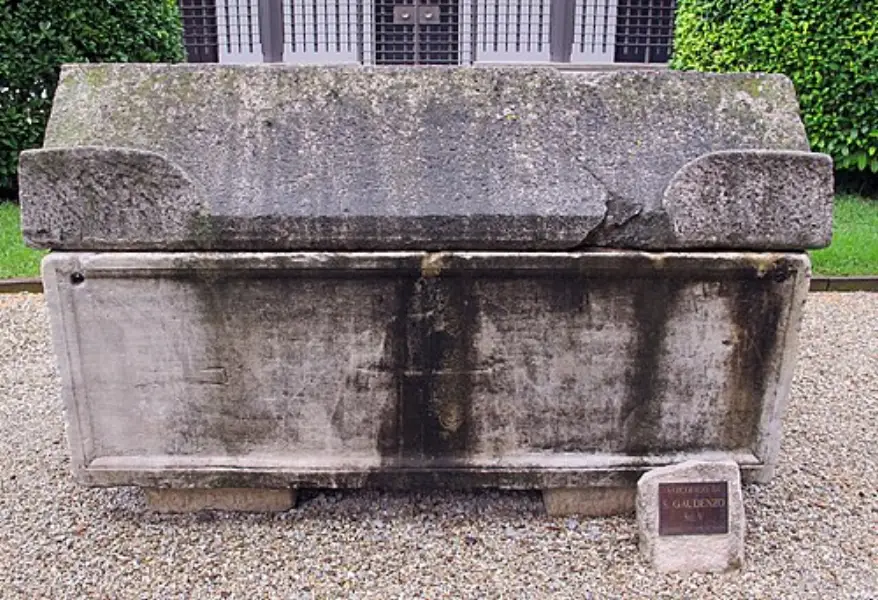
Gaudentius of Rimini, called in Italian San Gaudenzo and sometimes Gaudenzio, is the martyred patron bishop of Rimini, venerated in both the Catholic and Eastern Orthodox Churches. The accounts of his life vary with the hagiographic tradition that preserved them. In the dominant legend he was born at Ephesus around 280 to a wealthy Christian family; his parents were killed by Manichaeans, and he fled to Rome, where he was baptized, ordained priest and consecrated bishop. Pope Sylvester I sent him to preach the gospel at Ariminum, the modern Rimini, where he is honoured as the city's proto-bishop: there he founded a Christian community meeting in a domus ecclesiae and ordained as deacon the stonemason Marinus, future founder of San Marino, and perhaps as priest Leo of Montefeltro. Another tradition places him at the Council of Ariminum in 359, where he condemned Arianism before retreating with seventeen bishops to the town afterwards called Cattolica. On his return he was arrested, seized from the magistrates by a mob, and martyred on October 14, 360, in the marsh south of the Arch of Augustus, a spot remembered as the Lacus Martyrum. His remains, translated to Senigallia in 590 and to Ostra by 1520, are dispersed among Rimini, Ostra and Garaguso, while his sarcophagus stands in the courtyard of Rimini's Curia beside the Tempio Malatestiano.
The Complete Life
Origins at Ephesus and Flight to Rome
The hagiography of Gaudentius is not single tradition but a woven cloth, and its first threads are set at Ephesus in Asia Minor, where he was born around the year 280. His family was Christian and prosperous, means enough to secure the boy an education in a turbulent age. Prosperity, however, brought danger: his parents were killed by Manichaeans, and the young Gaudentius fled to Rome, the city of the apostles. There the shape of his life was determined in three sacramental steps, for he was baptized, raised to the priesthood, and consecrated bishop in the capital. In the earliest layer of the legends, Pope Sylvester I sent him forth from Rome to preach the gospel at Ariminum, the Rimini of the Adriatic coast, and he is honoured as the city's first proto-bishop. The community he founded met in a domus ecclesiae, the house-church of the generation before great basilicas, and from that domestic seed the ancient Christianity of Rimini is held to have grown. The martyred patron of the city is thus remembered first as a refugee from Asia who made the Adriatic his adopted homeland.
§ Early life and ministry
Apostle of Rimini and Ordainer of Saints
The ministry of Gaudentius at Rimini gathered into one story the beginnings of several sanctities. As the city's proto-bishop he preached, organized, and governed the young community, and the tradition credits him with ordinations whose fruits reached far beyond his diocese: it was from his hands that the stonemason Marinus received the diaconate, the same Marinus who would climb Monte Titano and found what became the Republic of San Marino. Some sources add that he also ordained to the priesthood Leo of Montefeltro, after whom the fortress town of San Leo takes its name. Around the living bishop clustered a cycle of wonder: he delivered a man from demonic possession, and turned the waters of the Misa at Sena Gallica, today's Senigallia, into wine to refresh his fellow travellers. Whatever evaluation such tales invite, they preserve the popular image of a bishop whose word commanded evil spirits and whose charity supplied the needs of those on the road with him. His later title of saint was earned in blood, but the memory of the miracle-worker and ordainer of founders came first.
§ Early life and ministry
The Council of Ariminum
A second and later tradition sets Gaudentius in the great crisis of the mid-fourth century, the Council of Ariminum summoned by Emperor Constantius II to reconcile the followers of Arius with their opponents. The emperor had come to Rimini in 357, charging the praetorian prefect Taurus with the city's preparations — a choice probably owed to Arian leanings among the local clergy; the assembly met from May to October of 359. In this account Gaudentius took his seat among the bishops and condemned the Arian heresy. When the defeat of the Arian party became certain, or, in another version, to escape the violence gathering in the city, he withdrew with seventeen brother bishops to a nearby town, which tradition says was renamed Cattolica in memory of their orthodox retreat. Modern historians judge this council episode inconsistent with the earlier legends, since another bishop of Rimini is attested as early as 313; rival tales instead have the saint combat a heretical priest named Marciano, or meet death at the hands of troops serving a consul Marcianus, a man who denied that the dead would rise. However much the versions conflict, they agree in the memory they serve: in every version Gaudentius stands with the Nicene faith against its attackers.
§ Martyrdom
Martyrdom
The return to Rimini ended in blood. Arrested on arriving back in the city, Gaudentius faced charges that vary with the teller: in one account he stood accused of having condemned Arianism; in another, his miracles brought blame upon him for the deaths in quick succession of two imperial troopers. The magistrates held him, but a mob tore him from their hands. In the prevalent version he was lynched or stoned by supporters of the Arian cause; in another he was stoned for perduellio, high treason against the state. He died on October 14, 360, in the marshy ground south of the city's Arch of Augustus. The killing place was never forgotten: it became known as the Lacus Martyrum, the Lake of the Martyr, and its name is believed to survive in the Via Lagomaggio and in the eponymous suburb of modern Rimini. Just outside that gate, in the necropolis by the Arch of Augustus, the city's most famous burial was made. The Bavarian Code, recording the Ravenna church's investitures of the eighth to tenth centuries, still calls the arch the Gate of Saint Gaudentius, naming the city by its martyr.
§ Martyrdom
Cult, Relics and Memory
From time immemorial Gaudentius has been patron of Rimini, where his feast of October 14 opens the diocese's pastoral year amid tombola, sports, concerts and the sweet festival bread called piada dei morti; Garaguso keeps him on August 14 so as not to disturb the October sowing. His remains have travelled almost as widely as his legends. In 590, with barbarian invaders at hand, Queen Theodelinda's circle judged the relics unsafe, and the body without its skull was carried to Senigallia; by 1520 the ruined abbey there gave them up to Montalboddo, the present Ostra, where they remain. Leg bones and an arm bone reached Garaguso in 1702 and 1794 through the gifts of Cardinal Carpegna and Bishop Fortunato Pinto, while Pius IX sent a silver reliquary to the Tempio Malatestiano for the skull in 1857. The extant sarcophagus stands in the courtyard of Rimini's Curia; Giovanni Francesco Mainardi printed the saint's first full hagiographic account there in 1659. In the Piazza Cavour a bronze statue, converted from a Pope Paul V in 1797 to save it from the Cisalpine Republic, was twice returned to papal form, most recently by Filogenio Fabbri in 1939, and 13th-century pilgrims such as Amato Ronconi already sought his tomb.
§ Cult
Timeline
- 280
Born at Ephesus in Asia Minor to a wealthy Christian family.
§ Early life and ministry
- May 359
Took part in the Council of Ariminum, called by Constantius II, and condemned Arianism.
§ Martyrdom
- 14 Oct 360
Martyred on October 14 by a mob in the marsh south of Rimini's Arch of Augustus, at the site called Lacus Martyrum.
§ Martyrdom
- 430
A blind woman of Ravenna, guided by an angel, obtained a worthy burial for the forgotten remains of Gaudentius, Valentino and Vittore.
§ Reburial
- 590
Amid barbarian invasion, the relics except the skull were moved to Senigallia for safety.
§ Relics
- 1520
After their Senigallia abbey fell to ruin, the remains were carried to Montalboddo, the modern Ostra.
§ Relics
- 1659
Giovanni Francesco Mainardi printed at Rimini his account of the saint's life and martyrdom, one of the earliest written hagiographies.
§ Reburial
- 1702
Cardinal Gaspare Carpegna donated a leg bone to the parish of St Nicholas of Myra in Garaguso.
§ Relics
- 1794
Bishop Fortunato Pinto of Tricarico presented the Garaguso parish with a bone from an arm.
§ Relics
- 1797
Rimini reshaped the bronze of Piazza Cavour into the saint's likeness, sparing it the Cisalpine Republic's iconoclasm.
§ Depictions in art
- 1857
Pope Pius IX donated a silver reliquary to the Tempio Malatestiano to house the saint's skull.
§ Relics
- 17 May 1916
An earthquake displaced the bronze statue of the saint in Piazza Cavour and broke its crozier.
§ Depictions in art
- 1939
Sculptor Filogenio Fabbri restored the statue to its original papal appearance.
§ Depictions in art
In Their Own Words
The bronze statue of S. Gaudenzo in Piazza Cavour has moved from its base and the crosier has broken
The Record
- Major works
- Christian community founded at Rimini, meeting in a domus ecclesiae
- Patron of
- Rimini·Garaguso·Ostra·Montefabbri (Vallefoglia)
- Symbols
- Bishop's mitre·Crozier·Martyr's palm
- Canonization
- Pre-congregation; venerated as a martyr in the Catholic and Eastern Orthodox Churches from time immemorial
Prayer
Bibliography
Show 8 sources
- "La Gambalunga racconta: San Gaudenzio patrono di Rimini". Biblioteca Civica Gambalunga (in Italian). Retrieved 11 January 2024.
- Lanzoni, Francesco (1927). Le diocesi d'Italia dalle origini al principio del secolo VII (an. 604) (in Italian). Vol. 2. Faenza. pp. 705–710.
- Cicchetti, Stefano (15 October 2016). "San Gaudenzo, chi era costui?". Chiamami Città (in Italian). Retrieved 11 January 2024.
- "San Gaudenzo, storia e misteri del patrono di Rimini". RiminiToday (in Italian). 18 October 2021. Retrieved 11 January 2024.
- "27 maggio 359 – L'imperatore Costanzo II convoca il Concilio di Rimini". Chiamami Città (in Italian). 26 May 2023. Retrieved 11 January 2024.
- "San Gaudenzo, un santo senza pace". Rimini Sparita (in Italian). 23 September 2016. Retrieved 11 January 2024.
- Morri, Carlo Ennio (23 January 2002). "San Gaudenzio (Gaudenzo) di Rimini". Santi e Beati (in Italian). Retrieved 11 January 2024.
- "I principali edifizi lesionati". Il Resto del Carlino (in Italian). 19 May 1916. Retrieved 16 January 2024.
Profile text adapted from the Wikipedia article, licensed CC BY-SA 4.0.
Pray with this saint every day
Save St. Gaudentius of Rimini to your favorites, read the full profile, and get feast-day reminders in the Saints app.
Get the Saints AppFree on the App Store for iPhone and iPad