
c. 550 – 619·Feast August 11
St. Gaugericus
Bishop of Cambrai and Apostle of Brussels
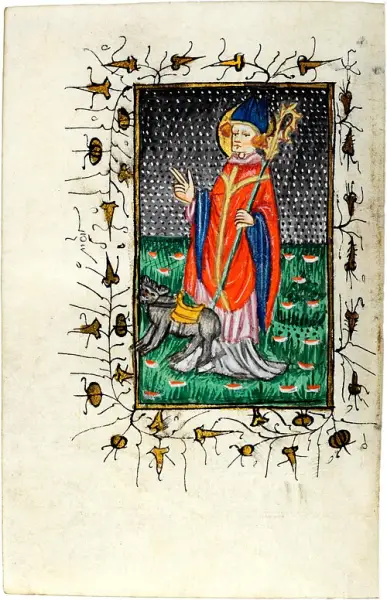
Overview
Saint Gaugericus, called Saint Géry in French and Djèri in Walloon, led the diocese of Cambrai from about 585 until his death on 11 August 619. Born near 550 at Eposium, today's Carignan, to the Roman couple Gaudentius and Austadiola, he so impressed Bishop Magnerich of Trier by his piety that the prelate ordained him deacon, but only after the young man had committed the entire psalter to memory. Magnerich then placed the pastoral care of Cambrai in his hands. Around 585 the united see of Cambrai and Arras lost its bishop; the choice of a successor fell upon Gaugericus, King Childebert II approved the election, and Egidius of Reims consecrated him. He fought paganism, ransomed captives, and visited the rural districts and estates of his diocese, founding churches and abbeys, among them a monastery honoring Saint Medard, which gave Cambrai both the appearance and the functions of a city. Between 584 and 590 he moved the episcopal seat from Arras to Cambrai, and in 614 he attended the Council of Paris. A chapel he raised near Brussels around 580 became, by tradition, the seed of that city. He died after thirty-nine years of service and was venerated from the moment of his death.
The Complete Life
Formed by the Psalms
Gaugericus came into the world around the year 550 at Eposium, the settlement known today as Carignan, born to parents of Roman stock named Gaudentius and Austadiola. The faith of his household showed itself early in the boy, and his reputation for piety reached Bishop Magnerich of Trier, who had succeeded Saint Nicetas in that ancient see. Magnerich took a personal interest in the youth, but his standards were exacting: he would ordain Gaugericus deacon only after the candidate had learned the complete psalter by heart. The requirement says much about the making of clergy in the Merovingian church, where the psalms stood as the bedrock of prayer, preaching, and daily discipline. Once the young man had met it, Magnerich ordained him and went further still, committing to his hands the pastoral charge of Cambrai and its people. In that charge the young deacon gained the experience of teaching and governance that would fit him for the episcopate. The road from a provincial town to responsibility for a major city ran through disciplined prayer, and Gaugericus had walked it under the eye of a watchful bishop.
§ Biography
Election to Cambrai-Arras
Around 585 the united see of Cambrai and Arras lost its occupant, and the choice of a successor fell upon Gaugericus. His election carried political weight: the Frankish lands were ruled by rival kings, and no episcopal appointment stood without approval from above. Childebert II consented to the choice, and Egidius, bishop of Reims, consecrated the new bishop for his charge. Gaugericus thus took up the government of a diocese whose two chief towns anchored the church of a broad region of the Frankish realm. From the first he proved a bishop in motion. He labored against the paganism that still gripped much of the countryside, paid ransoms to win the freedom of captives, and made his way through rural districts and villae to minister where the structures of parish life were thin. Thirty-nine years of episcopal service lay ahead of him, years in which he would transform a frontier diocese into a center of Christian civilization and leave his name attached to two cities, Cambrai and Brussels, whose oldest Christian monuments trace back to his hands. The consent of a king and the consecration of a metropolitan thus set their seal upon a calling that had begun in the psalter.
§ Bishop
Builder of Churches and Cities
Gaugericus' episcopate left a mark on the landscape that outlasted him by centuries. He founded churches and abbeys across his territory, among them a monastery dedicated to Saint Medard raised to house relics, and these foundations contributed powerfully to giving Cambrai the appearance and the functions of a true city. His own piety drew him on pilgrimage to the tomb of Saint Martin at Tours, and back home he built a church in Martin's honor, depositing relics of that saint within it; the bell tower of this church would become, much later, the belfry of the city. In the years from 584 to 590 he moved the bishop's seat from Arras to Cambrai, fixing the identity of the diocese upon his principal town. He cultivated a close relationship with Chlothar II, the new lord of Cambrai after Childebert's death, and in 614 assisted at the Council of Paris. Tradition adds another foundation of far-reaching consequence: around 580 he raised a chapel on the largest island of the Senne near Brussels, and a legend tells that from the church dedicated there to Saint Michael, after he had chased a dragon from its lair, the city of Brussels was born.
§ Bishop
Thirty-Nine Years, Then Rest
Gaugericus closed a remarkably long episcopate at Cambrai, an office he had held for thirty-nine years. Death came on 11 August 619, and his body received burial in the Saint-Médard church he himself had founded, the monastery he himself had founded in the city, so that in death he remained among the relics he had gathered in life. The men and women of the Meuse and Scheldt lands did not wait for any authority to tell them they had lost a saint: veneration commenced immediately after his death, rising from the memory of the captives he had freed, the chapels he had built, and the poor countryside he had visited year after year. The burial in his own foundation gave the place a new center of gravity, as the faithful came to pray where the founder lay. His passing in 619 marks the close of a generation of Merovingian bishops who carried the church through a fractured age, and Cambrai, the city he had served longest and shaped most deeply, naturally became the hearth of his cult. The church he had raised in honor of Saint Medard received the body of its founder and never surrendered it.
§ Veneration
An Immediate and Lasting Cult
Gaugericus belongs to the many bishops of the first millennium whose sanctity was recognized by the acclamation of the faithful rather than by formal process: veneration began at once upon his death and never ceased. The antiquity of his cult is documented in the liturgical books of the early Middle Ages, for his feast on 11 August is recorded in the martyrology of Rabanus Maurus, the great ninth-century abbot of Fulda. Alongside the principal feast, the church of Cambrai kept two further commemorations bound to the history of his remains: 18 November, marking the exhumation of his relics, and 24 September, recalling their translation. Such multiple feasts are the signature of an ancient and living devotion, renewed at each stage in the story of the saint's body. Through them the memory of the bishop of Cambrai passed intact from the Merovingian world to our own, and he stands today among the recognized saints of both the Roman Catholic and the Eastern Orthodox churches, honored especially in the lands he evangelized. No decree was required to declare holy a life the faithful had already embraced; his sanctity rested on the ordinary judgment of Christian people.
§ Veneration
Relics, Churches, and Patronage
The remains of Gaugericus became the center of a story that spanned a millennium. When the church of Saint Medard at Cambrai was demolished under the emperor Charles V to make way for the citadel, the canons carried the saint's relics away to the ancient church of Saint Vedast, thereafter known by the name of Saint Géry; it remains one of the oldest churches of Cambrai and has been a listed historical monument since 1919. Portions of the relics were distributed far and wide, reaching Carignan, his birthplace, as well as the church of Saint-Géry in Valenciennes, the abbey of Saint-Sépulcre in Cambrai, the abbey of Arras, the abbey of Liessies, the collegiate church of Saint-Pierre in Douai, the church of Saint-Donat in Bruges, Bierne, and Brussels. His reliquary can be seen today in the southern transept of Cambrai's church of Saint-Géry. In life he freed prisoners, criminals, and children carried into slavery during his journeys; in death he remains patron of Cambrai, Brussels, and Braine-le-Comte, and the special advocate of prisoners everywhere. Through these many dedications his name is spoken today in more places than any written record of his words could reach.
§ Relics
Timeline
- 550
Born at Eposium, present-day Carignan, to the Roman couple Gaudentius and Austadiola.
§ Biography
- 580
Built a chapel, according to tradition, on the largest island of the Senne near Brussels.
§ Traditions
- 585
Elected bishop of the vacant see of Cambrai-Arras with the consent of King Childebert II.
§ Bishop
- 590
Completed the transfer of the episcopal see from Arras to Cambrai, a move carried out between 584 and 590.
§ Bishop
- 614
Assisted at the Council of Paris, maintaining his close ties with King Chlothar II.
§ Bishop
- 11 Aug 619
Died at Cambrai, ending an episcopate of thirty-nine years; his body was laid to rest in his own church of Saint Médard.
§ Veneration
- 1919
The church of Saint-Géry at Cambrai, custodian of his relics, was listed as a historical monument.
§ Relics
The Record
- Major works
- Monastery dedicated to Saint Medard at Cambrai·Church dedicated to Saint Martin at Cambrai·Chapel on the Senne island near Brussels
- Patron of
- Cambrai·Brussels·Braine-le-Comte·prisoners
- Symbols
- Bishop in mitre with right hand raised in blessing·Left hand folded upon his breast·Shown without his crosier
- Canonization
- Pre-congregation; veneration commenced immediately after his death in 619.
Prayer
Bibliography
Show 8 sources
- Butler, Alban. "Saint Gery, or Gaugericus, Bishop and Confessor". Lives of the Fathers, Martyrs, and Principal Saints, 1866. CatholicSaints.Info. 11 August 2016
- Herbermann, Charles, ed. (1913). "St. Géry". Catholic Encyclopedia. New York: Robert Appleton Company.
- Monks of Ramsgate. "Gaugericus". Book of Saints, 1921. CatholicSaints.Info. 11 August 2016
- Mémoire de Cambrai, sous la direction de Michel Dussart, Société d'Émulation de Cambrai, 2004, p. 20.
- "Brussels History". City-data.com. Retrieved 5 July 2009.
- State, Paul F., Historical Dictionary of Brussels, Scarecrow Press, 2004, p. 269. ISBN 9780810865556
- Base Mérimée: Eglise Saint-Géry, Ministère français de la Culture.
- Arduino, Fabio. "San Gaugerico di Cambrai", Santi e Beati, May 30, 2006
Profile text adapted from the Wikipedia article, licensed CC BY-SA 4.0.
Pray with this saint every day
Save St. Gaugericus to your favorites, read the full profile, and get feast-day reminders in the Saints app.
Get the Saints AppFree on the App Store for iPhone and iPad