
died 962·Feast September 7
St. Gauzelin
Tenth-century Bishop of Toul and monastery founder
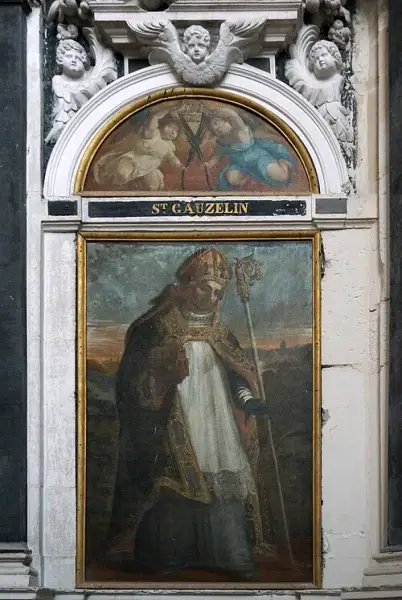
Overview
Gauzelin, who died on 7 September 962, governed the diocese of Toul in France as its bishop from 922 until his death. Born to noble Frankish parents, he entered royal service as a notary, working in the French kingdom from 913 until about 919. That service brought him to the attention of King Charles, who named him Bishop of Toul; Pope John X confirmed the appointment, and Ruotger consecrated him bishop on 17 March 922. His episcopate fell in an age of invasion: Danish and Hungarian raids had battered the region, and Gauzelin answered the devastation by reforming his diocese. He promoted discipline among the monasteries and the secular clergy, defended the church against secular threats, and founded a number of new monasteries, chief among them the house at Bouxières-aux-Dames, built in the years 935 and 936, the house that became linked with his noble household and later received his body. He died at Toul after forty years in office and was buried at Bouxières. Honored as a saint, he is commemorated on 7 September, with a second feast on 31 August recalling the translation of his relics to Nancy Cathedral in 1803.
The Complete Life
From the Chancery to the Church
Gauzelin was born to noble Frankish parents, a birth that set him among the aristocratic families from whom the tenth-century church so often drew its bishops. His first career, however, was administrative rather than pastoral: from 913 to about 919 he served as part of the corps of notaries of the French kingdom, the men who drafted and preserved the acts of royal government. The school of the chancery trained him in letters, law, and the conduct of affairs, accomplishments that would serve a bishop well in an age when the sword of the state was often needed to shield the altars. It was precisely this record of capable service that opened his path to the episcopate, for King Charles, observing the work of his notary, came to mark him out for higher responsibility. In the turbulent world of tenth-century Gaul, the road from the royal writing desk to the cathedral throne was a well-worn one, and Gauzelin traveled it while still a young man, carrying with him the habits of order and diligence learned in the king's service. That training would prove decisive for the church of Lorraine.
§ Life
Bishop of Toul
The king's choice fell upon Toul, an ancient diocese in the valley of the Moselle. Charles named Gauzelin to its episcopal throne, and the appointment received confirmation from Pope John X in Rome, binding the local act to the authority of the apostolic see. On 17 March 922 Ruotger consecrated him bishop, and he took up the government of the see, succeeding Bishop Drogo in an office he would hold for four decades. The circumstances of his elevation show the interlocking of royal, papal, and metropolitan authority in the church of the tenth century: a king nominates, a pope confirms, a bishop consecrates. Gauzelin's task was formidable, for Toul lay in a region exposed to the invasions and disorders of the age. Yet he brought to it both the nobility of his birth and the training of the royal chancery, and the long tenure that followed testifies that his beginning was accepted by clergy, people, and princes alike. His successor in the see, Gérard, would inherit a diocese reshaped by four decades of Gauzelin's government. Four decades of government lay before him, a tenure long enough for his reforms to take deep root.
§ Life
Reformer in a Ravaged Land
Gauzelin's episcopate was shaped by ruin. The Danish and Hungarian invasions had left deep damage across the region, and the bishop answered not with resignation but with reconstruction, becoming a reforming prelate in his diocese. He promoted discipline among the monasteries under his care and among the diocesan priests, calling clergy to a standard of life worthy of their office. At the same time he stood as a defender of the church against secular threats, shielding its property and liberty in an age when powerful lords too often preyed upon both. His most enduring works were foundations: he established a number of new monasteries to restore the fabric of religious life in his scattered diocese. Foremost among them stood the house at Bouxières-aux-Dames, built around 935 and 936, which became associated with his own noble household and grew into the spiritual heart of his foundations. In these enterprises the former royal notary found his true vocation, governing the church of Toul with the same diligence he had once given to the acts of kings, and leaving behind communities of prayer that outlived the invasions.
§ Life
Death and Burial
Gauzelin died on 7 September 962 at Toul, after forty years upon the episcopal throne of the diocese he had received in 922. He had chosen as his resting place the monastery he himself had founded at Bouxières-aux-Dames, and there his body was buried, returning the founder to the house his hands had built. The bond between the bishop and his foundation did not end with his death: the tomb at Bouxières became the focal point of the devotion that would one day recognize him among the saints. Within the cathedral of Toul, moreover, a number of objects associated with the bishop continued to be preserved, tangible links between the tenth-century shepherd and the church that remembered him. He thus ended his long episcopate as he had lived it, close to the monastic life he had restored and to the clergy and religious whose discipline he had labored to uphold. The date of his death, 7 September, became the day of his principal feast. So the circle of his life closed where his deepest work had been done, among the religious whose revival he had made the task of his episcopate.
§ Death
Two Feasts and a Translation
The memory of Gauzelin has been kept alive by two commemorations. The first is his principal feast, observed on 7 September, the anniversary of his death, which the Roman Martyrology and other liturgical records preserve in his honor. The second falls on 31 August and recalls a later chapter in the story of his remains: in 1803, in the aftermath of the upheavals that had scattered the religious houses of France, his relics were translated to the cathedral of Nancy. That translation carried the saint from the monastery of his founding at Bouxières-aux-Dames into the principal church of the region, where his cult continued among a new generation of the faithful. He is venerated today in both the Catholic and Eastern Orthodox churches. His historical reputation rests on the twin pillars of his episcopate: the discipline he restored to monasteries and priests after the invasions, and the monastic foundations, above all Bouxières-aux-Dames, through which the reforming impulse of his government passed into the religious life of Lorraine. Between the death of the bishop and the removal of his bones stand nine centuries of uninterrupted local devotion.
§ Feast days
Timeline
- 913
Entered royal service as a notary in the French kingdom.
§ Life
- 919
Concluded about six years of notarial service, after which King Charles named him Bishop of Toul.
§ Life
- 17 Mar 922
Received episcopal consecration from Ruotger, his appointment confirmed by Pope John X.
§ Life
- 935
Founded the monastery of Bouxières-aux-Dames, constructed around 935 to 936.
§ Life
- 7 Sep 962
Died at Toul after forty years as bishop and was buried at Bouxières-aux-Dames.
§ Death
- 31 Aug 1803
His relics were translated to the cathedral of Nancy.
§ Feast days
The Record
- Major works
- Monastery of Bouxières-aux-Dames (built c. 935–936)
- Canonization
- Pre-congregation; honored as a saint by longstanding devotion of the churches of Toul and Nancy.
Prayer
Bibliography
Show 6 sources
- "Saint Goscelinus of Toul". Saints SQPN. 8 September 2017. Retrieved 9 October 2017.
- "Gauzelin of Toul, St". Encyclopedia.com. 2003. Retrieved 9 October 2017.
- "Bishop St. Gauzelin". Catholic Hierarchy. Retrieved 9 October 2017.
- Catholic Church (2004). Martyrologium Romanum (2004).
- "Paroisse Orthodoxe Ste-Clotilde". www.facebook.com. Retrieved 16 July 2023.
- "Quelques dates sur l'Abbaye de Bouxières | Ville de Bouxières aux Dames" (in French). Retrieved 16 July 2023.
Profile text adapted from the Wikipedia article, licensed CC BY-SA 4.0.
Pray with this saint every day
Save St. Gauzelin to your favorites, read the full profile, and get feast-day reminders in the Saints app.
Get the Saints AppFree on the App Store for iPhone and iPad