
died 304·Feast May 30
St. Gavinus
Roman soldier and Martyr of Torres in Sardinia
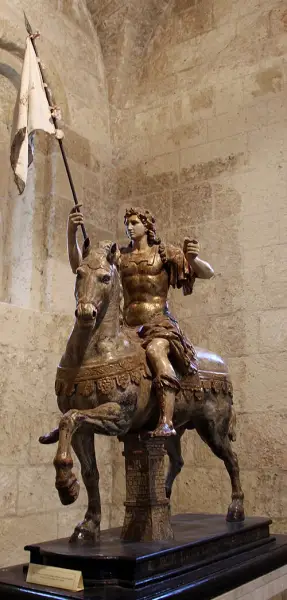
Overview
Gavinus, known in Italian as San Gavino, is a Christian martyr greatly celebrated in Sardinia and numbered among the Martyrs of Torres alongside two companions: Protus their bishop and Januarius their deacon. According to the tradition, he was a Roman soldier who suffered death for believing in Christ when Diocletian's persecution swept the empire, in 304, at Porto Torres, the Latin Turris, on the orders of Barbarus, governor of Sardinia and Corsica. The earliest account of his passion, written in the twelfth century, presents the three confessors denouncing the imperial edicts and refusing sacrifice to the gods, for which they were beheaded. A longer thirteenth-century narrative makes Gavinus the soldier guarding the captured Christians, converted by their courage, freed them, and was himself arrested and executed on the shore. He is the patron saint of Sassari, of Porto Torres, and of Camposano in Campania, and his feast is recorded in the Roman Martyrology under 30 May.
The Complete Life
A Soldier of the Empire
Gavinus entered history as a soldier of the Roman army, serving in an empire that still demanded sacrifice to its gods from every subject. His name lives today chiefly in Sardinia, where he is honored as one of the Martyrs of Torres, linked forever with two fellow confessors: Protus, who was a bishop, and Januarius, a deacon. The three are remembered together as the Martiri turritani, the martyrs of Turris, the Latin name of the city now called Porto Torres on the island's northern shore. Of Gavinus' origins and early life the ancient records say nothing; his story begins, as the stories of so many martyrs do, at the moment his faith collided with the power of the state. That collision came during the persecution ordered under the emperor Diocletian, the last and fiercest assault of the Roman authorities on the Christian church, which reached even the distant island provinces. Whatever his duties had been before, Gavinus' soldier's discipline and his location in Sardinia placed him, in the year of grace 304, at the very center of the trial that would define his memory.
§ Narrative
Martyrdom at Turris
The oldest account of the passion, a text reaching back no further than the twelfth century, tells that Barbarus, the official sent to govern Corsica and Sardinia, arrived at Turres and proclaimed the imperial edicts against the believers. It was the three Christians themselves, Proto, Gavino and Gianuario, who denounced the edicts; hauled before the tribunal, they stood firm in their refusal to offer sacrifice to the gods and were beheaded without delay. A second and longer passion, composed in the middle of the thirteenth century, follows the usual conventions of medieval hagiography and enlarges the story. In its telling, Protus and Januarius are arrested and tortured, while Gavinus is the soldier ordered to convey them to prison. Their bravery so moves him that he sets them free and asks for their prayers. Arrested the next day for losing his prisoners, he declares himself a Christian and is beheaded on the shore; the two confessors, hearing that he has gone before them, return to the city, are taken, and suffer the same death. The account was divided into nine readings for the recitation of Matins.
§ Narrative
Patron of Sardinia's Cities
The martyr's memory took root deep in the religious geography of the island. The well-known Romanesque church of San Gavino at Gavoi bears his name, while the town of San Gavino Monreale takes its name from him, as do several communes of Corsica across the strait. The greatest monument to him is the eleventh-century Basilica of San Gavino at Porto Torres itself, raised by Comita, also called Gomida, Judge of Torres; legend says the saint appeared to Comita and asked for the church to be built. Within the basilica rest the relics not only of Gavinus but of his companions Protus and Januarius, found in the crypt in the year 1614. Devotion to the martyr also carries civic weight: he numbers among the patron saints of Sassari, and he is the particular patron of Porto Torres in Sardinia and of Camposano in Campania. The Roman Martyrology assigns his feast to 30 May, the day on which the church recalls the soldier who laid down his arms and, in laying down his life, took up a crown. Such dedications show how deeply the martyrdom of 304 entered into the identity of the island and its neighbors.
§ Legacy
Timeline
- 304
Beheaded at Porto Torres (Turris) on the orders of the governor Barbarus during the persecution of Diocletian.
§ Narrative
- 1614
The relics of Gavinus, Protus and Januarius were discovered in the crypt of the Basilica of San Gavino at Porto Torres.
§ Legacy
In Their Own Words
Barbaro, who had been sent to Corsica and Sardinia, reached Turres and published the imperial edicts against the Christians, was denounced by Proto, Gavino and Gianuario. They were summoned to the tribunal and being steadfast in refusing to sacrifice to the gods, were summarily beheaded.
The Record
- Patron of
- Sassari·Porto Torres·Camposano, Campania
- Canonization
- Pre-congregation; ancient martyr whose cult is recorded in the Roman Martyrology.
Prayer
Bibliography
Show 5 sources
- Italy: Handbook for Travellers, Vol. 3, K. Baedeker, 1900, p. 390
- Borrelli, Antonio. "Santi Gavino, Proto e Gianuario Martiri di Porto Torres", Santi e beati, April 4, 2006
- "Gavino", La Rai per la Cultura, April 21, 2007
- "Basilica of St. Gavinus", Great Sardinia
- Cook, Joel. Western countries, John C. Winston Company, 1910, p. 439
Profile text adapted from the Wikipedia article, licensed CC BY-SA 4.0.
Pray with this saint every day
Save St. Gavinus to your favorites, read the full profile, and get feast-day reminders in the Saints app.
Get the Saints AppFree on the App Store for iPhone and iPad