
949 – 995·Feast August 27
St. Gebhard of Constance
Bishop of Constance and founder of Petershausen Abbey
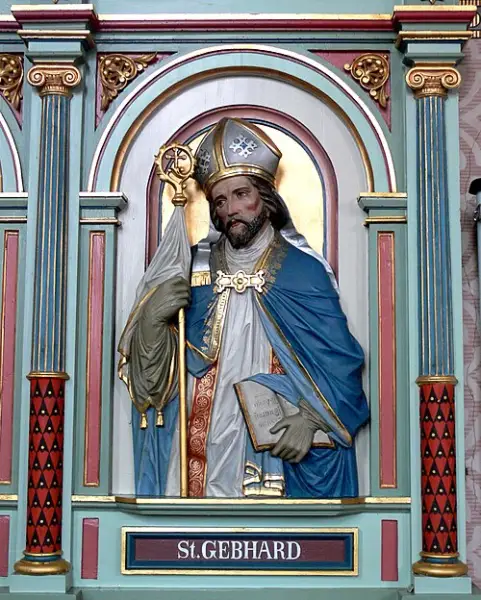
Overview
Gebhard of Constance, born around 949 and died in 995, governed the diocese of Constance from 979 until his death. A native of Hohenbregenz Castle and the youngest son of Count Ulrich of Bregenz, he lost his mother at his birth and was educated at the cathedral school of Constance under his uncle, Bishop Conrad. In 979 the emperor Otto II appointed him to the see of Constance, a diocese suffragan to the archdiocese of Mainz, and he was consecrated in Mainz Cathedral. His episcopate was marked by monastic reform and a striking care for the poor. In 983 he established across the river from his residence, on the Rhine's northern bank, an abbey of Benedictine monks in honor of Pope Gregory the Great, afterwards known as Petershausen. In 990 he set in motion a scheme on the lands of the see, teaching his dependent farmers handicrafts so they could earn their own living, and granted their heirs secure inheritance. Honored as a saint soon after his death, he became patron of the city of Constance, with his feast kept on 27 August.
The Complete Life
Born at Hohenbregenz
Gebhard first saw the light about the year 949 at Hohenbregenz Castle, above the lake country where the Rhine meets the mountains, in the region of his father's lordship. He was the youngest son of Count Ulrich of Bregenz, a nobleman of the lands at the eastern end of Lake Constance. His arrival in the world was shadowed by sorrow, for his mother died in giving him birth, and the boy grew up without her. His formation was entrusted to the church: at Constance, under the care of his uncle Bishop Conrad, he was educated at the cathedral school, the institution that prepared the sons of the nobility for service at the altar and in the government of the diocese. There, amid the studies of the cathedral close, the orphan of Hohenbregenz received the learning and discipline of a cleric. The tie between the nephew and the episcopal city proved lasting, for it was to the same see of Constance that Gebhard himself would one day be called as bishop, returning as shepherd to the school where he had been a pupil.
§ Life
The Emperor's Bishop
In 979 the young cleric's path rose abruptly to the summit of the church in his region: Holy Roman Emperor Otto II appointed him Bishop of Constance. The see he received was one of the great dioceses of the empire, stretching across lands on both sides of the lake, and it stood as suffragan to the archdiocese of Mainz. There, in Mainz Cathedral, Gebhard received his consecration as bishop. His elevation illustrates the order of the imperial church in the tenth century, in which the emperor chose shepherds for strategic dioceses and expected them to serve as both prelates and princes. Gebhard accepted the charge and held it for sixteen years, from 979 until his death in 995. He belonged to the reforming circles of his age, men troubled by the laxity that had crept into monastic and clerical life, and he brought to his diocese the combined outlook of a nobleman accustomed to rule and a cathedral-trained cleric formed in prayer. Under his government Constance would become known both for renewed monastic vigor and for a charity that reached the poorest of its people.
§ Life
Petershausen and the Poor
Two enterprises define the memory of Gebhard's episcopate. The first was monastic: in 983 he raised, on the Rhine's northern bank facing the bishop's own dwelling, an abbey of Benedictine monks placed under the patronage of Pope Gregory the Great, the house that came to be called Petershausen. It stood as the spiritual child of his reforming concerns, planting reformed Benedictine life beside his own cathedral city. The second was social. In 990 the bishop launched a program on the episcopal estate meant to teach the serfs crafts by which they could better sustain themselves. He summoned his dependents together, chose out the most capable, appointing some to bake and to grind, others to supply provisions or to wash cloth, others again to make shoes or to tend gardens, to work timber, or to preside over every manner of handicraft; on the days they worked for the brethren he ordered that they be refreshed with the brethren's bread, for the laborer deserves his hire. He went further and decreed that when a craftsman of their stock died, his goods should not be confiscated but pass entire to his heirs. The measure secured the families of the estate against arbitrary loss and remains a striking monument of a tenth-century bishop's care for the lowly.
§ Life
The Close of a Sixteen-Year Ministry
Gebhard died in the year 995, aged about forty-five or forty-six, after sixteen years at the head of the diocese of Constance. He had not reached old age, yet his years in office had been dense with achievement: a cathedral city strengthened, an abbey founded across the river, and a laboring population given both skills and security. The bishop who had arrived as a motherless noble boy from Hohenbregenz and had been formed in the cathedral school of Constance now went to his rest as the father of his flock. His body was laid at Petershausen, the abbey of his own founding, whose monks would become the first custodians of his memory and, in time, of his relics. The brevity of his life lends his accomplishment its particular weight: within a single generation he had joined the reforming movement of the imperial church, built an institution that would endure for centuries, and left behind a record of practical charity that medieval writers would preserve in detail. Death found him, as his whole episcopate had shown him, a servant of both altar and people.
§ Life
A Saint of the Lake
Honoring Gebhard as a saint began almost as soon as he was buried; he came to be venerated soon after his death, and the city of Constance took him as its patron. The cult received formal ecclesiastical sanction in 1134, when Bishop Ulrich II of Constance officially approved the veneration of his predecessor, fixing what had been the spontaneous devotion of the faithful into the settled practice of the diocese. The archdiocese of Freiburg marks his feast on 27 August; Rottenburg-Stuttgart remembers him on 26 November in company with Saint Konrad. He is revered in both the Roman Catholic and Eastern Orthodox churches. The pilgrimage church on the mountain above his birthplace keeps his name alive in the landscape of his childhood: records reaching back to 1670 attest the pilgrimages made to the Gebhardsberg above Bregenz, and the upper castle today shelters the pilgrimage church of St. Gebhard and St. George, while its lower portion contains the Gerbhardsberg Castle Restaurant, named for the saint born on the spot. The span of more than a century between his death and the formal sanction altered nothing in the substance of a cult already ancient.
§ Veneration
Relics, Emblems, and Honor
The bodily memory of Gebhard rests chiefly at Petershausen, the abbey he founded, where his relics lie; one arm excepted, which the abbey handed over to the castle chapel in 1821, returning a fragment of the saint to the fortress of his birth. His cult spread a web of patronage across the region: he is patron not only of the city of Constance and of its church of St. Gebhard, but also of the diocese of Feldkirch and of Vorarlberg, and the faithful invoke him against diseases of the neck. Medieval iconography fixed his emblem in a scene that captures his charity: the bishop reaching his staff toward a lame man. Artists also showed him beside a skull crowned with a papal tiara, set close at hand or placed upon a book, and with the Virgin Mary appearing to him. His standing in the German-speaking world was such that in 1949 the Republic of Austria issued a postage stamp bearing his image, a modern state's tribute to the tenth-century bishop whom Lake Constance has never forgotten. Few bishops of the tenth century can claim so wide a geography of remembrance.
§ Veneration
Timeline
- 949
Born at Hohenbregenz Castle, youngest son of Count Ulrich of Bregenz.
§ Life
- 979
Appointed Bishop of Constance by Emperor Otto II and consecrated in Mainz Cathedral.
§ Life
- 983
Founded the Benedictine abbey dedicated to Pope Gregory the Great, later called Petershausen, across the Rhine from the episcopal residence.
§ Life
- 990
Launched a program training episcopal serfs in crafts and decreed inheritance rights for their heirs.
§ Life
- 995
Died aged about forty-five, after sixteen years as Bishop of Constance.
§ Life
- 1134
Bishop Ulrich II of Constance formally sanctioned his veneration.
§ Veneration
- 1670
Pilgrimages to the Gebhardsberg near Bregenz are first documented.
§ Veneration
- 1821
The abbey of Petershausen gave an arm relic of the saint to the castle chapel at Hohenbregenz.
§ Veneration
- 1949
The Republic of Austria issued a postage stamp displaying St. Gebhard.
§ Veneration
The Record
- Major works
- Petershausen Abbey, founded 983
- Patron of
- Constance·Vorarlberg·diocese of Feldkirch·invoked against diseases of the neck
- Symbols
- Bishop reaching his staff to a lame man·Bishop with a skull wearing a papal tiara beside him or on a book·Bishop with the Virgin Mary appearing to him
- Canonization
- Veneration sanctioned by Bishop Ulrich II of Constance in 1134, after a local cult that arose soon after his death.
Prayer
Bibliography
Show 5 sources
- "St Gebhard of Constance", British Museum
- Informationstafel in der Wallfahrtskirche auf der Burg Hohenbregenz
- "Gebhard, Bishop of Constance: Allocation of Serfs to Crafts, 990", Medieval Sourcebook, Fordham University
- Ott, Michael. "Constance." The Catholic Encyclopedia Vol. 4. New York: Robert Appleton Company, 1908. 28 January 2019
- Drake, Maurice and Drake, Wilfrid. Saints and their emblems, Dalcassian Publishing Company, 1916, p. 52
Profile text adapted from the Wikipedia article, licensed CC BY-SA 4.0.
Pray with this saint every day
Save St. Gebhard of Constance to your favorites, read the full profile, and get feast-day reminders in the Saints app.
Get the Saints AppFree on the App Store for iPhone and iPad