
died 362·Feast December 10
St. Gemellus of Ancyra
Martyr Crucified under Julian the Apostate
Overview
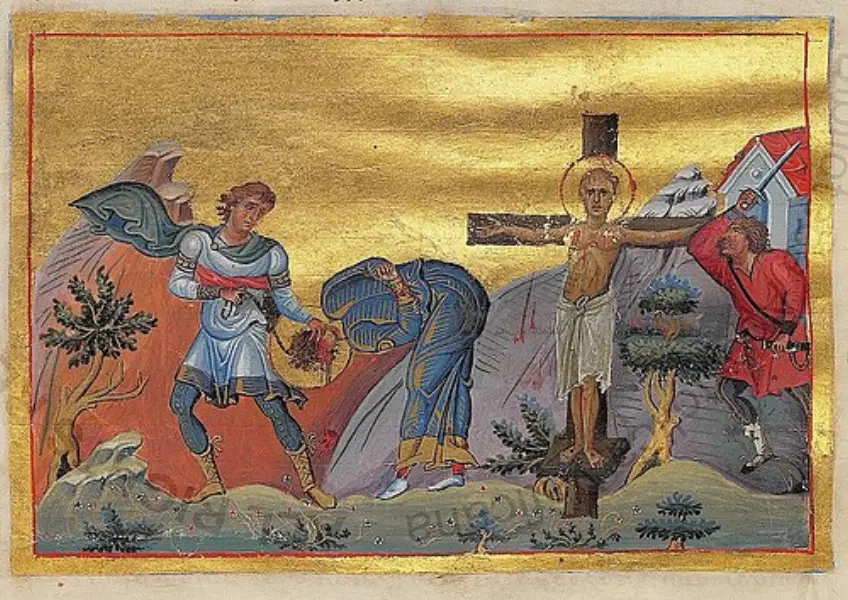
Gemellus was a Christian of Paphlagonia who died a martyr's death at Ancyra in Asia Minor, in the year 362, when the emperor Julian the Apostate had set about undoing the Christianization of the empire. Hearing that Julian was staying at Ancyra, Gemellus traveled there deliberately to rebuke the emperor for his abandonment of the faith — an act of astonishing boldness against the most powerful man alive. For this he was tortured and put to death on a cross, a punishment Rome had by then largely reserved for slaves and rebels; one source places the killing instead at Edessa. Christian tradition has preserved him as the last martyr to be executed by crucifixion, a grim distinction that marks the transitional moment of Julian's short reign, when the old penalties of an older age were briefly revived against the church. His memory was kept in Asia Minor for centuries: a village called Sykeon, on the Siberis River, possessed a church dedicated to him, and the Menologion of Basil II includes a depiction of his martyrdom.
The Complete Life
Rebuke and Crucifixion under Julian
Gemellus came from Paphlagonia, a rugged region of northern Asia Minor, and the tradition that surrounds him turns on a single act of defiance. In 362 the emperor Julian, who had renounced the Christianity in which he was raised and sought to restore the old cults of the empire, was present at Ancyra, the chief city of Galatia. Gemellus traveled there with the declared purpose of reproaching him for his apostasy. The outcome was never in doubt: the martyr was seized, tortured, and killed on a cross. One source relocates the execution to Edessa. What later generations emphasized was the manner of his dying — Christian memory records him as the final martyr put to death by crucifixion, a form of execution that the empire's conversion had otherwise rendered obsolete, briefly revived in Julian's campaign against the church.
§ Introduction
Veneration in Asia Minor
The martyr's cult took root in his native region. At Sykeon, a village on the Siberis River in Asia Minor, a church stood in his name, one of the rural shrines through which the saints of the great persecution and its aftermath were honored in the Anatolian countryside. His feast was kept on December 10, and his story passed into the standard compilations of the Byzantine tradition: the Menologion of Basil II includes an image of his martyrdom among its illustrations, and the learned dictionaries of saints produced in the nineteenth and twentieth centuries — from Smith's Dictionary of Christian Biography to Walsh's New Dictionary of Saints — carry his notice forward to modern readers.
§ Introduction
Timeline
- 362
Heard that Emperor Julian was at Ancyra and traveled there from his native Paphlagonia to denounce the emperor's apostasy.
§ Introduction
- 362
Was tortured and killed by crucifixion at Ancyra, or by one account at Edessa, remembered as the last Christian martyr crucified.
§ Introduction
The Record
- Symbols
- Cross and crucifix·Martyr's palm
- Canonization
- Pre-congregation martyr; venerated in the Christian churches from antiquity
Prayer
Bibliography
Show 3 sources
- Michael Walsh, A New Dictionary of Saints: East and West (Liturgical Press, 2007), 222.
- Sir William Smith, A dictionary of christian biography, literature, sects and doctrines: being a continuation of "The dictionary of the Bible", Volume 1 (Little, Brown & Co., 1880), 623.
- Sir William Mitchell Ramsay, The historical geography of Asia Minor (John Murray, 1890), 244.
Profile text adapted from the Wikipedia article, licensed CC BY-SA 4.0.
Pray with this saint every day
Save St. Gemellus of Ancyra to your favorites, read the full profile, and get feast-day reminders in the Saints app.
Get the Saints AppFree on the App Store for iPhone and iPad