
died c. 397·Feast January 31
St. Geminianus
Bishop of Modena who shielded his city
Overview
Geminianus, honored in Italy as San Giminiano, led the church of Modena as its bishop in the fourth century. He first enters the historical record in 390, when he took part in a council summoned at Milan by Saint Ambrose, and from his name scholars have read in it the mark of the Roman senatorial order. Everything else told of him comes from biographies written long after his lifetime. Tradition holds that when Athanasius passed through Modena on the road into exile in Gaul, Geminianus received him kindly, and that John Chrysostom later enjoyed the same hospitality. He is remembered as an opponent of Arianism and of Jovinianism, and he probably died on 31 January 397. Popular devotion credited his intercession with saving Modena from the invading Huns, whom he was said to have confounded by raising a dense fog over the city. The city itself long bore his name as Civitas Geminiana, a church stood over his tomb by the fifth century, and his relics were solemnly translated and recognized in 1106 and again in 1184, in the presence of two popes.
The Complete Life
A Bishop at the Council of Milan
The earliest secure fact about Geminianus places him in Milan in the year 390, among the bishops gathered for a council summoned by Ambrose, the city's celebrated bishop. Assemblies of this kind brought the leaders of the northern Italian churches together to settle questions of doctrine and discipline, and Geminianus's presence shows that by then he was shepherding Modena and stood recognized among his peers. His very name points to a distinguished origin: scholars have read in it the mark of the Roman senatorial order, that patrician class which filled so many sees of the late empire. Past these outlines the record goes quiet: every further detail of his life reaches us through biographies written hundreds of years after his death. That silence is itself telling. It recalls how the men who guided the Italian churches in the generations after Constantine are often known only through a council act or a signature. Modena, however, preserved his memory with unusual tenacity: by the 400s a church already rose above his grave, standing beside what is now the cathedral and away from the heart of the ancient city.
§ Introduction
Hospitality and Orthodoxy in a Troubled Age
Tradition assigns Geminianus a double role: host to the suffering and defender of the church's teaching. When Athanasius, the great champion of Nicene faith, was making his way into exile in Gaul, he is said to have passed through Modena and to have been received kindly by its bishop; John Chrysostom, in later years, was welcomed in the same way. To give shelter to a figure under imperial condemnation was an act of genuine courage, and the story, whatever weight history gives it, paints Geminianus as a friend to the persecuted. The sources likewise credit him with opposition to Arianism, which denied the full divinity of Christ, and to Jovinianism, the movement associated with Jovinian's rejection of ascetic honor. Both controversies agitated the Italy of the late fourth century, and a bishop who stood against them placed himself squarely beside Ambrose and the Nicene mainstream. Alongside this firmness legend preserves a gentler image. When the Huns swept into Italy, Geminianus was said to have conjured up a dense fog that hid Modena from the invaders and delivered its people. The episode belongs to hagiography rather than chronicle, but it fixed the bishop forever in civic memory as the city's protector.
§ Introduction
Death and the Translation of 1106
Geminianus probably died on 31 January 397, and that day became his feast. Of his closing years almost nothing is recorded, yet the city he led never let him go. Traces of his veneration have remained present in Modena without interruption: in the early Middle Ages the town was frequently described under a name that honored him, as though bishop and city had grown inseparable. His cult took documented shape in the twelfth century, when a manuscript known as the Relatio translationis S. Giminiani recorded two solemn events of the year 1106: the translation of his body on 30 April and its recognition on 7 October, both carried out in the presence of Pope Paschal II, the great countess Matilde di Canossa, and the assembled Modenese. A second recognition followed on 12 July 1184, when Pope Lucius III, traveling on the road to Verona, halted to honor the saint whose relics lay in the city. These ceremonies, staged before the highest authorities of church and empire, show a civic devotion that had endured unbroken across more than seven centuries and that the medieval city wore, quite literally, in its name.
§ Veneration
A Saint Written into Cities and Pictures
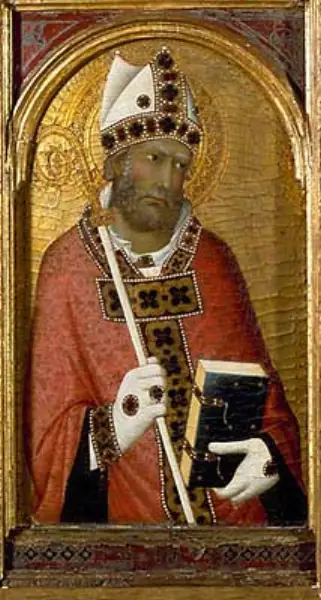
Geminianus belongs to that company of early bishops whose sanctity was confirmed by the affection of their cities rather than by any formal process. Devotion to him spread outward from Modena into Tuscany, above all in the town that took his very name, San Gimignano, and also at Pontremoli. Venice kept a church dedicated to him opposite St Mark's Basilica until 1807, when the Napoleonic reorganization of the west side of the Piazza San Marco swept the building away. In art he rarely appears far from his own region, but where he does he is unmistakable: a bishop holding a model of his town, a figure calming a storm at sea, or an exorcist delivering the daughter of the Byzantine emperor Jovian; a mirror reflecting the Virgin Mary belongs to his emblem as well, and a pentaptych by Simone Martini preserves his likeness. His feast of 31 January is kept in both the Roman Catholic and Orthodox churches. For a man of whom almost nothing can be historically verified, this endurance is striking: fourteen centuries of place names, churches, paintings, and civic identity all testify to a bishop remembered simply as the good shepherd of Modena.
§ Veneration
Timeline
- 390
Takes part in a council convened at Milan by Saint Ambrose
§ Introduction
- 31 Jan 397
Dies at Modena, according to the traditional date of 31 January
§ Introduction
- 30 Apr 1106
Body is translated at Modena before Pope Paschal II, Matilde di Canossa, and the people of the city
§ Veneration
- 7 Oct 1106
Relics are formally recognized in ceremonies recorded by the twelfth-century Relatio translationis
§ Veneration
- 12 Jul 1184
Pope Lucius III performs a second recognition of the relics while journeying toward Verona
§ Veneration
The Record
- Symbols
- bishop holding a mirror in which the Virgin Mary is reflected·bishop holding a model of the town·calming a storm at sea·exorcising the daughter of the emperor Jovian
- Canonization
- Pre-congregation; venerated since late antiquity at Modena
Prayer
Bibliography
Show 3 sources
- "San Geminiano di Modena"
- Drake, Maurice and Drake, Wilfrid. Saints and their emblems, Dalcassian Publishing Company, 1916, p. 52
- Ekkart Sauser (1999). "Geminianus von Modena". In Bautz, Traugott (ed.). Biographisch-Bibliographisches Kirchenlexikon (BBKL). Vol. 16. Herzberg: Bautz. col. 559. ISBN 3-88309-079-4
Profile text adapted from the Wikipedia article, licensed CC BY-SA 4.0.
Pray with this saint every day
Save St. Geminianus to your favorites, read the full profile, and get feast-day reminders in the Saints app.
Get the Saints AppFree on the App Store for iPhone and iPad