
1878 – 1903·Feast April 11
St. Gemma Galgani
Mystic of Lucca who bore the stigmata
Overview
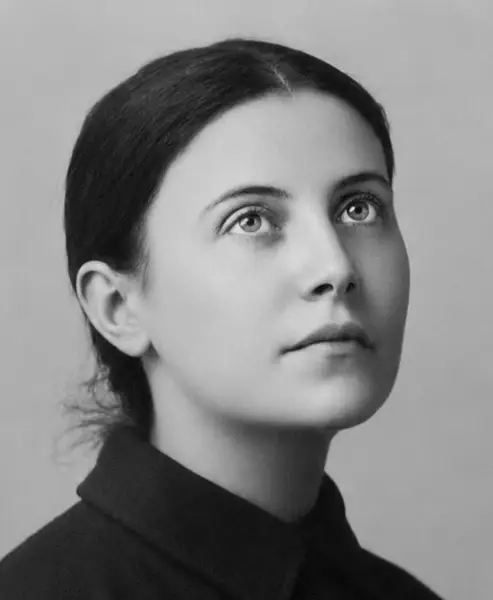
The Italian mystic Gemma Umberta Pia Galgani — Gemma of Lucca, as she came to be called — was raised to the altars in 1940. Born in 1878 into a prosperous pharmacist's family near Lucca, she lost her mother to tuberculosis at ten and her father at nineteen, and spent her youth caring for her younger siblings, excelling at school in French, arithmetic, and music, and refusing two offers of marriage. In 1899, at twenty-one, she began to manifest the stigmata, and throughout her short life she reported conversations with her guardian angel, Jesus, and the Virgin Mary, along with frequent ecstasies. Her claims divided opinion: her spiritual director and members of her household attested to her wounds, while the physician Pietro Pfanner judged them self-inflicted. Denied entry to the Passionists on grounds of health, she lived as a laywoman under the guidance of the Passionist Germano Ruoppolo, who later wrote her biography. Stricken with tuberculosis in early 1903, she died on Holy Saturday, 11 April 1903, at twenty-five. Called the daughter of the Passion for her imitation of Christ's suffering, she was especially embraced by the Passionist congregation and remains a popular modern saint.
The Complete Life
A Childhood Marked by Loss
The future mystic entered the world at Camigliano, a hamlet of the Capannori commune near Lucca, on 12 March 1878: fifth-born among eight, and eldest daughter, in the family of Enrico Galgani, a pharmacist of comfortable means. Soon after her birth the family moved north to a larger home in the city of Lucca, chosen to give the children better schooling. Misfortune arrived early. Her mother, Aurelia Landi, contracted tuberculosis when Gemma was two and a half, and while the sick woman fought the disease that would kill her, the little girl was placed with Elena and Ersilia Vallini in a private nursery school. The archbishop of Lucca, Nicola Ghilardi, confirmed her on 26 May 1885 in the church of San Michele in Foro. The years that followed took the family one by one: the firstborn, Carlo, and her sister Giulia died young; her mother succumbed on 17 September 1886 after five years of illness; and in 1894 her brother Gino, studying for the priesthood, died of the same disease at eighteen. Through it all her childhood confessor was Giovanni Volpi, later bishop of Arezzo, and the orphaned girl learned early that love and loss arrive together.
§ Early life
Schoolgirl, Orphan, Mother of Her Family
At school Gemma flourished. Her schooling came at a Lucca half-boarding academy directed by the Oblates of the Holy Spirit, the congregation that Saint Elena Guerra had established, and there she showed real talent in French, arithmetic, and music. The feast of the Sacred Heart brought her First Communion on 17 June 1887. Then came the death of Enrico, her father, from throat cancer on 11 November 1897. Nineteen years old and without either parent, she took charge of the younger children, shouldering the duty with her aunt Carolina. Two proposals of marriage came, and she refused them both. In 1898 and 1899 her body nearly failed her: osteitis of the lumbar vertebrae, an ear infection, and the loss of the use of her legs. Her recovery she attributed to the Sacred Heart of Jesus through the intercession of Saint Gabriel of Our Lady of Sorrows and Saint Margaret Mary Alacoque, and from that illness dates her particular devotion to the Sacred Heart. From September 1900 her spiritual life passed under the guidance of the Passionist Germano Ruoppolo, with whom she kept up an extensive correspondence, and she found a home with the Giannini family in Lucca, where Cecilia Giannini became a foster mother to her until shortly before her death.
§ Young adulthood
The Stigmata and Its Witnesses
The stigmata appeared for the first time, by her director's account, when Gemma was twenty-one, on the night preceding the Sacred Heart solemnity — 8 June 1899. Her own account speaks of overwhelming sorrow for sin, then a vision in which the Virgin Mary covered her with her mantle while Jesus appeared, flames rather than blood streaming from his open wounds, touching her hands, feet, and heart; the pain remained, and blood followed it. She said she spoke with her guardian angel, with Jesus, with Mary, and with Saint Gabriel of Our Lady of Sorrows, sometimes receiving messages about current and future events. Ecstasies became frequent, and she was reputed to levitate once, lifted from the floor as she kissed the side wound of the crucifix in her dining room. When her health declined, Ruoppolo directed her to pray for the stigmata's disappearance, and she obeyed until the marks left. Opinion divided sharply. The physician Pietro Pfanner, who had known her since childhood, wiped blood from her palms and found no wound, concluding the marks self-inflicted and suspecting a neurosis; her foster mother once noticed a sewing needle on the floor beside her, and the psychologist Donovan Rawcliffe later called the wounds those of a hysteric. Against this stand the witnesses of her own household: Ruoppolo, the future archbishop Pietro Paolo Moreschini, and several Giannini family members attested continuous wounds that fully pierced her palms.
§ Stigmata and medical examinations
Holy Week of 1903
In early 1903 tuberculosis, the disease that had taken her mother and her brother, claimed Gemma herself, and she entered a long and often painful decline attended, her witnesses said, by mystical phenomena. She was by then well known around Lucca, especially among the poor, though opinions about her had always been divided: some called her the virgin of Lucca out of pious admiration, while others mocked her, her own younger sister Angelina among them. At the beginning of Holy Week 1903 her condition deteriorated quickly, and when Good Friday arrived her pain had grown immense; a nursing sister on the ward admitted afterward that among all the sick they had ever tended none had shown anything comparable. On 11 April 1903 — Holy Saturday — she breathed her last, twenty-five years old, in the little room opposite the Giannini home, a life of barely a quarter century now closed and having spent its last years in visible union with the Passion she contemplated. The family that had received her as a daughter kept her memory, and the city that had watched her with divided eyes soon began to speak of her differently.
§ Illness and death
From Lucca to the Altars
The church's searching inquiry into her life ended in her beatification, decreed on 14 May 1933; seven years later, on 2 May 1940, she was enrolled among the saints in Saint Peter's Basilica. Lucca keeps her remains at the Sanctuary of Santa Gemma beside the Passionist monastery, where Francesco Nagni's bronze figure crowns her tomb; Madrid received her heart in 1985 for its Santuario de Santa Gema, a measure of how far her devotion had traveled. The story of her life reached the world through the man who knew it best: her spiritual director Germano Ruoppolo wrote the biography on which most later accounts rest. She has a special place in the Congregation of the Passion of Jesus Christ, the Passionists, the order whose habit she is depicted wearing and whose spirituality of the suffering Christ she lived out as a laywoman. The church has never made her a sister of any congregation; she is a saint of the home and the sickroom, canonized not for office or foundation but for a holiness of union with Christ crucified that astonished those who watched it and divided them almost to the end.
§ Veneration
The Daughter of the Passion
The title daughter of the Passion has clung to Gemma because she patterned her whole existence upon the sufferings of Christ, and it has outlasted every controversy that gathered round her. Her feast is kept on 11 April, the day of her holy death, while the Passionists celebrate it on 16 May. In art she appears in the Passionist habit, with lilies and roses, a crucifix, and the marks of the stigmata, the vocabulary of a spirituality centered on the wounds of Jesus. Her patronages are as varied as her short life: students and pharmacists, paratroopers and parachutists, those who have lost their parents, sufferers of back injury and pain, and those battling headaches and migraines, together with all who struggle against temptations to impurity and seek purity of heart. Devotion to her spread worldwide during the twentieth century, served by monasteries and shrines from Lucca to Madrid and by the continued circulation of her letters and spiritual writings. For modern Catholics she stands as proof that sanctity is not confined to the cloister: an orphan, a laywoman, a rejected vocante to religious life, and a dying consumptive became, in the church's judgment, one of the great mystics of her age.
§ Veneration
Timeline
- 12 Mar 1878
Born at Camigliano in the comune of Capannori, fifth of eight children of the pharmacist Enrico Galgani
§ Early life
- 26 May 1885
Confirmed by Nicola Ghilardi, archbishop of Lucca, in the church of San Michele in Foro
§ Early life
- 17 Sep 1886
Her mother Aurelia dies of tuberculosis after five years of illness
§ Early life
- 17 Jun 1887
Receives her First Communion on the feast of the Sacred Heart of Jesus
§ Education
- 1894
Her brother Gino, a seminarian she loved dearly, dies of tuberculosis at eighteen
§ Early life
- 11 Nov 1897
Her father Enrico dies of throat cancer, leaving her orphaned and responsible for the younger children
§ Young adulthood
- 1898
Falls gravely ill with osteitis of the lumbar vertebrae, an ear infection, and paralysis of the legs, then recovers, crediting the Sacred Heart
§ Young adulthood
- 8 Jun 1899
First shows the wounds of the stigmata, the night preceding the Sacred Heart solemnity
§ Mystical experiences
- Sep 1900
Comes under the spiritual direction of the Passionist Germano Ruoppolo and is taken into the Giannini household in Lucca
§ Young adulthood
- 1903
Diagnosed with tuberculosis, she enters a long and painful decline accompanied by mystical phenomena
§ Illness and death
- 11 Apr 1903
Breathes her last at twenty-five in the little room opposite the Giannini home, on the closing day of Holy Week
§ Illness and death
- 14 May 1933
Beatified by Pope Pius XI after a thorough examination of her life
§ Veneration
- 2 May 1940
Canonized by Pope Pius XII in Saint Peter's Basilica
§ Veneration
- 1985
Her heart is enshrined in the Santuario de Santa Gema in Madrid, Spain
§ Veneration
In Their Own Words
I felt an inward sorrow for my sins, but so intense that I have never felt the like again ... My will made me detest them all, and promise willingly to suffer everything as expiation for them.
The Blessed Virgin Mary opened her mantle and covered me with it. At that very moment, Jesus appeared with his wounds all open; blood was not flowing from them, but flames of fire which in one moment came and touched my hands, feet and heart.
We have cared for a good many sick people, but we have never seen anything like this.
Do grant, O my Lord Jesus, that when my lips approach Thine to kiss Thee, I may taste the gall that was given Thee. And when my shoulders lean against Thine, make me feel Thy scourgings. And when my flesh is united with Thine in the Holy Eucharist, make me feel Thy Passion. And when my head comes near to Thine, make me feel Thy thorns. And when my heart is close to Thine, make me feel Thine embrace.
The Record
- Major works
- Extensive correspondence with her spiritual director Germano Ruoppolo, later published with her other personal writings
- Patron of
- students·pharmacists·paratroopers and parachutists·loss of parents·back injury and back pain·headaches and migraines·those struggling with temptations to impurity and those seeking purity of heart
- Symbols
- Passionist habit·lilies and roses·crucifix·stigmata
- Canonization
- Beatified 14 May 1933 by Pope Pius XI; canonized 2 May 1940 by Pope Pius XII at Saint Peter's Basilica
Prayer
Bibliography
Show 4 sources
- Bell, Rudolph M.; Mazzoni, Cristina (2003). The Voices of Gemma Galgani: The Life and Afterlife of a Modern Saint. Chicago, IL, US: University of Chicago Press. ISBN 978-0-226-04196-4
- Orsi, Robert A. (2005). "Two Aspects of One Life" in Between Heaven and Earth: The Religious Worlds People Make and the Scholars Who Study Them. Princeton University Press, p. 110-145
- Roullet, Hervé (2019). Gemma Galgani. Paris, France: Roullet Hervé. ISBN 978-2956313731
- Germanus, Venerable Father (2000). The Life of St. Gemma Galgani. Illinois: Tan Books and Publishers, Inc. ISBN 978-0895556691
Profile text adapted from the Wikipedia article, licensed CC BY-SA 4.0.
Pray with this saint every day
Save St. Gemma Galgani to your favorites, read the full profile, and get feast-day reminders in the Saints app.
Get the Saints AppFree on the App Store for iPhone and iPad