
died 550·Feast September 5
St. Genebald
First bishop of Laon and penitent
Overview
Genebald, a Frankish clerk and a relative by marriage of Saint Remigius, became the first bishop of Laon around the year 499, when Remigius, finding the diocese of Rheims too vast, carved out a new see centered on Laon and placed him at its head. The Golden Legend records that Genebald was married to Remigius's niece, and that after his consecration he returned to his wife and fathered two children, a son and a daughter. When he laid bare what he had done, Remigius received his confession and imposed a severe penance: seven years shut in a small cell beside the church of St. Julian, fed on bread and water, while Remigius himself carried the burdens of the diocese of Laon. At the term's end an angel was said to have unsealed the cell door, and Remigius reinstated him as bishop. Genebald is reported to have lived chastely for the rest of his days. He died in 550 and was succeeded by his son Latro, who was also honored as a saint. A modern scholar of the story judges that the legend probably preserves a kernel of truth.
The Complete Life
A Married Clerk Made a Bishop
At the close of the fifth century the church in northern Gaul was still organizing itself around the vast diocese of Rheims, governed by Saint Remigius, the apostle of the Franks. Finding the territory too large for one shepherd, Remigius resolved to create a separate diocese centered on Laon, and for its first bishop he chose Genebald, a married clerk who was, according to the Golden Legend, married to Remigius's own niece. Around the year 499 Genebald left his wife's side and received consecration, becoming the founding bishop of a see that would endure for fifteen centuries. The choice of a married man was unremarkable in that age, when clerical marriage was common and celibacy was only slowly becoming the rule; what makes Genebald unusual is that his story does not end with the ordination. Medieval writers, above all the tenth-century chronicler Flodoard in his history of the church of Rheims, kept alive the memory of what happened next, and their account passed into the Golden Legend, where it colored the saint's memory for all later generations. At Laon Genebald would serve for roughly half a century, down to his death in 550.
§ Legend
Penance Behind a Sealed Door
The legend relates that after his consecration Genebald slept with his wife, who bore him a son. He asked that the boy be named Latro, meaning thief, because, as he said, he had begotten him by theft; and so that no one would think his wife had sinned, he received her again, and she bore a daughter named Vulpecula, the little she-fox. Then the bishop went to Remigius, confessed everything, and offered to abandon his diocese. Remigius instead comforted him, heard his confession, and set him a penance of another kind: seven years of enclosure in a little cell beside the church of St. Julian, with nothing but bread and water for food, while Remigius himself carried the government of Laon. When the term ended, an angel came and declared the penitent free; the door, sealed from outside, opened at the angel's word without its seal being broken. Genebald, careful to the end, still wanted his bishop's permission, and the angel brought Remigius to the cell, where the bishop of Rheims restored his penitent to the see. Genebald, so the story runs, kept chastity ever afterward. Christian Cochini, a modern scholar, judges that this narrative probably has a kernel of truth.
§ Legend
A Holy Line at Laon
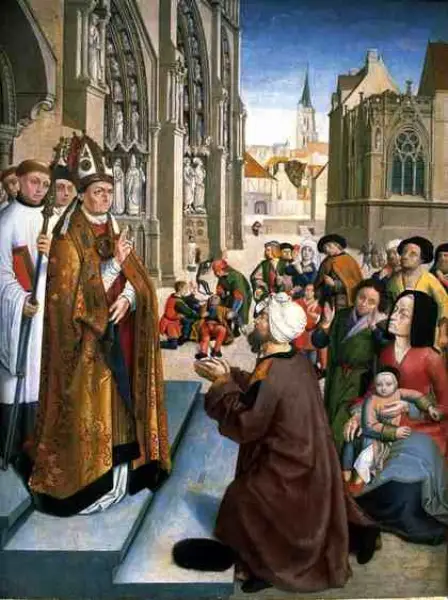
Genebald died in 550, after some fifty years of episcopal service broken by his famous penance. His successor in the see of Laon was his own son Latro, the child to whom he had given so strange a name, and Latro in turn was venerated as a saint, so that the story of the penitent bishop closes with a family honored at the altar. The tale was transmitted by the tenth-century historian Flodoard and retold in the Golden Legend, and it left traces beyond the written page: art historians studying an early Netherlandish painting of Saint Remigius have theorized that the four people in the right foreground may be Genebald, his spouse, and the son and daughter born during his tenure at Laon. Whatever the truth of that identification, the persistence of the story says something about the medieval imagination of holiness: it could embrace a bishop who sinned, confessed, and was restored, provided the restoration was real. The diocese Genebald founded kept his feast on September 5, remembering him not as an unblemished hero but as a sinner made a shepherd again.
§ Legend
Timeline
- 499
Chosen by Remigius as first bishop of the newly created diocese of Laon, leaving his married life for the episcopate.
§ Legend
- 550
Died after roughly half a century at the head of the church of Laon.
§ Introduction
- 550
Was succeeded in the see of Laon by his son Latro, who is also venerated as a saint.
§ Legend
In Their Own Words
Know thou that the door of heaven is opened to thee; I shall open this door without breaking of the seal which Saint Remigius hath sealed.
The Record
- Canonization
- Pre-congregation; venerated since the early medieval period as bishop of Laon
Prayer
Bibliography
Show 4 sources
- John Oliver Hand, Martha Wolff, Early Netherlandish painting (National Gallery of Art (U.S.)) (Cambridge University Press, 1986), 166
- "St. Genebaldus". Heiligen Lexicon. Retrieved May 12, 2009
- "The Golden Legend: The Life of Saint Remigius". Archived from the original on 2014-03-05. Retrieved 2014-03-05
- Christian Cochini, Apostolic Origins of Priestly Celibacy (Ignatius Press, 1990), 111
Profile text adapted from the Wikipedia article, licensed CC BY-SA 4.0.
Pray with this saint every day
Save St. Genebald to your favorites, read the full profile, and get feast-day reminders in the Saints app.
Get the Saints AppFree on the App Store for iPhone and iPad