
died c. 662·Feast June 3
St. Genesius of Clermont
Bishop of Clermont and builder of hospitals
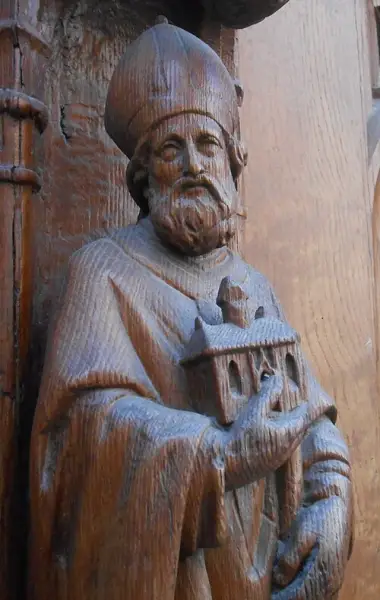
Overview
Genesius, known locally as Saint Genes, served as the twenty-first bishop of Clermont and died there in about the year 662. A late legend traces his descent to a senatorial family of Auvergne and tells that, after a liberal education, he abandoned his worldly prospects to serve the church of Clermont, where he rose to archdeacon under Bishop Proculus and took charge of the young Saint Prix as tutor. Despite his protests he succeeded Proculus in the episcopate in 656. His biographers describe a prelate of austere piety, wholly devoted to his flock, who strove for the defense of Christian morals, raised a hospital in Clermont, and established the Abbey of Manlieu. After about five years as bishop, fearing for his own soul, he slipped away from his city and journeyed to Rome dressed as a pilgrim; his sorrowing people dispatched a deputation to the Holy See, and he was found and persuaded to return. Back at Clermont he built a monastery at Chantoin, together with a church and a hospice. His death came in 662 or thereabouts, seven years into his episcopate, and his body was laid to rest in the church he had raised in honor of St. Symphorian.
The Complete Life
From the Senatorial World to the Church
The story of Genesius opens, as legend tells it, in the senatorial aristocracy of Auvergne, the old Roman nobility of the Auvergne highlands. Born to that rank and given the liberal education that belonged to it, he stood to inherit wealth and worldly standing; instead, the tradition says, he renounced his prospects and placed himself in the service of the church at Clermont. There he rose to become archdeacon under Bishop Proculus, the officer charged with the practical administration of the diocese, and in that office he was entrusted with something more delicate still: the parents of the child who would become Saint Prix handed over the boy's education to Genesius himself. The detail comes from the life of Prix, and it shows a man already trusted as a teacher and guardian of the young. When Proculus died in 656, Genesius was the natural successor, yet the sources insist that he accepted the episcopate only against his own protests, dragged to the throne he would have refused. That reluctance, whether rhetorical or real, became one of the marks by which his holiness was remembered.
§ Narrative
An Austere Shepherd and a Secret Pilgrimage
Of Genesius's nine or so years at Clermont, the sources preserve a portrait rather than a chronicle: a prelate of austere piety, wholly given to his flock, who labored earnestly for the maintenance of Christian morality among his people. His energy took built form. He founded a hospital at Clermont for the care of the sick, and he established the Abbey of Manlieu, adding monastery to city in an age when such foundations anchored both prayer and charity in the countryside. Then, after some five years in office, came the strange episode that fixed his legend: fearing for his own soul, he slipped away from Clermont in secret and set out for Rome dressed as a pilgrim, laying down the burden he had never wanted. His flock refused to let him go. The bereaved people dispatched a deputation to the Holy See itself, and there the fugitive bishop was found and induced to return. Genesius came home not chastened into silence but into renewed building: he proceeded to raise a monastery at Chantoin, together with a church and a hospice, doubling down on the works of religion and shelter that were his idea of the episcopate.
§ Narrative
The Church That Took His Name
The bishop's death came at Clermont around 662, seven years after his consecration, and his body was laid in a church of his own founding, the one he had built there in honor of St. Symphorian. In time that church took his own name instead, so that the martyr of Autun gave way in the city's memory to the bishop who had raised its walls; a foundation renamed for its founder is as plain a testimony to local affection as the Middle Ages left. His old pupil remembered him too: in the life of Praejectus, Genesius appears among the protectors of that saint's childhood, the tutor whose care had shaped a future bishop and martyr. The story of his life, preserved in sources from Butler's compilation to the dictionaries of the Bollandist era, carries the caution that the tale of his senatorial birth belongs to a rather late legend, yet the outline of his episcopate, his hospital, his abbey, his Roman flight and return, stood firm in the record. His feast is kept on June 3, and in the Auvergne he is still called, in the old local way, Saint Genes.
§ Narrative
Timeline
- 656
Succeeds Bishop Proculus in the see of Clermont, in spite of his own protests
§ Narrative
- 662
Dies at Clermont, in about the seventh year of his episcopate
§ Narrative
The Record
- Major works
- Hospital at Clermont·Abbey of Manlieu·Monastery at Chantoin, with a church and hospice
- Canonization
- Pre-congregation; ancient cult at Clermont
Prayer
Bibliography
Show 6 sources
- "Genesius (6) St.", A Dictionary of Christian Biography, (William Smith, Henry Wace, eds.) J. Murray, 1880, p. 627
- Butler, Alban. "Saint Genesius, Bishop and Confessor". Lives of the Fathers, Martyrs, and Principal Saints 1866. CatholicSaints.Info. 1 June 2013
- Goyau, Georges. "Diocese of Clermont." The Catholic Encyclopedia Vol. 4. New York: Robert Appleton Company, 1908
- Monks of Ramsgate. "Genesius of Clermont". Book of Saints, 1921. CatholicSaints.Info. 23 June 2013
- "Saint Genesius of Clermont". New Catholic Dictionary. CatholicSaints.Info. 21 May 2013
- Delaney, John J. Dictionary of Saints, 2003
Profile text adapted from the Wikipedia article, licensed CC BY-SA 4.0.
Pray with this saint every day
Save St. Genesius of Clermont to your favorites, read the full profile, and get feast-day reminders in the Saints app.
Get the Saints AppFree on the App Store for iPhone and iPad