
c. 422 – 502·Feast January 3
St. Genevieve
Patroness and protector of the city of Paris
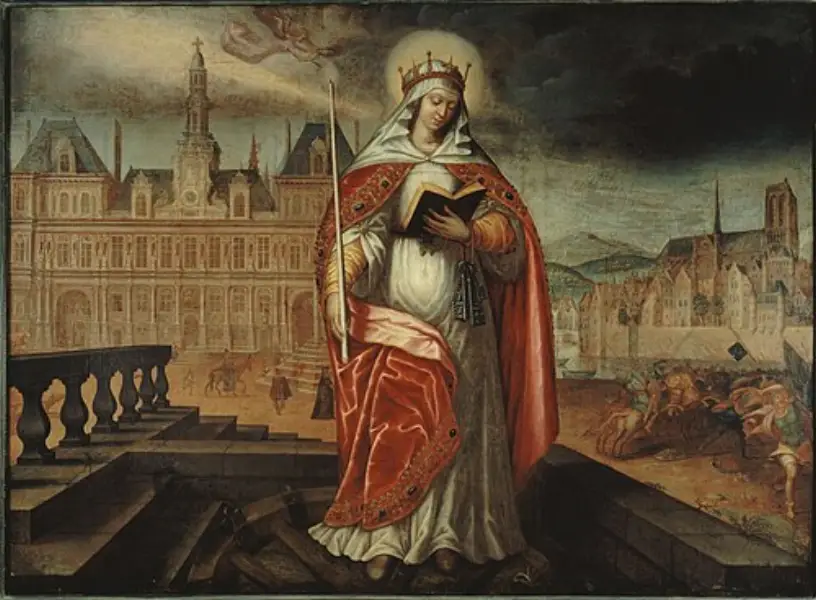
Overview
Genevieve, in French Sainte Geneviève and in Latin Genovefa, was a consecrated virgin of fifth-century Gaul who became one of the patron saints of Paris, honored by both the Catholic Church and the Eastern Orthodox Church. Born around 419 to 422 in Nanterre to a family of the Gallic upper class, she was marked out for holiness as a child, when Germanus of Auxerre recognized her piety and encouraged her dedication to God. After her parents' deaths she moved to Paris, where her asceticism, visions, and works of charity won both admiration and hostility; her neighbors twice plotted to kill her before Germanus's intervention saved her. Her most famous deed came in 451, when she organized the women of Paris in a sustained effort of fasting and prayer as Attila's Huns approached; the invader turned toward Orléans instead. Through the sieges and upheavals of the coming of the Franks she fed the starving city, ransomed prisoners, and won the respect of Childeric and Clovis, whose conversion she encouraged with Queen Clothilde. She built two basilicas in Paris and died in ripe old age, around 502 to 512. Her tomb became a shrine, and for over a thousand years Parisians invoked her in every crisis, from floods and famine to plague and war.
The Complete Life
The Child of Nanterre
Genevieve's birth fell between about 419 and 422 at Nanterre outside Paris; her father Severus, a Frankish magistrate in imperial service, and his wife Geroncia. Although popular tradition pictured her parents as poor peasants, their names, common among the Gallo-Roman aristocracy, point to a birth in the Gallic upper class. From her earliest years she was recognized for religious devotion. About 429, when the child was seven, the two bishops halted at Nanterre on their anti-Pelagian journey to Britain, and Germanus marked the thoughtful girl among the villagers that gathered for his blessing. After speaking with her and encouraging her perseverance in virtue, he questioned her parents and foretold that the child would stand high in the Lord's sight and would one day guide many consecrated virgins by her example. According to her vita, she told Germanus she wished to follow God, and he confirmed her desire, directing that a coin drawn from the ground be made into a necklace to remind her of their meeting; the Catholic Encyclopedia records that he gave her a cross-engraved medal to wear in place of pearls and gold. Since no convent stood near Nanterre, she stayed on in her parents' house in prayer, and Sluhovsky dates her consecration as a virgin to about 437, when she was about fifteen.
§ Early life
Trial and Vindication in Paris
After her parents died, Genevieve moved to Paris to live with her godmother, giving herself to prayer and charitable works. Her ascent in holiness was tested by suffering: she fell severely paralyzed and nearly died, and on recovering reported visions of heaven. Her ascetic discipline was extraordinary. She abstained from meat, broke her fast only twice a week, and between the ages of fifteen and fifty ate nothing from Sunday to Thursday or from Thursday to Sunday, living on beans and barley bread without alcohol; only at fifty, by her bishops' command, did she add fish and milk. She kept vigil every Saturday night in imitation of the servant awaiting the master's return. Such severity drew enmity. In 445 or 446 her neighbors, filled with jealousy and envy, denounced her as a hypocrite and imposter whose visions and prophecies were frauds; Sluhovsky notes she had received the gift of reading hearts, which displeased many, and that her prominence threatened the male hierarchy of Paris. Her enemies plotted to drown her, and she was saved only when Germanus came to the city in her defense. The bishop of Paris then entrusted her with the care of other consecrated virgins, whom, by her teaching and example, she led to a high degree of sanctity.
§ Later life and death
Savior of the City
Genevieve's public mission was inseparable from the catastrophes that fell upon Gaul. Shortly before Attila attacked Paris in 451, she foretold that Paris would escape harm while any who abandoned it would die. Alongside Germanus's archdeacon she persuaded the Parisians she was no prophetess of doom, and she convinced the women to remain, praying and doing penance as Esther and Judith had done, in what McNamara describes as her greatest feat of collective intercession. The Hunnic host marched instead on Orléans. When the residents again plotted against her after Germanus's death, the arrival of his eucharistic loaves stopped their hands. When Merowig's forces took Paris in 480 her charity and self-sacrifice shone, winning influence over him and over his successors Childeric and Clovis. She obtained provisions for the besieged city, transported by river from Arcis and Troyes, and led the convoy herself through enemy lines up the Seine, her prayers saving the eleven ships that carried the grain; on her return she fed the poor first. Childeric closed the city gates to stop her freeing his condemned prisoners, but she opened them by touch, without a key, and persuaded him to spare them. Clovis often pardoned criminals at her request, and with Queen Clothilde she labored for his conversion to Christianity.
§ Later life and death
The Candle That Would Not Go Out
The spirituality of Genevieve was marked by visions, fasting, and a constant working of miracles that filled her vita. The Catholic Encyclopedia records her frequent visions of heavenly saints and angels. Her miracles embraced exorcising demons, healing the blind and paralyzed, raising the dead, rescuing prisoners, and even changing the weather, as when her prayers shielded a harvest near Meaux from a whirlwind and calmed storms on the Seine. Her most famous sign was the miracle of the candle: while she walked from her dwelling toward the church of Saint-Denis her light failed, frightening the virgins accompanying her, but when she took it, it relit at once, and fragments of it healed those who carried them; later tradition added that a demon tried to extinguish the flame and an angel guarded her. This image, the saint with an angel at her right shoulder and a demon at her left, became her most common iconography, appearing in medieval statues, miniatures, and engravings, including her thirteenth-century statue at the Louvre. She anointed the sick with oil, once multiplied in a vessel after an hour of prayer, and healed the deaf, the withered, and the possessed in Paris, Troyes, Orléans, and Tours, where crowds of the demon-possessed met her at the Basilica of Saint Martin and were freed by her prayers and the sign of the cross.
§ Miracles
Ripe Old Age and the First Miracles of the Tomb
Her vita relates that she ended her days in virtue's fullness when old age was ripe, at eighty-two, in the period between 502 and 512. She was buried in the Basilica of the Holy Apostles, the church dedicated to Saint Peter and Saint Paul whose construction she had urged upon Clovis shortly before her death, and she was laid beside members of Clovis's own family, an honor that marked her standing as a protector of the royal house. Queen Clothilde, in recognition of Genevieve's part in the king's conversion, was able to honor her grave. Miracles began at the basilica immediately after her burial, and her vita records the earliest of them; soon her tomb was a pilgrimage site, and her entombment in the royal basilica secured the prestige of her cult. The building itself bore witness to her, its triple portico adorned with pictures of patriarchs, prophets, martyrs, and confessors of the ancient faith. Healings continued at her shrine for centuries: oil kept at the Abbey of Saint Genevieve, founded early in the sixth century, was reported to cure blindness as late as the ninth, and fourteenth-century pilgrims still recorded cures of eye disease, paralysis, plague, and fever, the same ailments she had healed in life.
§ Later life and death
Pre-Congregation Saint and Patroness of Paris
Genevieve belongs to the saints of the first millennium who were raised to the altars by the acclamation of the faithful rather than by formal process: her canonization is pre-congregation, and she is venerated in both the Catholic Church and the Eastern Orthodox Church. Her cult, attested from the miracles recorded immediately after her death, flourished on civil and national pride, as Farmer puts it, even though little about her can be known with certainty. By the fourteenth century she was hailed as patroness and guardian of Paris — an honor Sluhovsky finds striking precisely because she was a woman. Her public cult bound together the segments of French society, drawing peasants into the city and leading city dwellers to pray to her for the crops of the countryside. Two churches in England were dedicated to her in the Middle Ages, five convents there kept her feast, and her cult spread into southwest Germany. Her feast was kept on 3 January, the day Anne of Austria later chose for her pilgrimages to the Nanterre well; a translation of relics was kept in Paris on 28 October and the elevation of the relics on 10 January, and the ergot epidemic of 1129 added a third feast on 26 November, celebrated by the whole country.
§ Influence
From the Revolution to the Present
The French Revolution brought the greatest catastrophe of Genevieve's afterlife. In April 1791 the revolutionary government secularized the Church of Saint Genevieve and turned it into the Panthéon, ending more than a thousand years in which the building had been the center of her cult. Two years later, at the start of the Reign of Terror, her reliquary was dismantled at the Hôtel des Monnaies, her bones were put on trial, condemned for collaborating with the royal authorities, publicly burned at the Place de Grève, and thrown into the Seine. Yet Farmer insists that the Revolution's blows never destroyed her cult in France. Napoleon revived it in 1803 at the Saint-Étienne-du-Mont, where new relic fragments were gathered into a new reliquary; the Panthéon was repeatedly returned and taken from sacred use, and in 1831 Genevieve was formally reinstated as patron saint of Paris. Her intercession was sought in modern catastrophes as in ancient ones: she was invoked to save France during the First World War, and a procession with her relics was held during the Second to prevent the German occupation. Sluhovsky observes that although she remains the patroness of Paris, her cult has never regained its pre-Revolutionary popularity and unifying status, yet her candle has never gone out.
§ Post-Revolution to Modernity
Timeline
- 422
Born at Nanterre, near Paris, into the Gallo-Roman gentry; her father Severus served the Empire as a civil magistrate, and her mother was Geroncia. Dating is approximate, c. 419-422.
§ Introduction
- 429
Bishops Germanus of Auxerre and Lupus of Troyes halted at Nanterre while journeying against the British heresy; Germanus marked out the seven-year-old's piety and urged her toward God.
§ Early life
- 437
Consecrated a virgin, according to the dating of Sluhovsky; other sources place the consecration at age fifteen or attribute her veil to Pope Gregory I.
§ Early life
- 445
Neighbors accused her of being a hypocrite and imposter, claiming her visions and prophecies were frauds; the accusation was repeated in 446.
§ Later life and death
- 451
As Attila's Huns approached, she organized the women of Paris in fasts, prayers, and vigils; the Hunnic army turned toward Orléans instead of Paris.
§ Later life and death
- 475
Oversaw the building of a basilica in honor of Saint Denis of Paris, using materials found at an abandoned lime kiln near the bridge of Paris.
§ Later life and death
- 480
Distinguished herself by charity during the defeat of Paris by Merowig, and influenced him and his successors to be lenient toward the city's residents.
§ Later life and death
- 500
Shortly before her death, persuaded King Clovis to raise the church of the Holy Apostles in honor of the two chief apostles; its building was finished after the year 500.
§ Later life and death
- 502
Died in ripe old age at eighty-two and was laid to rest in the church of the Holy Apostles, whose construction she had promoted; her death is dated between 502 and 512.
§ Later life and death
- 834
During winter floods that deluged Paris, the waters of the Seine receded after prayers at her abbey around the floor area that held her deathbed.
§ Early Middle Ages
- 845
During the Norman siege of Paris, the abbey community fled with her reliquary and hid it at Athis, Draveil, and Marizy.
§ Early Middle Ages
- 862
The hidden reliquary was brought back to Paris, and miracles reported at every refuge had spread her fame across the Île-de-France.
§ Early Middle Ages
- 885
Invoked for the first time on behalf of the whole city when Paris was besieged by the Normans, and credited with the city's successful defense.
§ Early Middle Ages
- 997
King Robert I of France gave the basilica a new altar, and her reliquary was transferred from the crypt to this altar.
§ Early Middle Ages
- 1129
An epidemic of ergot poisoning was stayed after her relics were borne in solemn procession to the cathedral of Notre-Dame; a third feast was set at November 26.
§ High Middle Ages
- Dec 1206
With the Seine threatening a flood, her relics were carried in procession to Notre-Dame alongside relics of other churches, and the river receded.
§ High Middle Ages
- 1210
Her abbey was fortified and brought inside the city's new defensive walls; the parish church of Saint-Étienne-du-Mont was built close by.
§ High Middle Ages
- 1242
Her bones were moved to a new reliquary at Saint-Étienne-du-Mont, on the anniversary of when her body had first been removed during the Norse assaults.
§ High Middle Ages
- 1303
The oldest recorded confraternity devoted to her met at Paris's church of the Holy Innocents.
§ Late Middle Ages
- 1310
Her vita appeared in its first French-language edition.
§ Early life
- 1367
The first French translation of the vita was published.
§ Early life
- 1412
King Charles VI approved the Confraternity of the Bearers of the Reliquary, perhaps to consolidate his backing in the capital.
§ Late Middle Ages
- 1447
Bishop Guillaume Chartier of Paris declared her January 3 feast a civic holiday, a step later ratified by the Parliament of Paris.
§ High Middle Ages
- 1525
A lay confraternity founded in 1412 obtained the abbot's leave to share with the canons the carrying of her reliquary in processions.
§ Late Middle Ages
- 21 Jan 1535
Her reliquary featured in a grand penitential march commanded by King Francis I to invoke God against the Protestants in France.
§ 16th century
- 1562
Two processions pleaded for the purification of Paris from Protestant teaching; in the second, twenty barefoot laymen carried her reliquary.
§ 16th century
- 1589
Rites invoked her in the struggle between Henry III, the House of Guise, and the Catholic League — for the first time against a king.
§ 16th century
- 1591
While the royal army besieged the city, a feast-day assault on it failed and its leader, Chevalier d'Aumale, was killed; devotion dipped.
§ 16th century
- 1619
Cardinal François de La Rochefoucauld was named abbot; the house became headquarters of the Congregation of France and a hub of monastic reform.
§ 17th century
- 1642
Anne of Austria, a yearly pilgrim to the Nanterre well, donated the cornerstone of a new seminary there after the birth of her son.
§ 17th century
- 1649
During Paris's fresh rebellion against the crown, Anne of Austria beheld a vision of the saint after begging her for peace and the city's protection.
§ 17th century
- 1652
Further entreaties and processions answered the Fronde and the hunger it brought; public invocations afterward met widespread cynicism.
§ 17th century
- 1658
Prayed to for the ailing Queen Anne, her reliquary was taken up without any procession, and the queen recovered.
§ 17th century
- 27 May 1694
Amid bad harvests, war, and threatened starvation, an official procession on 27 May brought immediate rain that rescued the kingdom's crops.
§ 17th century
- 1744
Louis XV, stricken ill in Lorraine, invoked her, recovered, and made a pilgrimage to her shrine, pledging money to renovate the decayed church.
§ 18th century and French Revolution
- 1764
Louis XV laid the cornerstone of a new church built in her honor on the grounds of the old abbey, the building later known as the Panthéon.
§ 18th century and French Revolution
- Apr 1791
The revolutionary government secularized the Church of Saint Genevieve, renamed it the Panthéon, and moved her remains to another part of the abbey.
§ 18th century and French Revolution
- 1792
After the monarchy fell, the abbey was secularized and confiscated; despite neighboring residents' protests, her remains were moved again, to Saint-Étienne-du-Mont.
§ 18th century and French Revolution
- 1793
During the Reign of Terror her reliquary was dismantled, her bones were condemned and publicly burned at the Place de Grève, and her ashes were thrown into the Seine.
§ 18th century and French Revolution
- 1803
Napoleon revived her cult at the Saint-Étienne-du-Mont; new relic fragments were brought to Paris and a new reliquary was built.
§ Post-Revolution to Modernity
- 1806
Napoleon ordered that the Panthéon revert to its original sacred purpose.
§ Post-Revolution to Modernity
- 1822
Louis XVIII founded a new church under her name on the Panthéon grounds.
§ Post-Revolution to Modernity
- 1831
Reinstated as the patron saint of Paris.
§ Post-Revolution to Modernity
- 1851
Louis Philippe made the building a secular temple and sent her relics to Notre-Dame, until Napoleon III restored it as a church.
§ Post-Revolution to Modernity
In Their Own Words
be great before the face of the Lord
prayer marathon
It was a process of expanding patronage—from monastery to neighbourhood, to city, to the entire kingdom. Throughout, however, the saint managed to maintain her intimate friendship with the people of Paris.
The Record
- Major works
- Basilica in honor of Saint Denis of Paris (475), later the Priory of Saint Denis de Strata·Basilica of the Holy Apostles, dedicated to Saint Peter and Saint Paul, begun at her urging shortly before her death
- Patron of
- Paris·shepherds·winemakers·wax-chandlers·hatmakers·against eye complaints·against fever·against plagues·against drought·against war
- Symbols
- Lit candle·Breviary·Angels and demons·Liturgical vessel·Crown·Keys of the city of Paris
- Canonization
- Pre-congregation saint, venerated in the Catholic Church and the Eastern Orthodox Church
Prayer
Bibliography
Show 6 sources
- Attwater, Donald; John, Catherine Rachel (1993). The Penguin Dictionary of Saints (3 ed.). New York: Penguin. pp. 151–152. ISBN 0-14-051312-4.
- "Genovefa (423-502)". Sainted Women of the Dark Ages. Edited and translated from Acta Sanctorum by McNamara, Jo Ann; Halborg, John E. Durham; with Whatley, E. Gordon. England: Duke University Press. 1992. pp. 17–37. ISBN 0-8223-1200-X.
- Sluhovsky, Moshe (1998). Patroness of Paris: Rituals of Devotion in Early Modern France. Leiden, The Netherlands: Koninklijke Brill. ISBN 90-04-10851-3.
- Williams, Hannah (September 2016). "Saint Geneviève's Miracles: Art and Religion in Eighteenth-Century Paris". French History. 30 (3): 322–353. doi:10.1093/fh/crv076.
- Farmer, David Hugh (2011). "Genevieve". The Oxford Dictionary of Saints (5 ed.). Oxford, England: Oxford University Press. p. 180. ISBN 978-0-19-959660-7.
- MacErlean, Andrew (1909). "St. Genevieve". The Catholic Encyclopedia. Vol. 6. New York: Robert Appleton Company.
Profile text adapted from the Wikipedia article, licensed CC BY-SA 4.0.
Pray with this saint every day
Save St. Genevieve to your favorites, read the full profile, and get feast-day reminders in the Saints app.
Get the Saints AppFree on the App Store for iPhone and iPad