
died 4 December 1505·Feast December 4
St. Gennady of Novgorod
Archbishop of Novgorod and compiler of the Slavic Bible
Overview
Gennady, also known in Greek form as Gennadius, rose from the Gonzov boyar clan of Moscow to become one of the most consequential churchmen of late fifteenth-century Russia. Before his elevation he led the Chudov Monastery in the Moscow Kremlin as its hegumen. In 1484 he was named Archbishop of Novgorod the Great and Pskov, arriving in the city the following January to bring a recently subordinated church into line with Muscovite practice. His sixteen years in office were dominated by two struggles: the suppression of the Heresy of the Judaizers, which he pursued with severe measures that included the burning of heretics, and the consolidation of Russian religious life. His most enduring achievement came in 1499, when he oversaw the compilation of the first complete codex of the Bible in Slavic, the work still known as the Gennady Bible. Three years earlier he had computed the date of Easter for a thousand years ahead, averting a crisis of the calendar as the Byzantine year 7000 approached. Accused of simony in 1504, he retired to Moscow and died at the Chudov Monastery on 4 December 1505. The Russian Orthodox Church canonized him in 2016.
The Complete Life
A Boyar's Son in the Kremlin Cloister
Gennady came from the Gonzov boyar clan of Moscow, one of the service families that surrounded the grand princely court. Nothing in the record suggests a birthdate, and even his birthplace is given only presumably as Moscow, yet the family's standing clearly shaped the trajectory of his life. Before any thought of a northern see, he had embraced the monastic life and risen to lead the Chudov Monastery in the Moscow Kremlin as its hegumen. The house he governed was no remote foundation: it stood in the shadow of the princely palace and the cathedral churches of the capital, and its abbot moved naturally among the men who directed the affairs of the Russian Church. The monastery's prominence became evident again in the strange affair of his predecessor's downfall. Sergei, the archbishop whom Gennady would succeed in Novgorod, served less than a single year before being recalled to Moscow and confined to the very Chudov Monastery that Gennady governed, apparently because of mental illness. That a deposed prelate was placed in the custody of Gennady's house says much about the trust reposed in its hegumen, and it placed him, almost literally, in the rooms where the succession to Novgorod would be decided.
§ Biography
Called to the See of Novgorod
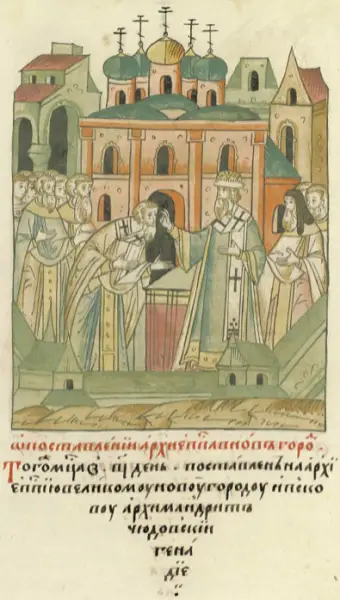
In December 1484 Gennady was named Archbishop of Novgorod the Great and Pskov and placed in office at Moscow. The manner of his appointment marked a turning point: he was the first Novgorodian prelate in more than a century who was not chosen by lot, the traditional method that had governed elections to the see since the city's days of independence. His predecessor Sergei had served less than a year, and the office itself had been vacant of locally elected incumbents since Feofil was removed in 1480. Gennady arrived in Novgorod in January 1485, only a few years after Moscow had annexed the city outright in 1478, and he carried a clear mandate: to bring the newly conquered Novgorodian church more in line with the ecclesiastical practices of Moscow. The assignment provoked resistance. The local clergy bristled at his commemoration of several Muscovite saints, seeing in the practice an unwelcome sign of incorporation into the capital's church. Gennady met the opposition not with confrontation but with accommodation, adding several local Novgorodian saints to his own commemoration and thereby weaving the two traditions together. The episode set the pattern of his episcopate, in which firmness of purpose was repeatedly joined to practical flexibility.
§ Biography
The Struggle Against Heresy and the Saving of the Calendar
The dominant struggle of Gennady's sixteen years in Novgorod was the rooting out of the Heresy of the Judaizers, a movement that had taken hold among the city's clergy and then spread to Moscow itself when Novgorodian churchmen were transferred to the capital. Gennady pursued it with a severity that startled his contemporaries. His measures, it was said, were modeled on the Spanish Inquisition, whose royal suppression of error he admired, and with the grand prince and the metropolitan behind him he sent several heretics to the flames. His energies, however, were not consumed by repression alone. The Novgorodian Fourth Chronicle credits him with funding a third of the rebuilding of the Detinets, the city's fortress walls, in the campaign of 1484 to 1490, an act that joined episcopal authority to the physical defense of the city. His most far-reaching act of stewardship came in 1492, the year the Byzantine calendar reckoned as 7000 from the creation of the world. Many Russians expected the end of the world in that year and had ceased to calculate Easter beyond it, a lapse that threatened not only the round of worship but the timing of planting and harvest, and with them the specter of famine. Gennady computed Easter for the next thousand years, and in doing so preserved the rhythm of Russian religious and agricultural life.
§ Biography
Retirement, Trial, and Death at Chudov
The closing years of Gennady's life brought a sharp reversal. In 1503 he took part in the Council of Moscow, still in possession of his see and engaged in the great questions confronting the Russian Church. The following year, however, he was accused of simony, and the charge ended his archiepiscopate. He retired from office after two decades in Novgorod and returned to Moscow, the city of his birth and of the monastery he had once governed. Death came to him on 4 December 1505 at the Chudov Monastery, the Kremlin house where his career had effectively begun. His grave was made beside Metropolitan Aleksei in the monastery's principal church, among the most honored dead of the Russian Church. That resting place did not endure. The monastery church was destroyed in 1929, and Gennady's remains vanished, as did those of over a hundred others interred within the Kremlin. The disappearance of his relics closed one chapter of his story, but it did not end his remembrance, for the Church that had honored him in burial would honor him again, formally, in a later age.
§ Death and burial
The Bible That Bears His Name
Gennady's enduring monument is the great codex assembled under his direction in 1499, known ever since as the Gennady Bible. It was the first complete codex of the Bible in Slavic, and its compilation answered the same crisis of learning that his paschal computation had addressed: a church that lacked the full text of Scripture in its liturgical language could neither teach nor defend the faith with confidence. The work secured his reputation as a figure of the first rank in the history of the Russian Bible, and his fight against the Judaizer heresy has made him a standing example of episcopal vigilance in Russian church memory. His name is also attached to a distinctive iconographic attribute: images of the saint carry the Bible that bears his name. The Russian Orthodox Church formally canonized him in 2016, more than five centuries after his death, confirming a veneration that his defense of the faith and his service to the Scriptures had long inspired. His feast is kept on 4 December in the old style, corresponding to 17 December in the Gregorian calendar, the day that recalls his quiet death in the Kremlin monastery where his life of service had begun.
§ Biography
Timeline
- 12 Dec 1484
Named Archbishop of Novgorod and installed in office at Moscow, the first Novgorodian prelate chosen without lots since 1359.
§ Biography
- Jan 1485
Arrived in Novgorod with the task of aligning the newly conquered city's church with Muscovite ecclesiastical practice.
§ Biography
- 1490
Bore a third of the cost of rebuilding the Detinets, Novgorod's Kremlin walls, a project running from 1484 to 1490.
§ Biography
- 1492
Calculated the date of Easter for the following thousand years as the feared Byzantine year 7000 approached.
§ Biography
- 1499
Compiled the Gennady Bible, the first complete codex of the Bible in the Slavic language.
§ Biography
- 1503
Took part in the Council of Moscow, the last major assembly of his archiepiscopate.
§ Death and burial
- 1504
Accused of simony and retired from the see of Novgorod, returning to Moscow.
§ Death and burial
- 4 Dec 1505
Died at the Chudov Monastery in the Moscow Kremlin and was buried near Metropolitan Aleksei.
§ Death and burial
- 2016
Canonized as a saint of the Russian Orthodox Church.
§ Biography
The Record
- Major works
- Gennady Bible (1499), the first complete codex of the Bible in Slavic·Paschal tables extending the computation of Easter for a thousand years
- Symbols
- Gennady's Bible
- Canonization
- Canonized in 2016 by the Russian Orthodox Church
Prayer
Bibliography
Show 7 sources
- Michael C. Paul, “Episcopal Election in Novgorod, Russia 1156-1478,” Church History: Studies in Christianity and Culture 72, No. 2 (June 2003): 275.
- David M. Goldfrank, “Burn, Baby, Burn: Popular Culture and Heresy in Late Medieval Russia,” The Journal of Popular Culture 31, no. 4 (1998): 17–32.
- Andrei Pliguzov, “Archbishop Gennadii and the Heresy of the 'Judaizers,'” Harvard Ukrainian Studies 16(3/4) (December 1992): 269–288.
- George Vernadsky, “The Heresy of the Judaizers and the Policies of Ivan III of Moscow,” Speculum, Vol. 8, No. 4 (October 1933): 436–454.
- T. D. Panov, Nekropoli Moskovskogo Kremlia (Moscow: Muzei Zapovednik Moskovskii Kreml', 2003).
- Michael C. Paul, “The Military Revolution in Russia, 1550-1682,” The Journal of Military History 68, No. 1 (January 2004): 34.
- William Craft Brumfield, A History of Russian Architecture (Cambridge: Cambridge University Press, 1993).
Profile text adapted from the Wikipedia article, licensed CC BY-SA 4.0.
Pray with this saint every day
Save St. Gennady of Novgorod to your favorites, read the full profile, and get feast-day reminders in the Saints app.
Get the Saints AppFree on the App Store for iPhone and iPad