
died 23 April 303·Feast April 23
St. George
Soldier of Rome and great-martyr of Lydda
Overview
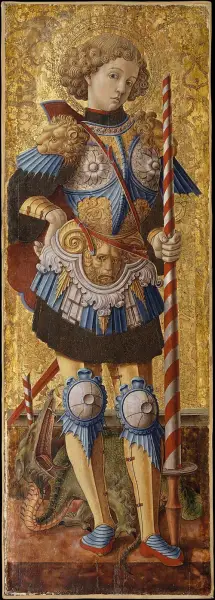
George, called George of Lydda, was an early Christian martyr whose death under the emperor Diocletian made him one of the most honored saints, heroes, and great-martyrs of Christianity. Of Cappadocian Greek origin, he served as a soldier in the Roman army and became a member of the Praetorian Guard of Diocletian himself. When the great persecution of 303 struck at Christians within the professional army, George refused to deny his faith and was condemned to death, suffering beheading on 23 April 303 at Diospolis, the Lydda of Palestine, where his body was buried and soon venerated. Little certain detail of his life survives; what grew around his memory, however, was immense. In hagiography he is immortalized as the slayer of the dragon, a legend first recorded in the eleventh century that carried his name into every corner of medieval Christendom. Since the era of the Crusades he has been honored above all as a military saint, the patron of England, Georgia, Ethiopia, Catalonia, Aragon, and countless cities and causes, and one of the Fourteen Holy Helpers. Christians, Druze, and Muslims alike revere him as a martyr of monotheistic faith, and his cross flies as the emblem of nations.
The Complete Life
Origins in Cappadocia and Lydda
Very little can be known with confidence about the early life of George, for the earliest sources disagree and legend gathered early and thickly around his name. He is consistently described as a man of Cappadocian Greek origin, born in the third century in that rugged region of eastern Anatolia that produced so many of the church's great ascetics and martyrs. The oldest surviving strand of his legend is a Coptic manuscript unearthed in 1964 beneath a column in the ruined cathedral of Qasr Ibrim in Nubia, a text dating from between 350 and 500. According to this document Gerontius, the saint's father, was a Cappadocian serving Rome in Nobatia, married to Polychronia, a woman of Christian belief. Her son, the text relates, came into the world while Aurelian wore the purple, in the years from 270 to 275, and received baptism in secret at his mother's hands, for his pagan father opposed the Christian rearing she intended for the boy. The Greek tradition likewise makes him the child of noble Christian parents; after his father's death his mother, a native of Lydda in Palestine, returned with him to her hometown, where the boy who would die at Diospolis passed his youth.
§ Christian traditions
A Soldier of the Praetorian Guard
George's path led, according to the constant tradition, into the army of the Roman Empire. Holy tradition describes him as a soldier, and the fuller accounts carry him to the very summit of military service: he became a member of the Praetorian Guard, the elite corps attached to the person of the emperor Diocletian. The choice of arms was a natural one for a capable young man of provincial nobility, and it placed him within arm's reach of the imperial court at the moment when the empire's long uneasy peace with Christianity was about to break. The Diocletianic persecution of 303, the last and fiercest of the general persecutions, fell with special weight upon the Christian faithful within the army's professional ranks, for no empire can endure a defiant conscience inside its own legions. Historians regard the reality of that persecution as beyond dispute, and it forms the historical stage on which George's career ended. A Roman officer of proven loyalty, decorated by service at the emperor's side, found himself required to choose between the uniform he wore and the Lord he served; the tradition is unanimous that, when the test came, he did not hesitate in the choice he made.
§ Christian traditions
Trial, Witness, and Martyrdom
When the edicts of persecution were published, George was arrested because of his Christian faith and refused to recant. The Greek tradition locates his trial and torture at or near Lydda, also called Diospolis, in Palestine; later versions of the legend transfer the scene to Nicomedia, where a persecutor named Dadianus appears, a figure rationalized in later retellings into Diocletian himself. What follows in the legends is a catalogue of torments endured and marvels worked, elaborated in the Latin Passio into more than twenty separate tortures spread over seven years, with the empress Alexandra converted by what she witnessed. The historical core is simpler and sterner: George was condemned to death for his refusal to sacrifice to the gods, and the sentence was carried out with the sword on 23 April 303. Someone who witnessed his torments was converted by what he saw and, in one telling, persuaded the empress to embrace the faith and share the same crown. His body was buried at Diospolis, and Christians soon gathered at his grave to honor him as a martyr, so that the earliest centers of his cult took root precisely in the city of his death. The historian Donald Attwater judged that this, at least, may reasonably be affirmed of him.
§ Christian traditions
The Martyr Shared by Three Faiths
The spirituality that radiates from George is the spirituality of the martyr: the conviction that faithfulness unto death is the highest form of witness, and that the soldier of Christ conquers not by taking life but by surrendering his own. From the earliest centuries the sick, the possessed, and the afflicted sought his intercession, and at his ancient shrine near Beit Jala in Palestine the suffering of all three communities have been brought together for healing. In the Middle East his figure fused with that of al-Khidr, the Verdant One of Islamic and Druze piety, so that Muslims invoke al-Khadr where Christians invoke George, often in the same shrine; at the monastery of Al-Khader the priest reported that Muslim visitors came in nearly the same numbers as Christian pilgrims. Muslim tradition numbered him among the prophetic figures, telling how he was killed and raised again, made dead trees flourish, and confounded the idols of the king of Mosul. In the Druze faith he is honored for bravery, the saint who confronted the dragon as Elias confronted the priests of Baal. This unique communion of venerations, rare among the saints, testifies to the power of his single act: a man who died rather than deny the one God.
§ Veneration in the Levant
The Grave at Diospolis
The last scene of George's life was played out at Diospolis, the Lydda of the coastal plain of Palestine, and it is there that his earthly story ends and his cult begins. Beheaded on 23 April 303, he was buried in the city, and the Christians of the region soon came to keep his memory at his tomb. A titular church stood at Diospolis by the reign of Constantine the Great, consecrated, in Eusebius's phrase, to someone of the highest worldly rank, though the historian never supplies the name; the Church of Saint George that stands in the city today, now Lod in Israel, is believed to house his relics, and pilgrims are shown the tomb in its crypt alongside the neighboring mosque of Al-Khadr. the archdeacon Theodosius, in his De Situ Terrae Sanctae composed between 518 and 530, supplies the earliest surviving picture of Diospolis drawing pilgrims to the martyr's tomb. By the end of the sixth century the center of devotion had shifted toward his native Cappadocia, where the seventh-century Life of Saint Theodore of Sykeon attests the veneration of his relics. A basilica stood at Lydda by the time of the Muslim conquest, and the church erected there in 1872 still keeps the feast of the translation of his relics each 3 November.
§ Veneration
Enrolled Among the Saints
George passed into the official calendar of the church's saints by an act recorded in the year 494, when Pope Gelasius I included him in a decree honoring saints celebrated across the Christian world whose deeds rest hidden in the knowledge of God alone. The formula was a prudent one, acknowledging the antiquity and reach of his cult while declining to vouch for every detail of the passions told under his name. By that date his veneration had already spread with certainty through the fifth century, and possibly back into the fourth: a church at Diospolis honored him under Constantine, and early dedications across the Christian world witness to his reputation. The scholarly Bollandists of the seventeenth century, Daniel Papebroch, Jean Bolland, and Godfrey Henschen, were among the first to establish the critical foundations of his historicity, and Herbert Thurston concluded from the ancient cultus, the narratives of early pilgrims, and the fourth-century church dedications that there is no good ground for doubting that George truly lived and died as the tradition says. The earliest Greek hagiography preserving his narrative is a fifth-century palimpsest identified by Hippolyte Delehaye, and the most complete early version survives in a Syriac translation of around 600, recovered from fragments in the British Library.
§ Veneration
Patron of Nations and the Dragon of Legend
No martyr of the early church commands a wider map of patronage than George. England, Georgia, Ethiopia, Catalonia, Aragon, Portugal, and Gozo all stand under his patronage, together with Genoa, Moscow, and Beirut; he is patron of Lebanese, Palestinian, and Syrian Christians, of the Brazilian state of Rio de Janeiro, and in his Greek homeland of farmers and shepherds, whose spring festivals bless the vines in his name. His cross became the flag of England and a component of the Union Jack, and in Aragon the Cross of Alcoraz still emblazons the provincial flags. The Crusades fixed him as the model of chivalry: his apparition was believed at Antioch in 1098, Edward III gave him the Order of the Garter, and English armies invoked his name as a battle cry. The legend of the dragon, first recorded in an eleventh-century Georgian source and carried through the Golden Legend of Jacobus de Voragine into English by William Caxton, made the image of the mounted saint spearing the monster one of the most familiar in all Christian art, from Novgorod icons to Uccello's panel. In Brazil he is honored in Umbanda as the orisha Ogun; in Ethiopia the Church of Saint George at Lalibela is carved from living rock in his honor.
§ Patronages
Timeline
- 270
A Coptic manuscript from Qasr Ibrim records that George was born during the reign of Emperor Aurelian, to the Cappadocian Gerontius and his Christian wife Polychronia.
§ Christian traditions
- 23 Apr 303
Beheaded at Diospolis (Lydda) in Palestine after refusing to recant his faith under Diocletian, and buried in that city.
§ Christian traditions
- 494
Pope Gelasius I's decree of 494 enrolled George among the saints whose fame endures among men while God alone knows their deeds.
§ Veneration
- 1096
King Pedro I of Aragon won the battle of Alcoraz, legend holding that George appeared on his white charger to lead the Christian cavalry at Huesca.
§ Patronages
- 1098
An apparition of the saint, the crusaders believed, gave heart to the Frankish host fighting at Antioch.
§ Veneration
- 1201
King Peter the Catholic of Aragon established the chivalric military Order of Sant Jordi d'Alfama in George's honor.
§ Veneration
- 1348
Edward III committed his new Order of the Garter to George's patronage and standard.
§ Veneration
- 1415
A church council elevated George's feast of 23 April to the rank of a festum duplex, codifying his standing in the late medieval West.
§ Veneration
- 1469
Emperor Frederick III founded the Order of St. George of Habsburg-Lorraine in Rome in the presence of Pope Paul II.
§ Patronages
- 1552
In the reign of Edward VI, all saints' banners except George's were abolished in England during the Reformation, fixing him as the nation's emblem.
§ Veneration
- 1872
A new church was erected at Lydda over the place where George's relics were honored; its consecration is commemorated on 3 November.
§ Veneration
In Their Own Words
whose names are justly reverenced among men, but whose actions are known only to God
this theory of Gibbon's has nothing to be said for it
The Record
- Patron of
- Patron saint of England·Patron saint of Georgia·Patron saint of Ethiopia·Patron saint of Catalonia and Aragon·Patron saint of Portugal·Patron of soldiers, chivalry, and the cavalry of the Brazilian Army·Patron of farmers and shepherds in Greece·Patron of Lebanese, Palestinian, and Syrian Christians
- Symbols
- Clothed as a crusader in plate armour or mail·Lance tipped by a cross·White horse·Slaying a dragon·St George's Cross
- Canonization
- Canonized by Pope Gelasius I in 494, among saints whose deeds are known only to God
Prayer
Bibliography
Show 8 sources
- "Saint George". Encyclopædia Britannica (Online ed.). Retrieved 21 July 2022
- Thurston, Herbert (1913). "St. George". In Herbermann, Charles (ed.). Catholic Encyclopedia. New York: Robert Appleton Company
- Attwater, Donald (1995) [1965]. Dictionary of Saints (Third ed.). London: Penguin Reference. p. 152
- Walter, Christopher (2003). The Warrior Saints in Byzantine Art and Tradition. Ashgate Publishing. ISBN 1-84014-694-X
- Brooks, Ernest W. (1925). "Acts of S. George". Le Muséon. 38: 67-115. ISSN 0771-6494
- de Voragine, Jacobus (1995). The Golden Legend. Princeton University Press. ISBN 978-0-691-00153-1
- McClendon, Muriel C. "A Moveable Feast: Saint George's Day Celebrations and Religious Change in Early Modern England". The Journal of British Studies 38.1 (January 1999): 1-27
- Dalrymple, William (1999). From the Holy Mountain: a journey among the Christians of the Middle East. Henry Holt and Company. ISBN 978-0-80-505873-4
Profile text adapted from the Wikipedia article, licensed CC BY-SA 4.0.
Pray with this saint every day
Save St. George to your favorites, read the full profile, and get feast-day reminders in the Saints app.
Get the Saints AppFree on the App Store for iPhone and iPad