
940 – 969·Feast June 26
St. George El Mozahem
Coptic martyr who followed Christ from Islam
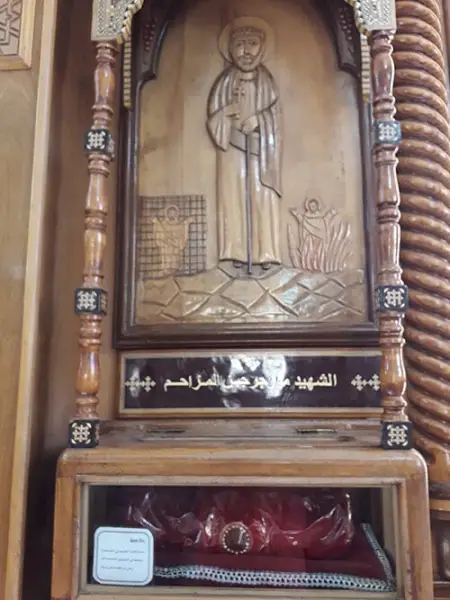
Overview
George El Mozahem was a Coptic Orthodox martyr of the tenth century, his birth came in 940 at Talkha in Egypt; Mary, his mother, was a Christian, while his father Jumaa Al Atawi was a Muslim, and under the name El-Mozahem the boy was raised in his father's religion, yet he went to church with his mother and was drawn from boyhood to the mysteries of her faith. His desire for the Eucharist set him on a path that could cost him everything: told that he must first be baptized, and finding no priest willing to risk so dangerous an act, he baptized himself by immersion three times. After his marriage to a Christian woman he fled with her to Samanoud, where he received baptism properly and the Christian name George, taken because the day was the feast of Saint George. The couple lived in continence, and George began to think of the monastic life until a voice directed him instead toward martyrdom. Arrested for leaving Islam, he was burned and miraculously emerged without harm. Even the governor hesitated to condemn him, but the crowd's fury prevailed, and George was executed on 26 June 969. His wife received his relics, which resisted every attempt to burn them.
The Complete Life
A Boy and the Bread of Heaven
George was born in Talkha, Egypt, in 940, and given the name El-Mozahem. His home was a household divided in faith: his mother Mary was a Christian, his father Jumaa Al Atawi a Muslim, and by the custom of the age the boy was raised in his father's religion until his twelfth year. Yet the faith of his mother proved inextinguishable in him. He used to go to church with her, and there his heart fastened on the holiest thing he could see: the sacrament of the Eucharist. When he told her that he wished to receive it, she answered with the Church's own rule: baptism had to come first. Sensing something of his longing, she allowed him to taste the blessed Eulogia bread, the Qorban. Its sweetness became for him a sign of things unseen, and his hagiography preserves the words it drew from him, marveling that bread not consecrated by prayer could taste so sweet, and asking what the Offering itself must taste like. From that moment the direction of his life was set, though the way to it would run through danger, exile, and fire.
§ Life
Baptism in Secret and in Samanoud
The desire born in the church of his childhood met immediate obstacles. George sought baptism, but the priests were afraid to take part in so dangerous an act, knowing the peril a convert from Islam faced under the law. Refusing to be kept from the grace he longed for, he dipped himself beneath the water three times, conferring the sacrament on his own soul. In time he married a Christian woman, and when at last he told her the story of his self-baptism she judged, with the seriousness the sacrament deserves, that what he had done was not accurate baptism. Rather than abandon the matter, the two of them fled together to the city of Samanoud, where George received baptism validly and with it a new Christian name: George, given because that day happened to be the feast of Saint George, the great martyr whose name he would now carry toward a martyrdom of his own. The husband and wife then bound themselves to a life without any marital relationship, living together as brother and sister, and George turned his thoughts toward the monastery before God made clear that another calling was his.
§ Life
Called Not to the Cloister but to the Fire
George's heart, having renounced the comforts of marriage, moved naturally toward the monastic life. But as he considered becoming a monk, a voice sounded within him, forbidding the monastery and summoning him rather to martyrdom. It was a calling he did not have to pursue far, for his very existence as a baptized Christian was a capital offense under the law he had been born into. He was arrested for leaving Islam, and the sentence of fire was carried out against him: he was burned, yet he miraculously survived without harm, an outcome his hagiography attributes to the power of God. The spectacle changed hearts where sermons could not. The governor of the region was deeply impressed by what he had witnessed and considered freeing the young man altogether. But the crowd, enraged at the thought of mercy, rose against their own ruler and threatened to kill the governor if he released the confessor. Faced with the fury of the people, the authorities proceeded to the execution, and George, who had been sent to the flames once and had conquered them, was put to death.
§ Life
Relics That Fire Could Not Consume
George was executed on 26 June 969, and the account of what followed forms the last scene of his hagiography. After the execution his wife came to receive his relics, taking into her own keeping the body of the man who had been her husband in name and her brother in purity. Even then the persecution seemed unwilling to release him, for some Muslims attempted to set his body on fire, and the attempt failed, because, as his hagiography records, God did not allow it. The fire that could not harm him living could not dishonor him dead. The Church of Egypt received him among her martyrs, keeping his memory on 26 June, the nineteenth day of the month of Paoni in the Coptic calendar, and numbering him among the martyrs and saints of the Coptic Orthodox Church. His story survived in the Synaxarium readings for that day, so that each year his longing for the Eucharist, his daring in the water, and his triumph in the flames are recounted again for the faithful. In him the Church of Egypt honors a convert who desired the sacraments more than life itself, and whose coming to the altar was sealed by a death that made the desire perfect.
§ Life
A Witness Across Centuries
The memory of George El Mozahem has endured for more than a millennium as a distinctive witness in the calendar of the Coptic Orthodox Church. He stands in the lists of her martyrs beside the great George whose name he took, and his feast on 26 June, the nineteenth of Paoni, places his story before each generation of Egyptian Christians through the Synaxarium. What the account preserves is rare in hagiographic literature: the interior conversion of a boy raised in another faith, drawn by the sweetness of the Eucharist he had only tasted in figure; the courage of a self-administered baptism when no priest would dare; the counsel of a wife who held the sacraments in too much reverence to accept it; and a martyrdom that began with a miraculous deliverance from fire and ended with relics that fire could not touch. For Coptic Christians living as a minority, his story has long carried its own consolation, that the grace of Christ reaches across every boundary of family and law, and that fidelity to him is worth whatever it costs.
§ Life
Timeline
- 940
Birth at Talkha in Egypt; his mother Mary was a Christian, his father Jumaa Al Atawi a Muslim.
§ Life
- 26 Jun 969
Executed for leaving Islam after miraculously surviving being burned; his wife received his relics.
§ Life
In Their Own Words
If the taste of this bread that was not consecrated by prayers tastes like this, what will be the taste of the Offering?
The Record
- Canonization
- Pre-congregation martyr, venerated in the Coptic Orthodox Church
Prayer
Bibliography
Show 6 sources
- "Why Did You Choose Them and Why Did They Follow?" (PDF). Archived from the original (PDF) on 2011-09-04. Retrieved 2011-07-11.
- Mena Ghaly. "St. George El-Mozahem". wiscopts.net. Archived from the original on 26 June 2018. Retrieved 8 May 2015.
- "الشهيد مار جرجس المزاحم - St-Takla.org". st-takla.org. Retrieved 8 May 2015.
- "Lives of Saints :: Paona 19". copticchurch.net. Retrieved 8 May 2015.
- "19 Paonah - Coptic Synaxarium". st-takla.org.
- "تذكار الشهيد مارجرجس المزاحم". 26 June 2016.
Profile text adapted from the Wikipedia article, licensed CC BY-SA 4.0.
Pray with this saint every day
Save St. George El Mozahem to your favorites, read the full profile, and get feast-day reminders in the Saints app.
Get the Saints AppFree on the App Store for iPhone and iPad