
died January 686·Feast August 18
St. George I of Constantinople
Ecumenical Patriarch of Constantinople in troubled times
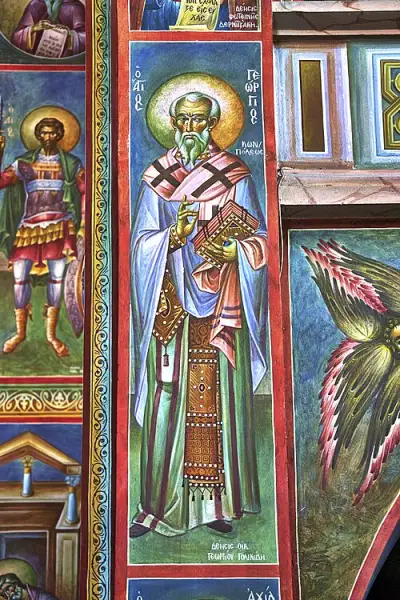
Overview
George I of Constantinople, known in Greek as Georgios, served as Ecumenical Patriarch of Constantinople from 679 to 686, in the age when the Byzantine capital stood under continual pressure from the Arab sieges that had recently battered it. He was installed around November 679, succeeding Theodore I of Constantinople on the patriarchal throne. He led the Chalcedonian Christians of the imperial capital through his years on the patriarchal throne. He held the see for roughly six years, until his death in January or February 686 in Constantinople, the city known today as Istanbul. After his death the throne returned to his predecessor Theodore I, who reigned once more after him. Though the surviving record of his life is brief, the Eastern Orthodox Church has never forgotten his service, numbering him among its saints and honoring his memory each year on 18 August, and the mural of him preserved in the Church of the Holy Trinity at Kerameikos keeps his face before the faithful.
The Complete Life
Called to the First See of the East
George, a son of the Chalcedonian Church, was raised to the Ecumenical Patriarchate of Constantinople in 679, installed around the November of that year. The see he inherited was the most exposed great throne in Christendom: the imperial capital had within living memory withstood successive Arab sieges, and the Church of the empire was still torn over the question of the operation and the will of Christ, a dispute that had wrecked patriarchates and emperors alike. His immediate predecessor, Theodore I, had held the throne before him, and George's election restored a measure of order to a succession that would prove unsettled. He came to the patriarchal office as a confessor of Chalcedonian Christianity, the two-natures Christology of the great council of 451 that Constantinople itself had done so much to defend. For the six years of his patriarchate he stood at the center of the Byzantine Church's life, guiding it through the years in which the empire prepared the council that would at last settle the doctrine of Christ's two wills, and holding the see of the new Rome steady while greater names argued over the faith it confessed.
§ Notes and references
Death in the Imperial City
George's patriarchate ended with his death in Constantinople in January or February of 686. He had held the see from 679 to 686, a term of roughly six years, an unusually stable tenure in a period when patriarchs of the capital were often made and unmade by imperial policy and doctrinal upheaval. His death reopened the question of succession, and the answer was a strange one: the throne did not pass to a new man but returned to his own predecessor, Theodore I, who reigned again in Constantinople after George's death. The record preserves little of George's last months, but his burial in the imperial city and the peaceable transfer of the see stand in quiet contrast to the storms that had carried off so many of his predecessors. He died as he had served, within the walls of Constantinople, the city whose church he had governed, leaving behind a patriarchate remembered not for controversy but for faithful stewardship in a hard age. The manner of his passing is unrecorded, and no account of his last illness or words survives; the brevity of the notice is itself a measure of how quietly the years of his patriarchate closed.
§ Notes and references
Remembered Among the Saints
Whatever the brevity of the surviving record, the Church's judgment on George has been constant: the Orthodox communion numbers him among her saints. His feast is kept on 18 August, when his memory is kept each year alongside the great hierarchs of the patriarchal list on which his name stands between Theodore I and Paul III. The venerable sequence of the bishops of Byzantium and the patriarchs of Constantinople, stretching from the apostolic age down to the present, carries his name in its rightful place, a witness that his six quiet years counted for something in the life of the Church. He is also preserved in image: a mural depicting Saint George of Constantinople survives in the Church of the Holy Trinity at Kerameikos, keeping before the faithful the face of a shepherd known to most of history only by his office and his dates. For the Orthodox Church, that is fitting remembrance: not every saint is given a chronicle, and some are given instead a place in the unbroken chain of witness that runs from the apostles to the present day.
§ Notes and references
Timeline
- Nov 679
Installed as Ecumenical Patriarch of Constantinople, succeeding Theodore I.
§ Notes and references
- Jan 686
Died in Constantinople after a patriarchate of roughly six years, ending his term in January.
§ Notes and references
The Record
- Canonization
- Pre-congregation saint, venerated in the Eastern Orthodox Church
Prayer
Bibliography
Show 3 sources
- "List of Patriarchs". Ecumenical Patriarchate of Constantinople. Retrieved 18 July 2011.
- "Ecumenical Patriarch".
- "Saint George, Patriarch of Constantinople". oca.org. Retrieved 16 April 2023.
Profile text adapted from the Wikipedia article, licensed CC BY-SA 4.0.
Pray with this saint every day
Save St. George I of Constantinople to your favorites, read the full profile, and get feast-day reminders in the Saints app.
Get the Saints AppFree on the App Store for iPhone and iPad