
1901 – 1959·Feast November 4
St. George of Drama
Confessor-monk and founder in Greek Macedonia
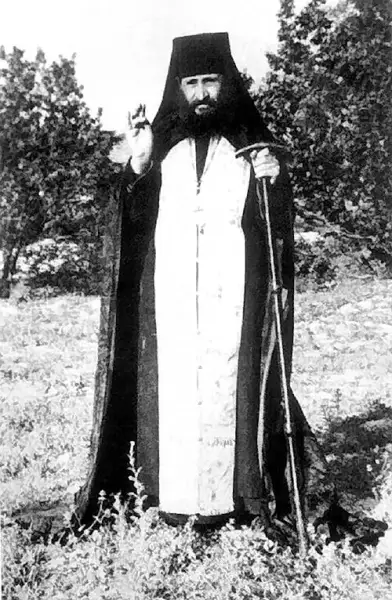
Overview
George of Drama, born Athanasios Karslidis on 1 January 1901, was a Greek Orthodox monk of Caucasian origin whose life spanned persecution, exile, and quiet pastoral labour. Orphaned in childhood in the Tsalka region of the Russian Empire, the child of a family of Pontic Greek refugees from Gümüşhane, he fled hardship as a boy and found shelter in monastic life in Georgia. Tonsured in 1919 with the name George Symeon, he suffered imprisonment and, according to tradition, a commuted death sentence under the communist authorities, surviving three gunshot wounds. In 1929 he settled at Taxiarches in the Sipsa district of northern Greece, where he spent the remaining thirty years of his life. In 1938 the Greek state granted him land on which he built the small Monastery of the Ascension of Christ, officially opened in 1939 and served by him as elder. Renowned for spiritual guidance and an austere asceticism, he drew crowds of visitors, and followers credited him with prophecies concerning the Second World War and the Greek Civil War; in 1941 Bulgarian occupation forces reportedly sentenced him to death, but he was not executed. He died on 4 November 1959 at the age of fifty-eight and was buried behind the monastery church. He was canonized by the Ecumenical Patriarchate in 2008, and his relics remain at Taxiarchis, Drama.
The Complete Life
An Orphan of the Tsalka Hills
The future elder was born on 1 January 1901 at Chadik in the district of Tsalka, then part of the Borchaly uezd of the Tiflis Governorate in the Russian Empire, in a region that lies within the present country of Georgia. His parents, Savva and Sophia Karslides, belonged to a family of refugees: his grandparents had fled from Gümüşhane in the Pontic region of the Ottoman Empire in the aftermath of the Crimean War, joining the stream of Pontic Greeks who resettled in the Caucasus. The boy's childhood was marked by catastrophe. While still young he lost both his father and his mother on the same day, and he was handed over to the care of an older brother. According to anonymous accounts of his early years, he suffered unspecified abuse at his brother's hands and ran away to the mountains. There Turkish villagers found the fugitive child and took him to Pontus, the ancestral land of his family. The narrative of these years, drawn partly from hagiographical sources, describes a boyhood defined by displacement and loss, yet it was precisely this orphaned wandering that set him on the road to the monastic life: after reaching Tiflis, a priest took the homeless boy under his care and directed his first steps toward a monastery in Georgia.
§ Early life
Tonsure, Prison, and the Name George Symeon
Karslidis began monastic life as a novice in a Georgian monastery, having travelled to Tiflis, where a priest received him into his care. His path to full monastic profession was long by any measure: accounts report that he waited nearly ten years as a novice before receiving the habit. In July 1919, having reached eighteen, he at last received the habit and took the monastic name George Symeon. The years that followed brought him into direct conflict with the new Bolshevik order in the Caucasus. The communist authorities jailed him and, according to report, subjected him to torture; tradition adds that a death sentence failed when three bullets could not kill him. Whatever the precise details, the young monk emerged from these trials with a reputation that had already begun to spread: biographers observe that already in those years crowds were seeking him out for spiritual direction, a remarkable position for a man still in his twenties. Among the signs his devotees later recorded from this period is a claim preserved in hagiography that he was seen raised off the ground in prayer while the Divine Liturgy was being celebrated, an account that belongs to the miracle-working reputation which gathered around him in life and grew after his death.
§ Career
Settlement in Greece and Wartime Trials
In 1929 Karslidis left the Caucasus for northern Greece, settling in the village of Taxiarches in the Sipsa district, the place where he would spend the final thirty years of his life. Seven years later, in 1936, he undertook a pilgrimage to the Holy Land, visiting the Christian holy sites, monasteries, and hermitages of Palestine, a journey that marked him as a man of traditional ascetic piety. His enduring work began in 1938, when the Greek government, under a programme intended to support rural communities, granted him a single acre of land. On this modest plot he raised a small monastery in honour of the Ascension of Jesus, solemnly blessed and opened in 1939, and there he served for three decades as an elder and spiritual father. The Second World War and its aftermath brought new danger. Some of his followers attribute to him prophecies concerning the war and the Greek Civil War that followed it. In 1941, during the occupation of Greek Macedonia by Axis forces and their Bulgarian allies, Bulgarian forces reportedly condemned him to die, though, as under the communists earlier, the execution never took place. Twice-condemned and twice-surviving, he continued his ministry of counsel and confession at Taxiarches until his death.
§ Career
Elder, Ascetic, and Counsellor
The tradition surrounding George of Drama presents him above all as a geron, an elder endowed with the gift of spiritual direction. From his novitiate in Georgia to his final years at the Monastery of the Ascension, visitors sought him out for guidance, and biographers record that the stream of pilgrims began well before he held any official position. His lifestyle was markedly ascetic, in keeping with the monastic ideals of both the Greek and the Georgian Orthodox traditions with which he is associated. To this outward austerity his devotees joined the charisms familiar from Orthodox hagiography: prophetic insight into the disasters of the war and civil war era, wonder-working intercession, and the extraordinary claim, preserved in hagiographical accounts, that during the Divine Liturgy he was seen lifted from the ground in prayer. The single saying of his that circulated most widely distils his teaching into two sentences: that God has care for every soul, and that despair amounts to an absence of faith. The words reflect a life that repeatedly tested that conviction, in orphanhood, torture, exile, and two death sentences. In the Orthodox Church he is honoured as a New Confessor, a title acknowledging his suffering for the faith under persecuting regimes, and his memory is kept with the rank of the venerable, the hosios of monastic sanctity.
§ Attributed sayings
Death and Burial at Taxiarchis
George served the Monastery of the Ascension for thirty years and died there on 4 November 1959, at the age of fifty-eight, in the village of Taxiarchis in Drama. He was buried behind the katholikon, the main church of the monastery he had founded, in the spot where his grave remains a place of pilgrimage. After his death the monastery entered a period of decline: deprived of its founder, it slipped into neglect and decay, and for ten years the buildings stood at risk of disappearance. Revival came through the initiative of Dionysios, Metropolitan of Drama, who in 1970 set about repairing and reviving the complex. The monastery reopened as a living religious community, now home to a new sisterhood of nuns rather than the monks of the founder's day; on 25 April 1971 it was blessed anew, and formal recognition came from the Church of Greece on 5 November 1976, securing its continued existence as a functioning monastery. The old elder thus outlived his own foundation by only a decade, yet the community that now inhabits it traces its continuity to his founding work, and his tomb behind the church anchors its identity.
§ Monastery of the Ascension
Canonization in 2008
George was officially canonized on 2 November 2008, when the Ecumenical Patriarch Bartholomew visited Drama and the Ecumenical Patriarchate of Constantinople inscribed the elder of Taxiarchis in its catalogue of saints, fifty years after his death. The canonization took place at the Monastery of the Ascension of Christ, the community he had founded, which now houses his relics as its principal shrine. Veneration spread rapidly beyond Greece. On 24 December 2008, scarcely seven weeks later, the Holy Synod of the Russian Orthodox Church inscribed Athanasios Karslidis in its Menology, assigning his feast to the Old Style date of 24 October, corresponding to 6 November New Style, while the Greek churches keep his memory on 4 November New Style. The Romanian Orthodox Church likewise entered him on its calendar in 2015. His cult thus spans the jurisdictions of Eastern Orthodoxy in a manner befitting a saint of Caucasian birth and Greek ministry. The formal recognition confirmed a devotion that had flourished among the faithful for half a century, fed by published lives of the elder and by the reports of wonders gathered at his tomb in the Macedonian hills.
§ George of Drama
Relics and a Reputation that Crossed Borders
The material centre of George's legacy is the Monastery of the Ascension of Christ at Taxiarches, Drama, where his relics are preserved and where pilgrims continue to seek his intercession. The bodily remains themselves carry a sign that devotees read as divine seal: reports tell that the imprint of a cross may be seen upon his skull. His relics have also travelled along the diaspora routes of Orthodox Christianity. In 2013 one of them was translated to Wuppertal in Germany, serving the Greek-speaking faithful of that industrial city, and in 2016 part of his relics was presented to the Episcopal Church of Tsalka in Georgia, within the Georgian Orthodox communion, a gift that returned the saint, in sacramental form, to the region of his birth. His literary legacy grows through the lives and translations devoted to him: an English-language chapter in a 2004 collection of contemporary Greek elders, a monograph by the Monk Moses of Mount Athos, a Greek life published by his monastery in 2019, and annual notices in the Orthodox press on his feast. For Greek and Georgian Orthodoxy alike he stands as a modern confessor who linked the Pontic and Caucasian worlds to the Church of Greece.
§ George of Drama
Timeline
- 1 Jan 1901
Born Athanasios Karslidis at Chadik in the Tsalka district of the Tiflis Governorate, Russian Empire.
§ Early life
- Jul 1919
At eighteen, after nearly ten years as a novice, he was tonsured a monk and received the name George Symeon.
§ Career
- 1929
Karslidis took up residence at Taxiarches in the Sipsa district of northern Greece, his home for his final three decades.
§ Career
- 1936
He journeyed on pilgrimage to the Holy Land, touring its sacred places, monasteries, and hermitages.
§ Career
- 1938
The Greek government granted him an acre of land at Taxiarches, on which he began building a monastery.
§ Monastery of the Ascension
- 1939
The small monastery he had built, dedicated to the Ascension of Jesus, was officially blessed and opened.
§ Monastery of the Ascension
- 1941
Bulgarian forces reportedly sentenced him to death during the occupation, but the sentence was never carried out.
§ Career
- 4 Nov 1959
George died at Taxiarchis in Drama at the age of fifty-eight and was buried behind the monastery's main church.
§ George of Drama
- 1970
Metropolitan Dionysios of Drama began work to repair and revive the neglected monastery.
§ Monastery of the Ascension
- 25 Apr 1971
The restored monastery, now home to a new community of nuns, was blessed again.
§ Monastery of the Ascension
- 5 Nov 1976
The Church of Greece formally recognized the monastery as an active religious community.
§ Monastery of the Ascension
- 2 Nov 2008
The Ecumenical Patriarch Bartholomew canonized George during his visit to Drama.
§ George of Drama
- 24 Dec 2008
The Holy Synod of the Russian Orthodox Church inscribed him in its Menology with a feast of 24 October Old Style.
§ George of Drama
- 2013
One of his relics was translated to Wuppertal in Germany.
§ George of Drama
- 2016
Part of his relics was given to the Episcopal Church of Tsalka in Georgia, within the Georgian Orthodox communion.
§ George of Drama
In Their Own Words
God cares for everyone. Despair is in effect a lack of faith.
The Record
- Major works
- Monastery of the Ascension of Christ, Taxiarchis, Drama
- Symbols
- Monastic habit·Skull bearing the imprint of a cross
- Canonization
- Canonized November 2, 2008 by the Ecumenical Patriarchate of Constantinople during Patriarch Bartholomew's visit to Drama.
Prayer
Bibliography
Show 7 sources
- Πορφυρία Μοναχή (2019). Ὃ ὅσιος Γεώργιος τῆς Δράμας - Νέα ἔκδοση [in Greek]. Ιερά Μονή Αναλήψεως του Σωτήρος Ταξιαρχών Δράμας (Σίψα): Εκδόσεις Κάστρο. ISBN 9786188452107.
- Middleton, Herman A. 'Elder George of Drama.' In: Precious Vessels of the Holy Spirit: The Lives and Counsels of Contemporary Elders of Greece. 2nd Edition. Thessalonica, Greece & Asheville, North Carolina: Protecting Veil Press, 2004. pp. 178–191. ISBN 9608761409.
- Moses, Monk of Mount Athos. The Blessed Elder George Karslides (1901–1959). Thessaloniki: Orthodox Kypseli Publications, 1998. 149 pp.
- Görgens, Manfred (2013-02-17). 'Ein Heiliger für Wuppertal'. Westdeutsche Zeitung [in German].
- 'St. George of Drama Has Been Entered into the Calendar of the Romanian Orthodox Church'. Orthodox Christian. 28 October 2015.
- 'Memory of Saint Georgios (Karslidis) of Drama'. Orthodox Times. 4 November 2019.
- Great Synaxaristes: Ὁ Ὅσιος Γεώργιος Καρσλίδης [in Greek]. 4 Νοεμβρίου. ΜΕΓΑΣ ΣΥΝΑΞΑΡΙΣΤΗΣ.
Profile text adapted from the Wikipedia article, licensed CC BY-SA 4.0.
Pray with this saint every day
Save St. George of Drama to your favorites, read the full profile, and get feast-day reminders in the Saints app.
Get the Saints AppFree on the App Store for iPhone and iPad