
1880 – 1962·Feast May 9
St. George Preca
Founder of the Society of Christian Doctrine in Malta
Overview
George Franco Preca was a Maltese Catholic priest whose Society of Christian Doctrine — M.U.S.E.U.M. in everyday Maltese speech — carried him to the altars as the second saint of Malta. Born in Valletta in 1880, the seventh of nine children, he was a frail child whose studies for the priesthood were nearly cut short by acute pulmonary tuberculosis; he credited his recovery to the intercession of Saint Joseph. Ordained in December 1906, he threw himself into teaching the catechism to ordinary people, and on 7 March 1907 he gathered the first members of a society of lay catechists that would spread across Malta and beyond. His work among the uneducated drew suspicion from senior clergy: his centres were ordered closed in 1909, and a formal enquiry was opened in 1916, which cleared the movement and led to its official recognition in 1932. In 1918 he joined the Third Order Carmelites, taking the name Franco, and in 1957 he composed five Mysteries of Light for the Rosary, widely seen as the seed of the Luminous Mysteries later introduced by John Paul II. Named a Monsignor in 1952, he shunned the honors attached to the title. He died on 26 July 1962, was beatified in 2001 by John Paul II, and was canonized by Benedict XVI in 2007.
The Complete Life
The Frail Boy from Valletta
George Preca's birth took place at Valletta on 12 February 1880; he was the seventh of the nine children of Vincent and Nathalie Ceravolo Preca, and his father worked both as a merchant and as a health inspector. He was baptized five days later in the Church of Our Lady of Porto Salvo. His childhood was shadowed by poor health; a range of illnesses left him a frail child, and in 1885 he came close to death a second time when he nearly drowned in the harbour, saved only by the boatmen who pulled him from the water. In 1886 the family moved from the capital to Ħamrun, where the boy's life took its enduring shape around the parish. His First Communion came at some point in childhood, and on 2 August 1888 he was confirmed in the Parish Church of St Cajetan. His schooling began at the island's state school, where he took up Latin and English as well as Italian, and even took a prize in handwriting. The decisive turning point came in 1897, when, as he walked through the Maglio Gardens in Floriana he came upon a professor of his, Father Ercole Mompalao, who cheered on the religious vocation that would carry him to the priesthood and to the founding of one of Malta's most distinctive Catholic movements.
§ Life
Through the Shadow of Death to the Altar
As his studies for the priesthood drew to a close, Preca's vocation was tested in the most literal way. Not long before ordination, acute pulmonary tuberculosis was diagnosed, and his doctors held out little hope for him. Saint Joseph, patron of the dying, received the credit for his cure in Preca's own eyes; the sickness nonetheless left his left lung permanently damaged. Alongside this trial came what he regarded as a mystical confirmation of his calling: on 8 April 1905 Aloysius Galea, his confessor, passed away; Preca often told how Galea then seemed to visit him and press him on toward the priesthood. During his studies he had begun to write a rule in Latin for a planned religious movement of permanent deacons, an idea that occupied his mind for years before he reshaped it after ordination. Bishop Pietro Pace ordained him with thirteen companions on 22 December 1906, and his first Mass followed on Christmas Day at the Saint Cajetan parish church in Ħamrun. Appointed assistant priest at St. Gaetano, he immediately gave himself to the work that would define his life: the teaching of the young in the faith.
§ Life
M.U.S.E.U.M. and the Gospel for the Common People
Down by the waterfront Preca started teaching the Catholic catechism to working people, labourers among them, and drew men such as Ewgenju Borg into a circle of catechists. A spiritual conference he convened at the Ta' Nuzzo church in February 1907 moved on to premises at 6 Fra Diegu Street, and out of these gatherings the Society of Christian Doctrine — M.U.S.E.U.M. in everyday Maltese usage — took shape at Ħamrun on 7 March 1907. The movement's rapid growth among the low-skilled and uneducated alarmed senior clergy, who suspected heretical implications. In 1909 the Vicar General, Mgr Salvatore Grech, ordered every MUSEUM centre shut; when other parish priests protested, the order was withdrawn. Criticism in the press continued, and in 1916 Bishop Maurus Caruana opened a formal enquiry, which vindicated the movement and opened the road to formal church recognition, granted on 12 April 1932. The crisis had not yet passed when, in 1910, Preca received the experience he treasured most: passing the Marsa Cross, he was called by a boy of twelve, pushing a cart of manure, to lend a hand, and felt a profound spiritual calm as he understood that the boy symbolized Christ and the cart the work of evangelizing. In the 1950s he sent six members of the Society to Melbourne to serve emigrated Maltese, and by 2016 the Society counted 1,200 members serving in six countries.
§ M.U.S.E.U.M.
A Carmelite Tertiary and the Mysteries of Light
Preca's spiritual life was marked by deep Marian devotion and by his belonging to the Carmelite family. His admission to the Third Order Carmelites came on 21 July 1918, his profession followed on 26 September 1919, and with it he took the religious name Franco, by which he was ever afterwards known. He introduced Christmas Nativity plays in the parishes, a custom that endures in nearly every parish on Malta. Though capable in both Italian and English, the languages of the educated, he chose to teach and publish in Maltese, the tongue of ordinary people, so that no one would be shut out; his output ran to roughly 150 booklets, pamphlets and leaflets, and to circulate them he secured a printing press, establishing in the 1920s the house that grew into Veritas Press, today among Catholic Malta's principal publishers. His most far-reaching devotional contribution came in 1957, when he composed five new mysteries of the Rosary for his followers, which he called the Mysteries of Light, drawing on John 8:12, where Christ calls himself the world's light: his baptism in the Jordan, his revelation as true God, his teaching of the Beatitudes, his Transfiguration, and his Last Supper. These appear to have been the basis for the Luminous Mysteries that John Paul II proposed to the whole Church in 2002.
§ Mysteries of Light
Honors Declined and a Crowd-Filled Farewell
Preca's later years brought recognition that he received with unmistakable embarrassment. On 2 October 1952 Pope Pius XII named him a papal privy chamberlain with the rank of Monsignor, much to his mortification; he held the title until the pope's death in 1958, but he never wore the vestments the title entailed and never even claimed the official document from the archbishop's office. He remained to the end a popular preacher and a sought-after confessor, the ordinary priest of the people despite his fame. Evening brought his death on 26 July 1962, when he was eighty-two, in Santa Venera. His funeral on 28 July, presided over by Bishop Emanuel Galea at the Saint Cajetan church, was one of the largest ever held in Malta, a farewell that measured better than any title the place he held in the hearts of the island. The devotion that filled the streets that day would carry his cause forward: within thirteen years the formal process of his canonization was opened in Rome, and the humble catechist who had refused the purple of a Monsignor would be raised to the altars of the universal Church.
§ Life
From Servant of God to Malta's Second Saint
The road to the altars began on 13 March 1975, when the cause formally opened under Pope Paul VI and Preca received the title Servant of God once the Congregation for the Causes of Saints gave its nihil obstat; a decree from Archbishop Mikiel Gonzi on 24 June 1975 opened the way for the diocesan investigation, which opened in Malta on 25 February 1976 and closed in solemnity on 23 June 1988. Rome's validation of the process came on 19 June 1992, and the Positio was submitted in 1998. Approval followed swiftly: the theologians on 16 March 1999, the Congregation on 1 June 1999, and on 28 June 1999 John Paul II confirmed his heroic virtue, declaring him Venerable. The beatification miracle concerned Charles Zammit Endrich, healed in February 1964 of a detached retina after placing one of Preca's belongings under his pillow, a recovery his own doctor, the future President Ċensu Tabone, could not explain. Approved through 1999 and 2000, it bore fruit when John Paul II beatified Preca in Malta on 9 May 2001, calling him the Second Apostle of Malta. The second miracle involved the infant Eric Catania, whose irreversible liver disease reversed after his parents placed a glove from Preca's exhumation on him; approved through 2004 to 2007, it led Benedict XVI to canonize him on 3 June 2007 as the second Maltese saint, after Saint Publius, calling him a friend of Jesus.
§ Sainthood
The Teacher of Malta
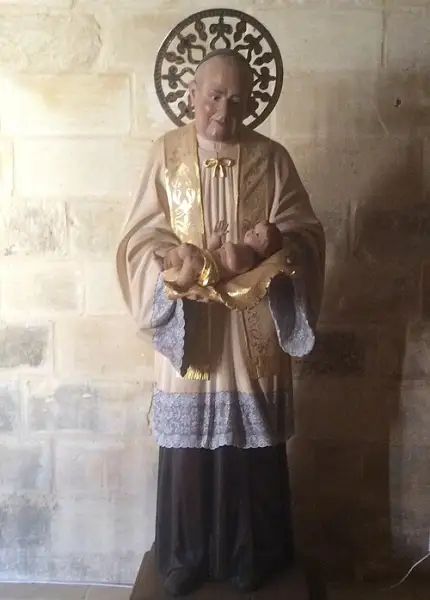
George Preca's legacy is written first in the Society of Christian Doctrine, which carried the catechism into every corner of Maltese life and, from the missions he sent to Melbourne in the 1950s, across the world; as of 2016 the movement numbered 1,200 members serving in six countries. His Mysteries of Light, composed in 1957 for his followers, entered the prayer of the universal Church in the Luminous Mysteries that John Paul II promulgated in 2002, a rare case of a local catechist's devotion shaping the Rosary of the whole Catholic world. His insistence on teaching in Maltese left a body of some 150 publications and the publishing house Veritas Press, still among the main Catholic publishers in Malta. The memory of his presence endures in bronze and stone: a statue by the sculptor Gianni Bonnici, made in Caggiati in Parma, was unveiled at the Saint Cajetan parish in Ħamrun on 17 December 2009, placed on the very spot where Preca used to hear confessions, with his relic and a sample of his blood beside it, while a portrait bust commemorates him outside St. Patrick's Cathedral in East Melbourne, Australia. Named patron of Malta and of its towns, and honored by John Paul II as Malta's second father in faith, he remains the island's great teacher of the faith.
§ Sainthood
Timeline
- 12 Feb 1880
Birth at Valletta to Vincent and Nathalie Ceravolo Preca, the seventh of their nine children.
§ Life
- 17 Feb 1880
Baptized in the Church of Our Lady of Porto Salvo.
§ Life
- 1885
Nearly drowned in the Valletta harbour before boatmen rescued him.
§ Life
- 1886
His family relocated from Valletta to Ħamrun.
§ Life
- 2 Aug 1888
Received the sacrament of Confirmation in the Parish Church of St Cajetan, Ħamrun.
§ Life
- 1897
Met his professor Father Ercole Mompalao in the Maglio Gardens, who encouraged his religious vocation.
§ Life
- 8 Apr 1905
His confessor Aloysius Galea died; Preca later recounted an appearance of Galea encouraging his priesthood.
§ Life
- 22 Dec 1906
Ordained to the priesthood by Bishop Pietro Pace, alongside thirteen others.
§ Life
- 25 Dec 1906
Celebrated his first Mass on Christmas Day at the Saint Cajetan parish church in Ħamrun.
§ Life
- Feb 1907
Held a spiritual conference at the Ta' Nuzzo church; the gatherings later moved to 6 Fra Diegu Street.
§ M.U.S.E.U.M.
- 7 Mar 1907
Founded the Society of Christian Doctrine (M.U.S.E.U.M.) at Ħamrun at its first meeting.
§ M.U.S.E.U.M.
- 1909
The Vicar General, Mgr Salvatore Grech, ordered all MUSEUM centres closed; a protest by parish priests had the order rescinded.
§ M.U.S.E.U.M.
- 1910
Received a profound religious experience at the Marsa Cross after helping a boy push a cart of manure.
§ M.U.S.E.U.M.
- 1916
Bishop Maurus Caruana opened a formal enquiry into the Society, which cleared it of any negative behaviour.
§ M.U.S.E.U.M.
- 21 Jul 1918
Admitted to the Third Order Carmelites.
§ Life
- 26 Sep 1919
Made his Carmelite profession, taking the religious name Franco.
§ Life
- 12 Apr 1932
The Society of Christian Doctrine received formal ecclesiastical recognition.
§ M.U.S.E.U.M.
- 2 Oct 1952
Named a papal privy chamberlain by Pope Pius XII, receiving the rank of Monsignor.
§ Life
- 1957
Composed five new mysteries of the Rosary, which he called the Mysteries of Light.
§ Mysteries of Light
- 26 Jul 1962
Died in the evening in Santa Venera; his funeral two days later was among the largest ever held in Malta.
§ Life
- Feb 1964
Charles Zammit Endrich was healed of a detached retina after placing one of Preca's belongings under his pillow, the miracle credited for the beatification.
§ Beatification
- 13 Mar 1975
The cause for canonization formally opened and Preca was given the title Servant of God.
§ Veneration
- 25 Feb 1976
The diocesan investigation of his cause opened in Malta.
§ Veneration
- 23 Jun 1988
The decade-long diocesan process was solemnly closed in Malta under Archbishop Joseph Mercieca.
§ Veneration
- 19 Jun 1992
The Congregation validated the diocesan process in Rome.
§ Veneration
- 28 Jun 1999
Pope John Paul II confirmed his heroic virtue and granted him the title of Venerable.
§ Veneration
- 9 May 2001
Beatified by Pope John Paul II during a visit to Malta, who called him the Second Apostle of Malta.
§ Beatification
- 3 Jun 2007
Canonized by Pope Benedict XVI in Saint Peter's Square as the second Maltese saint.
§ Sainthood
- 17 Dec 2009
A bronze statue by Gianni Bonnici was unveiled at the Saint Cajetan parish in Ħamrun, at the spot where he heard confessions.
§ Sainthood
In Their Own Words
Lend me a hand!
Malta's second father in faith
The light of the world
Magister utinam sequatur Evangelium universus mundus!
Lord God, how obliged I am to you! Thank you, Lord God, and forgive me, Lord God!
The Record
- Major works
- Society of Christian Doctrine (M.U.S.E.U.M.), founded 1907·The five Mysteries of Light for the Rosary (1957)·About 150 booklets, pamphlets and leaflets written in Maltese·Veritas Press, the Catholic publishing house he founded in the 1920s
- Patron of
- Malta·Swatar, Malta·Ħamrun, Malta·Society of Christian Doctrine catechists
- Symbols
- Priest's attire
- Canonization
- Canonized 3 June 2007, Saint Peter's Square, by Pope Benedict XVI
Prayer
Bibliography
Show 6 sources
- "Blessed George Preca (1880 - 1962) - Biography". www.vatican.va. Retrieved 2020-04-23.
- Agasso, Domenico. "Saint George Preca". Santi e Beati. Retrieved 16 January 2017.
- "The First Maltese Saint: Dun Gorg Preca – A biography". Malta Independent. Retrieved 11 September 2018.
- Caldwell, Jonathan Petre (2007-05-22). "Baby's 'miracle' recovery in British hospital to give Malta its first saint". The Daily Telegraph.
- "Remembering San Ġorġ Preca: a masterpiece of God's wisdom". Times of Malta. 22 July 2012.
- Formosa, John. "Probable Origin of the Mysteries of Light". Catholic Planet.
Profile text adapted from the Wikipedia article, licensed CC BY-SA 4.0.
Pray with this saint every day
Save St. George Preca to your favorites, read the full profile, and get feast-day reminders in the Saints app.
Get the Saints AppFree on the App Store for iPhone and iPad