
died 814·Feast April 19
St. George the Confessor
Iconodule bishop twice exiled for the holy icons
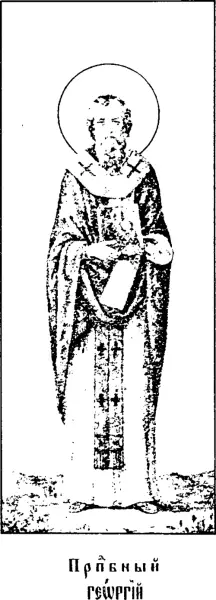
Overview
George the Confessor, also known as George of Antioch, was bishop of Antioch in Pisidia during the eighth and early ninth centuries and a steadfast defender of the veneration of icons during both waves of the iconoclast controversy. A monk in his youth, he won renown for piety before his ordination to the episcopate of the Pisidian see. In 754 he attended the iconoclast Council of Hieria at Constantinople, which outlawed the veneration of images; refusing to submit to its decrees, he was exiled by the Emperor Constantine V. He survived the persecution to see orthodoxy restored, and in 787 he took part in the Second Council of Nicaea, which reinstated the honour paid to icons. When Emperor Leo V revived iconoclasm early in his reign, George once more refused to remove the sacred images from the churches of his diocese and publicly criticized the imperial policy. The emperor banished him, and he died in exile in 814. For his endurance under two persecutions, suffering banishment rather than betray the tradition of the church, he received the title Confessor of the Faith. He is venerated in both the Eastern Orthodox Church and the Roman Catholic Church, with a common feast on 19 April.
The Complete Life
From the Monastery to the See of Pisidian Antioch
George's life in the service of the church began in the monastery. As a young man he embraced the monastic habit and gained renown for his piety, a reputation that marked him out for higher responsibility in an age when bishops were frequently drawn from the cloister. In due course he was ordained bishop of Antioch in Pisidia, the inland Anatolian city whose church reached back to the apostolic preaching of Saint Paul, and he undertook the government of that diocese in the decades when the Byzantine empire was convulsed by the first great crisis over the sacred images. His monastic formation proved decisive for the stance he would take: the defence of icons in the eighth century was led largely by monks and monastically minded bishops, who regarded the imperial campaign against images as an assault on the incarnational heart of the faith. Nothing is recorded of the details of his pastoral administration, his writings, or his conduct as diocesan bishop apart from his conduct in the iconoclast crisis, but the sources agree that his episcopate was defined by fidelity. The piety first observed in the monastery became, under pressure, the confession for which he is honoured by both the Orthodox and Catholic traditions.
§ Biography
Hieria, Exile, and Nicaea
The defining test of George's episcopate came in 754, when the iconoclast emperor Constantine V summoned the Council of Hieria at Constantinople, the assembly that formally prohibited the veneration of icons and claimed for itself the status of an ecumenical council. George attended, one of the bishops gathered under imperial pressure, but he refused to comply with its rulings. As an iconodule, committed to the honour paid to the sacred images, he would not sign away the tradition of the church, and for his refusal the emperor sent him into exile. There he remained through the remainder of Constantine V's reign and that of his son Leo IV, one of the many confessors scattered by the persecution. The turnaround came in 787, when the empress Irene convoked the Second Council of Nicaea, which repudiated Hieria and restored the veneration of icons to the life of the church. George, returning from exile, attended the council in person, adding his voice to the assembled fathers who defined the orthodox doctrine of the honour due to images. Few bishops of his generation experienced both sides of the controversy so completely: condemned by the one council, vindicated by the other, and present at the restoration of the practice for which he had suffered.
§ Biography
The Second Exile and Death in 814
The peace won at Nicaea lasted for nearly three decades, until the accession of Emperor Leo V the Armenian in 813 brought a renewal of the iconoclast policy. George, now an aged bishop who had already borne one exile for the icons, did not temper his response to the new persecution. He spoke out against the revived policy as Leo's rule began, and when the imperial policy reached his own province he once more refused to remove the icons from the churches within his diocese, defying the emperor exactly as he had defied Constantine V sixty years before. Leo V answered with the penalty familiar from the first persecution: banishment. The old confessor was sent into exile, and there he died in 814, at the very beginning of the second iconoclast period, without seeing the final restoration that would come in 843 under the empress Theodora. He thus spent the closing year of his life in the same condition in which much of his episcopate had been passed, a banished witness to the tradition of the church. For this endurance, sustained across two separate persecutions separated by a generation, the church gave him the distinctive title of Confessor of the Faith, honouring one who suffered for the faith without shedding his blood.
§ Biography
A Confessor Honoured in East and West
George the Confessor is venerated as a saint in both the Eastern Orthodox Church and the Roman Catholic Church, a shared cult that goes back to the undivided Christianity of the Byzantine world in which he lived. He received no formal process of canonization, for he belongs to the ranks of the pre-congregation saints, whose reputations for holiness were established by the verdict of the faithful and confirmed by liturgical commemoration rather than by papal or synodal decree. His designation is precise and significant: he is a Confessor rather than a martyr, the title reserved for those who suffered persecution, exile, or punishment for the faith without being put to death. In his case the title rests on two banishments, one under Constantine V after the Council of Hieria in 754 and a second under Leo V that ended with his death in exile in 814. His feast day is kept on 19 April in both traditions, recorded in the Orthodox synaxaria and in the Catholic calendars of saints. He is also known as Saint George of Antioch, from the Pisidian city of his see, and appears in the comprehensive dictionaries of the saints and in the annual commemorations of the Orthodox Church in America and the Greek Great Synaxaristes.
§ Biography
Timeline
- 754
Attended the iconoclast Council of Hieria in Constantinople and, refusing its decrees, was exiled by Emperor Constantine V.
§ Biography
- 787
Returned from exile and attended the Second Council of Nicaea, which restored the veneration of icons.
§ Biography
- 814
Died in exile, having been banished again by Emperor Leo V for resisting the second outbreak of iconoclasm.
§ Biography
The Record
- Symbols
- Bishop's vestments·Gospel book·Icon of Christ
- Canonization
- Pre-congregation; honoured as a Confessor of the Faith and venerated by the Eastern Orthodox and Roman Catholic Churches.
Prayer
Bibliography
Show 4 sources
- Watkins, Basil (2015). The Book of Saints: A Comprehensive Biographical Dictionary. Bloomsbury Publishing.
- 'St George the Confessor and Bishop of Antioch, in Pisidia'. Orthodox Church in America.
- 'Ὁ Ἅγιος Γεώργιος ὁ Ὁμολογητής Ἐπίσκοπος Πισιδίας' [in Greek]. ΜΕΓΑΣ ΣΥΝΑΞΑΡΙΣΤΗΣ.
- 'St. George of Antioch'. Catholic Online.
Profile text adapted from the Wikipedia article, licensed CC BY-SA 4.0.
Pray with this saint every day
Save St. George the Confessor to your favorites, read the full profile, and get feast-day reminders in the Saints app.
Get the Saints AppFree on the App Store for iPhone and iPad