
1009 – 1065·Feast July 10
St. George the Hagiorite
Athonite translator and defender of Georgian autocephaly
Overview
George the Hagiorite, in Georgian Giorgi Mtatsmindeli (1009 – 27 June 1065) worked as a Georgian monk, calligrapher, religious author, theologian, and translator, and he directed the Georgian monastic communities active in the Byzantine Empire. Born in Trialeti to the aristocratic family of Jacob, an envoy of King Bagrat III, he was educated in the monasteries of Tadzrisi and Khakhuli, perfected his Greek in Constantinople, and after monastic tonsure and a pilgrimage to Jerusalem settled in 1040 at the Iviron Monastery on Mount Athos, of which he became hegumen in 1044. He rebuilt Iviron into a flourishing centre of Georgian culture, translated the Fathers, the Psalms, and liturgical books from Greek, and wrote his chief original work on his Athonite predecessors John and Euthymius. His defence of the autocephaly of the Georgian church before the Patriarch of Antioch, crowned with confirmation around 1057, placed him among the saints his nation venerates most deeply. Recalled to Georgia, he reformed the church's hierarchy in preparation for the council of Ruisi-Urbnisi. More moderate than most Eastern hierarchs during the schism of 1054, he nevertheless rejected the Filioque. He died at Athens in 1065 on his way back to Athos and was buried at Iviron.
The Complete Life
A Noble Child of Trialeti
George was born around 1009 in Trialeti, a province of southern Georgia, into the aristocratic household of Jacob and his wife Mariam. His father was a man of diplomatic standing at the royal court, having served at some time as the envoy of King Bagrat III of Georgia to Iran. The family directed the boy toward the church from earliest childhood: at the age of seven he was sent to the local monastery at Tadzrisi to begin his education, and after three years he moved to another monastery, at Khakhuli, continuing the monastic schooling that would shape the rest of his life. Around 1022, still in his early teens, he was sent to Constantinople, the capital of the Byzantine Empire and the greatest centre of Christian learning of the age. There he mastered the Greek language completely and acquired a profound knowledge of Byzantine theology, the twin foundations of his later career as translator and theologian. He remained in the capital for more than a decade. In 1034 he returned to his native land, received monastic tonsure at Khakhuli, and then set out on the pilgrim road: he made a pilgrimage to Jerusalem and afterwards spent time on the Black Mountain near Antioch as the disciple of another Georgian ascetic, George the Recluse, completing his formation in the Georgian monastic diaspora.
§ Biography
Hegumen of Iviron on the Holy Mountain
In 1040 George made his home at the Iviron monastery on Mount Athos, the house whose very name, meaning 'of the Georgians', announced its national character; from this association he took the epithets by which he is known, Hagiorite or Mt'ats'mindeli, 'of the Holy Mountain', and Atoneli, 'of Athos'. Four years later Stephanos the hegumen died, and George was chosen to succeed him. Under his leadership the Iviron cloister was reorganized and refurbished and became a vibrant centre of Georgian Orthodox culture, the hub of the Georgian monastic communities scattered across the Byzantine Empire. George served as arbiter and go-between in the cultural exchange linking Georgia and Byzantium, standing at the point where the two Christian worlds met. He personally brought young Georgian compatriots to be educated at Athos, ensuring that the reforming generation of his homeland would be formed in the discipline of the Holy Mountain. His own literary labour grew from this office: he copied, translated, and revised on a prodigious scale, turning into Georgian the Fathers of the Church, the Psalter, exegetical writings, and synaxaria, including works that had never before existed in Georgian, and he improved upon the translations of his great predecessor Euthymius of Athos, to whom he later dedicated his principal original work.
§ Biography
Champion of Georgian Autocephaly
At some point in the years 1052 to 1057, George entrusted Iviron to his fellow monk George of Oltisi and set out for Antioch to answer charges brought by a group of Greek clerics against his brethren. The dispute rapidly widened into a question of first principles: whether the autocephaly enjoyed by the Georgian Orthodox church, which had been drifting toward independence from the see of Antioch since the sixth century, was canonically lawful. The difficulty had a celebrated history, for the autocephalous catholicos Melchizedek I had assumed the additional title of patriarch early in the eleventh century, while Antioch refused recognition on the ground that none of the Twelve Apostles had ever preached in Georgia. George answered with the tradition of his nation: he invoked the mission of Saint Andrew to ancient Colchis and Iberia as preserved in medieval Georgian ecclesiastical memory. His advocacy prevailed, and he persuaded Patriarch Theodosius III of Antioch to grant formal confirmation of the Georgian church's autocephalous status, a triumph that coincided with the Byzantine government's reconciliation with King Bagrat IV. Declining the king's repeated requests to head the Georgian church itself, George nevertheless accepted in 1057/8 a five-year invitation to return home, where his reforms purged the church's hierarchy and brought order to its dealings with the crown, work later ratified at the council of Ruisi-Urbnisi.
§ Biography
Orthodox Learning and a Moderate Heart
George's spiritual legacy is inseparable from his scholarship. He regarded faithful translation as an act of devotion, and his renderings of Basil of Caesarea, Gregory of Nyssa, Athanasius, John of Damascus, Nectarius, Dorotheus of Tyre, and further Fathers, together with his revised Gospel text, fixed the norms of medieval Georgian hymnography, liturgy, and hagiography. His labour carried forward, and in part corrected, the achievement of Euthymius of Athos; it stands at the summit of the literary tradition nurtured in the overseas houses of Georgian monasticism. His principal original work, the Vitae of John and Euthymius, written sometime after 1040, combines hagiography with historical record and a defence of Byzantine monasticism, its vivid rhythmic prose picturing monks at work in gardens and vineyards. In theology he was both firm and temperate. During the East–West Schism of 1054 his stance toward the Western Church was considerably softer than that of most Eastern hierarchs, and in 1064, in the presence of Emperor Constantine X, he declared that he did not consider the Latin practice of the Eucharist heretical. Yet he judged the Filioque heretical and translated into Georgian the anti-Latin writings of Photius of Constantinople, whose sanctity his hand-copied Synaxarion honoured.
§ Biography
The Last Journey and Death at Athens
When his five years of reforming labour in Georgia were complete, George set out on the road back to Mount Athos. On the way he passed through Constantinople, where he obtained an imperial decree securing the education of Georgian students at Athos, the last great service of organization he rendered to the Georgian monastic project. He did not live to deliver it. George died at Athens on 27 June 1065, short of his destination on the Holy Mountain, an aged abbot worn out by journeys between his native land, the patriarchal courts, and his monastery. The Athonite monks received his body and interred it at the Iviron monastery, the house he had governed and made glorious, where his memory was honoured in fresco and liturgy. The date of his death, given in the sources as 27 June, is fixed by the calendar of his feast, kept on 10 July in the new style. A year after his death, in 1066, his disciple George the Minor, a priest-monk who survived him by many years, repaid the debt of gratitude by writing his teacher's biography, making the translator the subject of the same kind of hagiographical tribute that he had devoted to John and Euthymius. Thus the disciple's pen completed what the master's own works had begun.
§ Biography
Saint of the Georgian Church
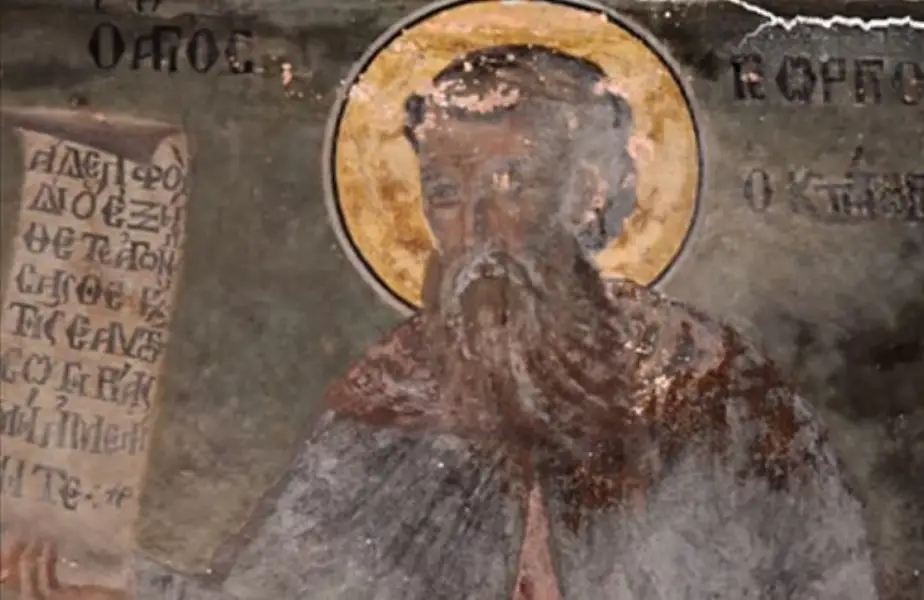
The Georgian Orthodox Church subsequently canonized George the Hagiorite, and his memory is celebrated annually on 10 July. His veneration is among the highest in his native land: the church counts him among its most influential churchmen, and his successful defence of Georgian autocephaly before the Patriarch of Antioch gave his cult a national character, for he had secured in law the independence that every Georgian believer treasured. His image survives at the place of his sanctity, in a fresco at the Iviron Monastery on Mount Athos, where his body lies buried, and the Orthodox Church in America commemorates him among the venerable fathers of June 27 as Venerable George of Mt. Athos, the Georgian. Later hagiographers preserved his life in Georgian, notably in the account by Mikhail Sabinin, which joined him to the gallery of the nation's saints. His feast on 10 July places him in the calendar of the great Athonite fathers, beside the John and Euthymius whose lives he wrote and whose literary tradition he completed. In the memory of the Georgian church he stands as monk, hegumen, translator, theologian, and diplomat, the figures of his diverse service gathered into the single honour of sainthood.
§ Biography
The Foundations of a National Church Culture
The influence of George's legacy on Georgian religious tradition was immense. His translations and original compositions fixed the norms of medieval Georgian hymnography, liturgy, and hagiography, and his revised text of the Gospels corrected and perfected the scriptural text of his nation. Modern scholars rank his accomplishment as the summit of the literary tradition nurtured in the overseas houses of Georgian monasticism, one that carried forward and partly corrected the earlier work of Euthymius. Beyond letters, what George and his fellow Athonite Georgians did supplied the ground plan for the essential norms of Christian practice and moral living, and for the right ordering of royal power and church, norms afterwards championed and formally enacted when the national ecclesiastical council of Ruisi-Urbnisi met in 1103 with King David IV presiding. The autocephaly he defended at Antioch remained the constitutional bedrock of Georgian Christianity. His biography by his disciple George the Minor became itself a monument of Georgian literature, and his Vitae of John and Euthymius endures as both a history of the Iviron community and a masterpiece of graphic, rhythmic prose. Historians of the Georgian language, of the New Testament versions, and of the Athonite commonwealth alike place him among the formative figures of medieval Orthodoxy.
§ Legacy
Timeline
- 1009
Born at Trialeti in southern Georgia into the aristocratic family of Jacob and Mariam.
§ Biography
- 1022
Sent to Constantinople, where he perfected his Greek and acquired a profound grounding in Byzantine theology.
§ Biography
- 1034
Returned to Georgia, received monastic tonsure at Khakhuli, and made a pilgrimage to Jerusalem.
§ Biography
- 1040
Established himself at the Iviron Monastery of Georgian monks on Mount Athos.
§ Biography
- 1044
Consecrated hegumen of Iviron upon the death of his predecessor Stephanos, and set about reorganizing the monastery.
§ Biography
- 1052
Left George of Oltisi in charge of Iviron and travelled to Antioch to defend his brethren against charges of heresy.
§ Biography
- 1054
During the East–West Schism he took a notably moderate position toward the Western Church.
§ Biography
- 1057
Having secured confirmation of Georgian autocephaly, he accepted King Bagrat IV's invitation and returned to Georgia for five years of church reform.
§ Biography
- 1064
Stated before Emperor Constantine X that the Latin manner of celebrating the Eucharist was, in his view, not heretical.
§ Biography
- 27 Jun 1065
Died at Athens without reaching Mount Athos; the Athonite monks interred him at the Iviron monastery.
§ Biography
- 1066
His disciple George the Minor, a priest-monk, wrote a hagiographic biography of him a year after his death.
§ Legacy
The Record
- Major works
- The Vitae of Our Blessed Fathers John and Euthymius·Updated translation of the Gospels into Georgian·Georgian translations of Basil of Caesarea, Gregory of Nyssa, Athanasius, John of Damascus, Nectarius of Constantinople, and Dorotheus of Tyre·Georgian translations of the anti-Latin works of Photius I of Constantinople·Hand-copied Synaxarion honouring Photius as a saint
- Patron of
- Georgia·Mount Athos
- Symbols
- Monastic habit·Fresco at the Iviron Monastery·Gospel book and scroll
- Canonization
- Canonized by the Georgian Orthodox Church; remembered annually on July 10.
Prayer
Bibliography
Show 7 sources
- Speake, Graham (2018-06-07). A History of the Athonite Commonwealth: The Spiritual and Cultural Diaspora of Mount Athos. Cambridge University Press. p. 59. ISBN 9781108425865.
- Kekelidze, Korneli (1951). History of Old Georgian Literature. Vol. 1. Tbilisi. p. 202.
- Rayfield, Donald (2000). The Literature of Georgia: A History. Routledge. pp. 54–55. ISBN 0-7007-1163-5.
- Mikaberidze, Alexander (2007). 'Giorgi Atoneli'. Dictionary of Georgian National Biography.
- Metzger, Bruce Manning (1977). The Early Versions of the New Testament: Their Origin, Transmission, and Limitations. Oxford University Press. p. 198. ISBN 0-19-826170-5.
- Martin-Hisard, Bernadette (2000). In: Vauchez, André; Dobson, Richard Barrie; Lapidge, Michael (eds.). Encyclopedia of the Middle Ages. Routledge. p. 596. ISBN 1-57958-282-6.
- 'Lives of all saints commemorated on June 27: Venerable George of Mt. Athos, Georgian'. Orthodox Church in America.
Profile text adapted from the Wikipedia article, licensed CC BY-SA 4.0.
Pray with this saint every day
Save St. George the Hagiorite to your favorites, read the full profile, and get feast-day reminders in the Saints app.
Get the Saints AppFree on the App Store for iPhone and iPad