
c. 776 – 821·Feast April 7
St. George the Standard-Bearer
Archbishop of Mytilene, Confessor of the Icons
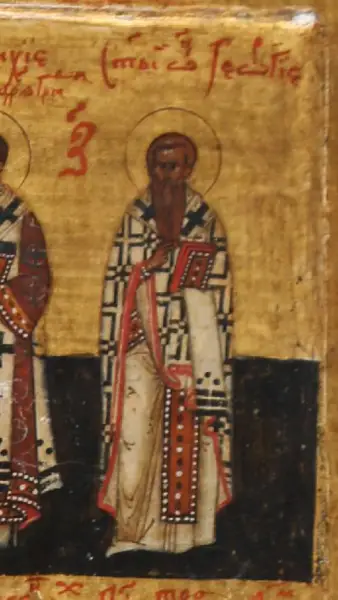
Overview
George the Standard-Bearer — in Greek Hosios Georgios ho Simeioforos, also honoured as George the Confessor — led the church of Mytilene on Lesbos at the moment the Byzantine world split over the veneration of icons. Born around 776 into a prosperous family on the Anatolian coast facing Lesbos, he gave away his inheritance when his parents died, entered monastic life at eighteen, and later settled on Lesbos as a hermit. His reputation for holiness was such that when the island's bishop died the people chose George to succeed him, and he was ordained Archbishop of Mytilene in 804. In 815, when Emperor Leo V revived iconoclasm and turned on the image-venerators, George joined Patriarch Nikephoros and other bishops in pleading with the emperor to halt the persecution. His forthrightness cost him dearly: he was flogged with a hundred lashes and banished to a barren island in the Sea of Marmara, while an iconoclast prelate took his see. Six years of exile followed, marked by severe asceticism, a stream of pilgrims seeking his counsel, and miracles of healing that earned him the name simeiophoros — standard-bearer, or wonder worker. He died on 7 April 821, and a radiant star was said to hang over Mytilene that night.
The Complete Life
A Son of the Anatolian Coast
George was born around 776 into a family of substance living on the coastal plain of Anatolia, directly across the strait from the island of Lesbos. Little survives of his childhood beyond the fact that his parents died while he was still young. Their death became the turning point of his life: instead of administering the estate he inherited, he disposed of it entirely, distributing the proceeds among the poor. The gesture was more than generosity; it was a deliberate renunciation of the worldly path his birth had prepared for him. At the age of eighteen he entered a monastery in his home region, where he spent two years learning the disciplines of common prayer, obedience, and manual work. Two years of cenobitic life were enough to form him, but they did not satisfy the hunger that had driven him from his inheritance. He left for Lesbos, the island his family's land had faced across the water, and there took up the harsher, solitary calling of an ascetic. It was on Lesbos, in prayer and self-denial, that the reputation for holiness began to gather around his name — a reputation that would soon draw the whole island to him.
§ Biography
Chosen by the People of Lesbos
George's move from monastic obedience to solitary asceticism on Lesbos proved decisive for the island church. He gained renown for his piety among the Lesbians, who watched his manner of life and came to trust his judgment and his prayers. When the bishop of the island died, no external candidate was imposed and no imperial official intervened: the Christian people of Lesbos themselves chose George to succeed their shepherd. He was ordained Archbishop of Mytilene in 804, taking charge of a see whose cathedral stood in the island's principal town. The elevation of a hermit to the episcopate was a recognition that the holiness formed in the desert was meant for service, not concealment. As archbishop he bore responsibility for the clergy and faithful of Lesbos, and the choice of a man of proven ascetic discipline signalled what the island valued in its bishops. Yet George never regarded the honour as his own achievement; it came to him unsought, from the voice of the people he had served quietly. For nearly a decade he governed the church of Mytilene in peace, before the storm of imperial politics broke over the entire icon-venerating East.
§ Biography
Petitioning the Emperor
In 813, during the reign of Emperor Michael I, George travelled to Constantinople to settle ecclesiastical cases, and the Patriarch, Nikephoros, asked him to remain in the capital for two further years. That extended stay placed him at the centre of events when Michael's successor, Leo V, took the throne. At the onset of the new reign Leo restored iconoclasm, the imperial doctrine that religious images must be destroyed, and began to persecute the iconodules who defended them. George stood with the besieged Patriarch and the other confessors of the icons. In 815 he joined the delegation that approached the emperor to petition for an end to the persecution. George was forthright in his criticism of Leo V — he did not flatter, hedge, or ask for an accommodation. The emperor answered with the lash: a hundred stripes, and banishment to a waterless island in the Sea of Marmara. As a final insult he installed an iconoclast called Leo in George's place at Mytilene. George had lost his see, his city, and his freedom, but he had kept the confession that mattered, and the church would remember him as a confessor rather than as a deposed bishop.
§ Biography
Wonder Worker in Exile
The barren island of exile became, under his hands, a place of astonishing fruitfulness. George practised the same severe asceticism he had known on Lesbos, surviving on wild greens gathered from the treeless ground. Word of his presence spread, and Christians began making the journey to the island to confess their sins, listen to his teaching, and ask for healing. Several miracles were attributed to him during these years: a man possessed by a demon was delivered, a deaf person recovered hearing, a blind person recovered sight, and others were healed besides. These wonders gave rise to the name by which history knows him — simeiophoros, rendered as standard-bearer or wonder worker in Greek. For six years he sustained this hidden ministry until his death on 7 April 821, and he was buried on the island of his banishment, the place his enemies had chosen as an erasure becoming instead the site of his tomb. One last sign was told of his death: a bright star was said to shine over the city of Mytilene at that hour, as if the island he had shepherded were keeping vigil for the shepherd torn from it.
§ Biography
Return of the Saint's Relics
George's vindication came with the end of iconoclasm. In 846–847, once the empire had returned to the veneration of the holy icons, his remains were brought from the barren island to Lesbos itself and buried at a place known as Tria Kyparissia, near the chapel of St John the Baptist. The translation reunited the confessor with the flock that had chosen him, and his tomb became a centre of local devotion. A further gesture of honour came later: in the eighteenth century George's right hand was moved to Mytilene, the episcopal city from which he had been driven by imperial force nearly nine hundred years earlier. In the Eastern Orthodox Church his feast is kept on 7 April, the anniversary of his death, and he is remembered under both of his titles — George the Standard-Bearer, for the wonder-working name the exiles gave him, and George the Confessor, for the faith he defended at the price of a hundred lashes and six years of banishment. His story stands with those of the iconodule confessors whose endurance, not arms, brought the second iconoclasm to an end.
§ Biography
Timeline
- 776
Born into a wealthy family on the Anatolian coast facing the island of Lesbos
§ Biography
- 804
Ordained Archbishop of Mytilene after the people of Lesbos chose him to succeed their late bishop
§ Biography
- 813
Travels to Constantinople to settle cases under Emperor Michael I and remains two further years at Patriarch Nikephoros's request
§ Biography
- 815
Confronts Leo V over his persecution of the icon-venerators; the emperor has him given a hundred lashes and shipped to a barren island in the Sea of Marmara
§ Biography
- 7 Apr 821
Dies after six years of exile and is buried on the island where he had been banished
§ Biography
- 846
Remains are translated to Lesbos and buried at Tria Kyparissia near the chapel of St John the Baptist, once iconoclasm has ended
§ Biography
The Record
- Major works
- Episcopal ministry and preaching at Mytilene·Teaching and spiritual counsel to pilgrims during his island exile
- Patron of
- Venerated as a model confessor of the holy icons in the Eastern Orthodox Church
- Symbols
- Archbishop's omophorion·Star (said to have shone over Mytilene at his death)·Book of the Gospels
- Canonization
- Pre-congregation; venerated as a saint and confessor in the Eastern Orthodox Church from the centuries after his death
Prayer
Bibliography
Show 3 sources
- Great Synaxaristes: (in Greek) Ὁ Ἅγιος Γεώργιος ὁ Σημειοφόρος Ἐπίσκοπος Μυτιλήνης.
- St. George the Confessor the Bishop of Mytilene. OCA – Lives of the Saints.
- Saint George, Bishop of Mytilene (+ 821). Mystagogy Resource Centre
Profile text adapted from the Wikipedia article, licensed CC BY-SA 4.0.
Pray with this saint every day
Save St. George the Standard-Bearer to your favorites, read the full profile, and get feast-day reminders in the Saints app.
Get the Saints AppFree on the App Store for iPhone and iPad