
6th century·Feast August 10
St. Geraint
Saint King of Dumnonia and Host of St Teilo
Overview
Geraint is remembered through several strands of early British tradition, from heroic poetry and saints' lives to medieval romance. His name is the Welsh form of the Latin Gerontius, meaning old man, and it belongs at once to a saintly king of the Britons, to warriors celebrated in the oldest Welsh poetry, and to the valiant hero of Arthurian romance. He is identified in Briton hagiography as a sixth-century saintly king of Dumnonia, living perhaps in the age of the historical Arthur or a little before it. In the vita of Saint Teilo he appears at his finest: in 549, as the Plague of Justinian swept Britain, Teilo and his monks fled Llandaff for Brittany and found a generous welcome at Din Gerrein from King Geraint. In return Teilo pledged the monarch his aid when death drew near, and seven years on he came back to give Geraint the final sacraments — a service for which, the vita says, the king was proclaimed holy. Around his memory gathered older verse: he is the Geraint of the South who fights at Catraeth in the Gododdin, numbered among the Three Seafarers of the Isle of Britain by the Welsh Triads, and mourned as the fallen champion of the Llongborth elegy. As Sir Geraint he later rode through the romances of Geraint and Enid and Tennyson's Idylls of the King, while in Cornwall he is honoured as the folk-saint king of Gerrans, with a feast on 10 August.
The Complete Life
Son of Erbin, Name of an Old Man
Geraint's name is the Welsh form of the Latin Gerontius and means old man, yet the figure who bears it belongs to the youngest stratum of British memory, the age of Arthur. Welsh folklore and Arthurian legend describe him as a valiant warrior, perhaps kinsman to the historical king Geraint of Dumnonia who died in the early eighth century, and know his name also as that of a sixth-century saintly Dumnonian ruler, a figure of the Arthurian age itself or of the years just before it. His lineage is fixed in the tradition: he is the son of Erbin of Dumnonia, the fifth-century king, and in the tale Geraint and Enid his father is said to be a shepherd named Erbin, a humbler figure for a romance setting. The Old Welsh tale Culhwch and Olwen gives him two brothers, Ermind and Dywel. Behind the family stands a shifting geography: scholars note that Strathclyde, also called Damnonia after the Dumnonii tribe, had rulers named Geraint and Erbin in the same era and is easily confused with Dumnonia in Devon. Whatever the precise homeland, the tradition is unanimous in placing Geraint among the British kings who faced the Saxon advance from the southwest.
§ Arthurian legend
The Warrior in the Old Poetry
The oldest layer of Geraint's memory is martial. A Geraint of the South stands in the ranks at Catraeth around the year 600, as the Gododdin of Aneirin records — possibly a pointer to Geraint mab Erbin, whose father Erbin ruled Dumnonia in the fifth century. The Welsh Triads list him among the Three Seafarers of the Isle of Britain, a curious title for a landlocked king and one that hints at voyaging traditions later attached to the south-western peninsula. The old elegy on Geraint son of Erbin — its composition usually placed in the tenth or eleventh century, with Llywarch Hen named as its traditional author — sings his exploits at Llongborth. Scholars have long tried to fix the reality behind the verse: Derek Bryce, following others, suggests that the later historical Geraint of Dumnonia, who died in 710, may be the real warrior eulogised in the poem, identifying Llongborth with that king's battle against the Saxon leader Ine of Wessex. The Anglo-Saxon Chronicle's entry about Portsmouth — recording the slaying of a young Welshman, a very noble man — is read by scholars as the same event, and as Geraint's death. Hero of one name or several, the figure in the poetry fell fighting the invaders of his people.
§ Early sources
Teilo's Host, Teilo's Penitent
The saint of the calendars emerges from the vita of Saint Teilo, in a story of hospitality repaid with holiness. In 549, to escape the Plague of Justinian then sweeping through Britain, Teilo left Llandaff with a small company of monks intending to join Samson of Dol in Brittany. Passing through Dumnonia, the fugitives were received hospitably by King Geraint at Din Gerrein, his stronghold. The king gave them shelter in the season when the plague was emptying Britain of its people. Teilo pledged that when the king's last hour came he would stand beside him in spirit; seven years on, the bishop duly came back and administered the final rites. Because of the relationship that bound him to Teilo, the vita records, Geraint too was proclaimed holy. The canonisation is thus of the oldest and most personal kind: not a decree but a debt of love between a wandering bishop and the king who sheltered him. The plague was known in Italy as the yellow pestilence of 547, and Geraint's glorification falls squarely within that first great demographic catastrophe of the British middle ages.
§ Saint Geraint
From Din Gerrein to Camelot
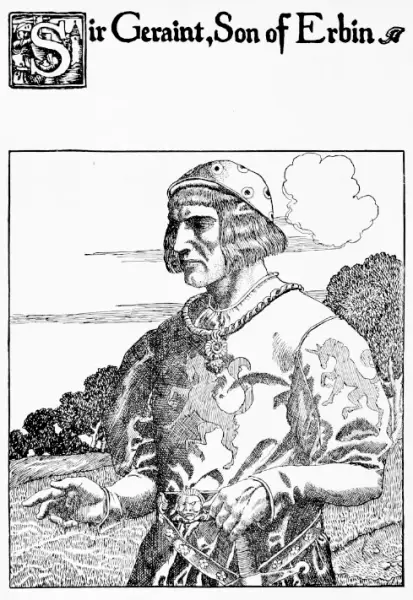
Geraint's afterlife is one of the richest of any British saint king. In Cornwall, near Falmouth, local legend knows him as King Geraint, patron saint of Gerrans, and claims his burial on Carne Beacon near Veryan; the parish of Gerrans keeps his festival on the second Sunday of August, while his feast day is 10 August. In literature he traveled further than any relic. He is the hero of Geraint and Enid, counted among the three Welsh Romances of the Mabinogion — the story of how he won and all but lost Enid his bride. Its plot runs close to Chrétien de Troyes's Erec and Enide, and the scholarly majority holds that the Welsh telling depends on the French poet directly or otherwise, the celebrated Geraint having been drafted in for readers who had never heard of Erec. Alfred Tennyson recast the story in The Marriage of Geraint and Geraint and Enid in his Idylls of the King, published in 1868, and the Howard Pyle illustrations of 1910 carried Sir Geraint into the modern picture-book Middle Ages. A king of the Saxon wars became a knight of the Round Table; a host of a plague-fugitive bishop became a saint of the Cornish coast.
§ Arthurian legend
Timeline
- 549
Welcomed St Teilo and his monkish fugitives from the Plague of Justinian at Din Gerrein in Dumnonia.
§ Saint Geraint
- 556
Teilo came back seven years after their first meeting and administered the last rites he had pledged to the king.
§ Saint Geraint
- 600
A Geraint of the South, possibly Geraint mab Erbin, fights at the Battle of Catraeth in the poem Y Gododdin.
§ Early sources
- 710
Scholars link the Battle of Llongborth, where Geraint of Dumnonia fought Ine of Wessex, with the warrior of the Llongborth elegy.
§ Early sources
- 1868
Tennyson's Idylls of the King, dated to this year in the article, recast the tale as The Marriage of Geraint and Geraint and Enid.
§ Arthurian legend
The Record
- Major works
- Hero of the Middle Welsh romance Geraint and Enid, one of the three Welsh Romances of the Mabinogion·Subject of the early Welsh poem Geraint son of Erbin, on the Battle of Llongborth
- Patron of
- Gerrans, Cornwall (local folk-saint and patron of the parish)
- Symbols
- King's crown·Ship (one of the Three Seafarers of the Isle of Britain)
- Canonization
- Pre-congregation; according to the vita of Saint Teilo he was proclaimed holy on account of his bond with Teilo, who gave him his last rites
Prayer
Bibliography
Show 6 sources
- Bollard, John K. (1994). "Arthur in the Early Welsh Tradition". The Romance of Arthur: An Anthology of Medieval Texts in Translation. Routledge. pp. 14–15.
- "Elegy for Geraint", Britannia.com. Archived from the original on 21 November 2021. Retrieved 12 June 2018.
- "BBC Wales - History - Themes - Geraint and Enid". www.bbc.co.uk. Retrieved 5 January 2020.
- Lupack, Alan. "Enid and Geraint/Erec", The Camelot Project, University of Rochester. Archived from the original on 21 November 2021. Retrieved 12 June 2018.
- Salsano, Mario. "San Geraint II King of Cornwall", Santi e Beati, June 11, 2008
- "Porthscatho & Gerrans Bay", South West Coast Path National Trail. Archived from the original on 19 October 2021. Retrieved 19 October 2021.
Profile text adapted from the Wikipedia article, licensed CC BY-SA 4.0.
Pray with this saint every day
Save St. Geraint to your favorites, read the full profile, and get feast-day reminders in the Saints app.
Get the Saints AppFree on the App Store for iPhone and iPad