
c. 855 – c. 909·Feast October 13
St. Gerald of Aurillac
Celibate Count of Aurillac, Lay Confessor of Auvergne
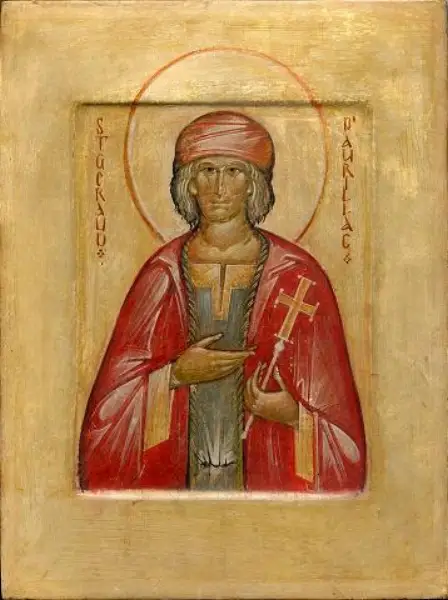
Overview
Gerald of Aurillac, born around 855 and dead by about 909, is the rare aristocrat whom the medieval church canonised precisely for remaining in the world. Born into Gallo-Roman nobility of the Auvergne — he counted Cesarius of Arles among his forebears and was related to Robert de Turlande — he succeeded to his father's estates and in later life assumed the title Count of Aurillac, a dignity that, as the scholarship notes, belonged to no one before or after him. Almost everything known of him comes from the Life of St. Gerald of Aurillac written by Odo of Cluny around 930–931, two decades after the saint's death. From Odo we learn of a sickly, bookish boy whose childhood illness advanced his reading, of the duke of Aquitaine's failed attempt to bind him to himself rather than the distant king at Paris, and of a layman who took seriously the counsels of perfection: persuaded by Bishop Geusbert of Rodez that he could do more good as a layman than in a monastery, Gerald took a secret tonsure under his habitual cap, consecrated his life to God, gave away his possessions, vowed chastity, and prayed the breviary daily. On his own estate at Aurillac rose the church and abbey where he now lies buried, having died on a Friday — 13 October, most likely of 909. Counts and bachelors, the disabled, and all Upper Auvergne claim him as patron.
The Complete Life
A Sickly Boy of the Auvergne Nobility
Gerald was born around 855 into the Gallo-Roman aristocracy of the Auvergne, a family ancient enough to count Cesarius of Arles among its forebears and connected by kinship to Robert de Turlande. The estates of Aurillac came to him from his father, and here scholars find a point of significance: the title Count of Aurillac was not his father's, and Gerald himself assumed it only in later life. Sitwell notes that Aurillac knew no count before Gerald and has known none since; his comital dignity was a personal creation, not an inherited office. His childhood was marked by illness of unusual duration. Odo of Cluny, our only substantial witness, reports that the boy suffered an affliction of the skin — probably acne — that lasted so long his parents despaired of a cure and set him to his books, reasoning that a son unfit for the pursuit of arms and the world might be fitted for the ecclesiastical state. The remedy shaped the man: Gerald became a reader in an age when nobles rarely were. Blindness came upon him in his closing years, so that frailty bookended his career and, in his developing cult, became one of the keys to his patronage.
§ Life
A Tonsure Under the Cap
Gerald seriously considered joining a religious order, and the decision was argued out of him by a friend: Geusbert, Bishop of Rodez, persuaded him that a man of his standing could serve God's purposes better in the world as a layman than within any cloister. The counsel was unusual, and Gerald answered it with an arrangement of equal unusualness. Secretly tonsured beneath the cap he habitually wore, he consecrated his life to God while keeping his place in secular society. The substance of that hidden consecration can be enumerated: he surrendered his goods, bound himself by a private vow of chastity, and recited the breviary daily — an office proper to clergy, kept by a man who never entered orders. He had recently assumed the title of count, and contemporaries might have expected him to convert his lands into dynastic power; instead his chief foundation was spiritual. On his estate of Aurillac he built a church and an abbey, the institution that would carry his name and memory long after his line had ended. The pattern — a celibate, property-renouncing aristocrat governing his lands as a trust — is what made Gerald a category that the tradition had to invent: the saintly lay count.
§ Life
Resistance to the Duke of Aquitaine
Odo of Cluny, writing around 930–931, some twenty years after Gerald's death, preserved the one political drama the tradition records. William, duke of Aquitaine, pressed Gerald to give up the militia regia — the king's own feudal service — and transfer his homage to the duke, a request Odo says was made for the sake of love. Gerald would not. He had only lately taken the title of count, and he chose to reserve his fealty for the distant sovereign in Paris, Charles the Simple, whose effective rule at the monarchy's lowest ebb scarcely passed that city's walls. Georges Duby notes that the episode illuminates the process by which political institutions, at their weakest point in this era, were locally reinvigorated: a magnate's choice of liege was itself an act of state-building. For Gerald the matter was at once constitutional and spiritual, a refusal to let the duke's claim of affection reorganise his obligations. The quiet stand of a sickly count in the Auvergne became, in Odo's telling, a model of the Christian noble's freedom: bound to his king, bound to his God, and free from every lord who asked for more.
§ Life
Death on a Friday in October
Gerald died at Cezeinac — also written Cézerniac — the name of a locality that cannot now be certainly identified, though scholars propose either Cézens or Saint-Cirgues in the region. The day is remembered precisely: a Friday, 13 October, probably in the year 909. The coincidence of a Friday and the thirteenth of the month attached itself affectionately to the memory of a man whose whole life had been spent quietly inverting expectations. From his place of death his body was carried back to the church and abbey he had founded on his estate at Aurillac, and there he was buried — the founder at rest in the foundation. His memorial feast was fixed on 13 October, the day of his death. In his last years and after, his poor health and blindness were remembered and emphasised — indeed, the developing cult gave more weight to these afflictions than Odo's Life had done. From that emphasis came a second and third patronage: the celibate count became the recourse of the disabled, the handicapped, and the physically challenged, who found in his endurance of bodily failure a saint who understood them.
§ Life
The Saint Whom Odo of Cluny Made Known
Gerald's veneration rests on a single act of early tenth-century verification: Odo of Cluny, second abbot of that house and a leading reformer of the age, examined and validated the Auvergne devotion. Odo not only wrote the Life between about 930 and 931; to that endorsement is credited the spread of Gerald's cult beyond his own region. Two Latin versions of Odo's Life survive, edited by Poncelet in 1895, and the modern English translation by G. Sitwell appeared in 1958 — a slender textual base, but one whose reliability the scholarly literature has weighed carefully in annotated notes. The Church found in Gerald the exemplar of the celibate Christian aristocrat, and his patronages follow the shape of his life: counts, who imitated his just stewardship; bachelors, who shared his unmarried state; the disabled, who claimed his compassion won through suffering; and Upper Auvergne, the land of his estates and his abbey. He is honoured on 13 October by the Catholic Church and recognised as well by other Christian denominations, an aristocrat who was canonised by the affection of the poor.
§ Life
Timeline
- 855
Born into the Gallo-Roman nobility at Aurillac, counting Cesarius of Arles among his forebears
§ Life
- 13 Oct 909
Dies on a Friday at Cezeinac, an uncertainly identified locality, probably this year, and is buried in the abbey he founded at Aurillac
§ Life
- 930
Odo of Cluny writes the Life of St. Gerald of Aurillac, about twenty years after the saint's death, and his validation of the local cult establishes Gerald's wider veneration
§ Life
In Their Own Words
And for a long time he was covered with small pimples that it was not thought that he could be cured. For this reason his father and mother decided that he should be put more closely to the study of letters, so that if he should prove unsuited for worldly pursuits he might be fitted for the ecclesiastical state.
The Record
- Major works
- Church and abbey founded on his estate at Aurillac
- Patron of
- Bachelors·Counts·Disabled and physically challenged people·Upper Auvergne
- Canonization
- Pre-congregation; his local cult was validated by Odo of Cluny, and that endorsement established his wider veneration
Prayer
Bibliography
Show 6 sources
- Dates in Sitwell 1958:94 note 2
- According to Odo of Cluny, (Sitwell 1958:90) noted in Derek Baker, "'Vir dei'", in G. J. Cuming and Derek Baker, eds. Popular Belief and Practice: papers read at the ninth summer meeting (Ecclesiastical History Society) 1972:43 note 8.
- Sitwell points out there was no count of Aurillac before or after him. (Sitwell 1958:122); Odo's favore comitis nuper usurpato "could bear a stronger translation", Baker notes (Baker 1972:44 note 3).
- G. Sitwell, tr. in St Odo of Cluny, 1958:90–180; there are two Latin versions of Odo's Life: A. Poncelet, "La plus ancienne 'Vie de Saint Géraud", Ann. Bolandist, 14 (1895:83–105).
- Georges Duby, France in the Middle Ages 987–1460, 1993:28
- "Saint Géraud d'Aurillac". nominis.cef.fr. Retrieved 2020-11-09.
Profile text adapted from the Wikipedia article, licensed CC BY-SA 4.0.
Pray with this saint every day
Save St. Gerald of Aurillac to your favorites, read the full profile, and get feast-day reminders in the Saints app.
Get the Saints AppFree on the App Store for iPhone and iPad