
died 1109·Feast December 5
St. Gerald of Braga
Benedictine Reformer and Bishop of Braga
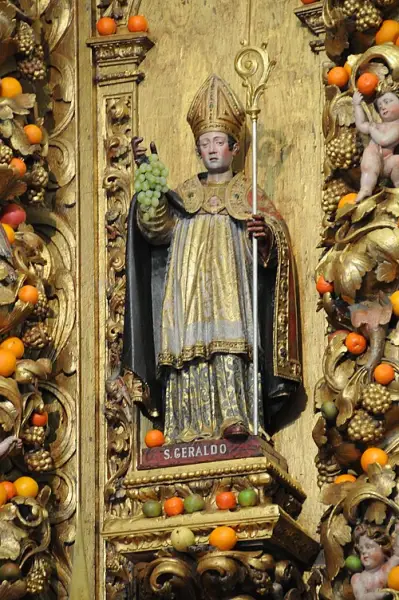
Overview
Gerald of Braga rose from the abbey of Moissac to the episcopal see of Braga in Portugal. Born in Cahors in Gascony, he became a Benedictine monk at Moissac, one of the great reformed abbeys of the age. His musical gift redirected his life: Archbishop Bernhard of Toledo, himself a Cluniac monk, admired the liturgical singing of the monastery and asked Gerald to come to Spain and renew the liturgical music of Toledo, where Gerald served as the cathedral's choir director. From Toledo he was called north to Braga, and in 1100 he became Bishop of Braga in Portugal, at the moment when the county's rise toward independence demanded a reformed and disciplined local church. In office he abolished the custom by which laymen conferred church appointments within his diocese — a local application of the great reform program that reserved the Church's offices to the Church — and he baptised Afonso Henriques, the future Afonso I, first king of Portugal. Gerald died on 5 December 1109 at Bornes in Vila Pouca de Aguiar, in the Kingdom of Galicia, and was buried in Braga Cathedral. His companion and fellow Cluniac, a French monk named Bernard, wrote his Vita Sancti Geraldi, the source of what is known of him. The Roman Catholic Church keeps his feast on 5 December, the day of his death.
The Complete Life
From Cahors to Moissac
Gerald was born in Cahors, in Gascony, in the Kingdom of France, and while still a young man he entered the Benedictine monastery of Moissac, taking the habit in one of the most celebrated reformed houses of southern France. The record of his early life is brief, but the essentials are clear: a south-French upbringing and a Cluniac formation that would decide everything about his later course. Moissac belonged to the world of monastic renewal associated with Cluny, where the liturgy was performed with unparalleled splendour and monastic discipline was strict, and its chant was reckoned among the glories of the order. It was precisely this formation — monk, musician, reformer — that the Spanish church would shortly find itself needing as the reconquered lands were reorganised around reformed sees. Among those who knew the young monk was Bernhard, himself a Cluniac, who would rise to the archbishopric of Toledo; the two men's paths, joined in the cloister of Moissac, would meet again across the Pyrenees. Everything Gerald later accomplished in Iberia — the renewal of Toledo's music, the discipline of Braga, the baptism of a king — flowed from the monastic culture in which he was schooled as a young Benedictine at Moissac.
§ Gerald of Braga
Choir Director of Toledo
The turn in Gerald's life came through another man's ears. Archbishop Bernhard of Toledo, himself a Cluniac monk, knew the monastery of Moissac and admired the liturgical singing there. Toledo, the ancient Visigothic capital newly recovered from Islam and now the seat of the primatial see of Spain, needed exactly what Moissac possessed — a reformed, ordered, beautiful liturgy that could root the Roman observance in freshly recovered ground. Bernhard asked Gerald to come to Spain and renew the liturgical music of his cathedral, and Gerald accepted, taking up service as the cathedral's choir director. The assignment looks modest and was in fact strategic: in the twelfth-century reform movement, the liturgy was the primary instrument by which Roman and Cluniac practice was implanted in reconquered lands, and the choir was its workshop. Under Gerald the singing of Toledo's cathedral became a model for the province, and the director of that singing became a known quantity to the reformers who staffed the new episcopates of the peninsula. No dates survive for this Toledan period, but its fruit is visible in what followed: a monk formed at Moissac and proven at Toledo was exactly the candidate the reforming party would trust with a frontier diocese in Portugal.
§ Gerald of Braga
Bishop of Braga and Baptiser of a King
In 1100 Gerald became Bishop of Braga, the historic metropolitan see of the lands that were becoming Portugal, and his episcopate fell in the formative years of Portuguese history. Two deeds stand out. First, he put a stop to lay investiture throughout his diocese, refusing to let nobles and lords hand church offices to their own clients as though the government of souls could be bought and sold — thus bringing Braga into line with the great reform program that reserved the Church's appointments to the Church itself. In a frontier diocese hemmed in by powerful noble families, the reform required both courage and firmness, and it marked Gerald as a bishop of the strict observance. Second, he baptised Afonso Henriques, the future Afonso I of Portugal, the count's son who would win his independence on the field and reign as the first king of the Portuguese nation. The significance of the scene is hard to overstate: the Cluniac bishop from Cahors stood godfather, in the sacramental sense, to the royal house that would carry the Portuguese church through the centuries. Gerald's Braga thus stands at the beginning of both the Portuguese nation and its particular ecclesial tradition.
§ Gerald of Braga
Death at Bornes and Burial in Braga
Gerald died on 5 December 1109 at Bornes, in the lands of Vila Pouca de Aguiar, in the Kingdom of Galicia to which the region then belonged. Of his death only the place is known — a village in the Portuguese interior, far from the cathedral city he governed — and its date, which the church fixed as his feast. He had served Braga for roughly a decade, years that spanned the first struggles of the Portuguese county for its identity and the reforming programme's hardest battles against lay control of churches. His body was brought back to Braga and buried in Braga Cathedral, the church of which he had been the chief shepherd. There, among the prelates of the oldest Portuguese see, the Cluniac from Cahors found his resting place. The brevity of the record is typical of a twelfth-century frontier bishop, but the essentials of a holy death are present: he died in office, was buried in his own cathedral, and was honoured immediately by the community he had served. Within a generation his companion Bernard had written his Life, ensuring that the memory of the reforming bishop would not depend on gravestones alone.
§ Gerald of Braga
The Vita Sancti Geraldi
The written memory of Gerald rests on a single work: the Vita Sancti Geraldi, composed by one Bernard, a companion of the saint and a fellow Cluniac monk from France. A companion's vita is testimony of the most intimate kind, drawn from shared table, shared journey, and shared reforming labours, and it is through Bernard's loyalty that Gerald's cult survived at all — without it, a French bishop dead in a Galician village would have left scarcely a trace. The modern study of this text — Stephen Lay's essay on sanctity and social alienation in twelfth-century Braga — points to what makes the work historically interesting: it portrays the holy bishop from within the social world of the reformed church, with its tensions between Cluniac outsiders and the local society they were sent to reform, and it shows how sanctity was argued in a community that experienced its bishop as a stranger. The Roman Catholic Church keeps his memory on 5 December, the anniversary of his death, and he is counted among the saintly bishops of Braga, the city whose cathedral holds his tomb and whose earliest national history is inseparable from his ministry.
§ Gerald of Braga
Timeline
- 1100
Becomes Bishop of Braga in Portugal and abolishes lay investiture in his diocese
§ Gerald of Braga
- 5 Dec 1109
Dies at Bornes in Vila Pouca de Aguiar and is buried in Braga Cathedral
§ Gerald of Braga
The Record
- Major works
- Renewal of the liturgical music of Toledo as cathedral choir director·Reform of the diocese of Braga, ending ecclesiastical investiture by laypeople
- Patron of
- Diocese of Braga
- Symbols
- Bishop's crozier
- Canonization
- Pre-congregation; venerated as a saint in the Roman Catholic Church, his cult attested by the Vita Sancti Geraldi written by his companion Bernard
Prayer
Bibliography
Show 2 sources
- Odden Per Einar. "Den hellige Gerald av Braga ( -1109)", Den katolske kirke
- Lay, Stephen. "Sanctity and Social Alienation in Twelfth-Century Braga as Portrayed in the Vita Sancti Geraldi." Portuguese Studies vol. 31, no. 2, Modern Humanities Research Association, 2015, pp. 153–68
Profile text adapted from the Wikipedia article, licensed CC BY-SA 4.0.
Pray with this saint every day
Save St. Gerald of Braga to your favorites, read the full profile, and get feast-day reminders in the Saints app.
Get the Saints AppFree on the App Store for iPhone and iPad