
c. 1025 – 1095·Feast April 5
St. Gerald of Sauve-Majeure
Benedictine Abbot and Founder of Grande-Sauve
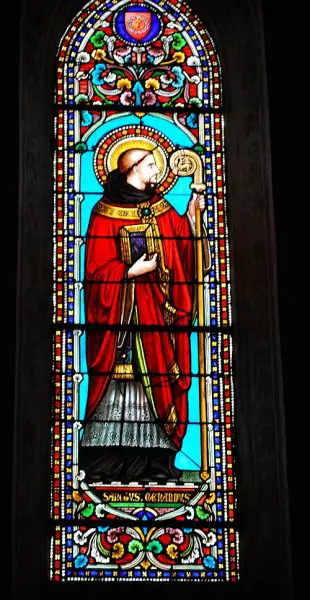
Overview
Gerald of Sauve-Majeure, who also appears as Gerard or Geraud, and who takes a second name from his birthplace — Gerald of Corbie — served as a Benedictine abbot of the eleventh century whose ministry was forged by disappointment and completed in foundation. Born around 1025 at Corbie in Picardy and educated at its great abbey, he became a monk and cellarer there, though violent headaches often prevented him from performing his devotions. A pilgrimage south to Monte Gargano and Monte Cassino brought him to Rome, where Pope Leo IX ordained him; back home he was healed through the intercession of St Adalard, a former abbot of Corbie, for whom he later wrote a hagiography. His search for the right arena proved long: elected abbot of St Vincent's Abbey at Laon after a journey to Palestine, he could not make the monks accept his authority or discipline and resigned after about five years; chosen next at St Medard's Abbey in Soissons, he was driven out by a usurper. Only then did he turn to founding. Duke William VIII of Aquitaine made over to Gerald a vast wooded domain in the Gironde, hard by Bordeaux, and there he raised the abbey of Grande-Sauve — the great forest — under the Benedictine Rule enriched by Cluniac customs. Its first abbot died there in 1095, leaving a practice of thirty days of masses for deceased monks and the counsel to shun all discussion. Celestine III canonized him in 1197.
The Complete Life
Corbie, and the Healing of Adalard
Gerald was born around 1025 at Corbie in Picardy and received his education at Corbie Abbey, one of the oldest and most learned monasteries of northern France. In time he took the habit there and was entrusted with the office of cellarer, the monk responsible for the material provisioning of the house — a post of trust given only to stable and capable brethren. His principal trial in those years was physical: he suffered greatly from violent headaches, severe enough to prevent him from carrying out his devotions. For a monk, the loss of prayer was the true affliction, and Gerald treated it as such, seeking a cure by pilgrimage. With his abbot he travelled to Monte Gargano to seek the intercession of St Michael the Archangel and to Monte Cassino to pray at the tomb of St Benedict, and while in Rome he was ordained by Pope Leo IX, whose pontificate placed him in the heart of the reforming church of the eleventh century. The cure, when it came, came from nearer home: on his return Gerald was healed of the headaches through the intercession of St Adalard, a former abbot of Corbie. In thanksgiving he wrote a hagiography of his healer — the first literary work of a man whose life would be spent repaying monastic tradition with monastic service.
§ Life
Two Abbeys That Would Not Keep Him
After a pilgrimage to Palestine — the journey of a lifetime for an eleventh-century monk — Gerald's reputation brought him his first abbacy: he was elected abbot of St Vincent's Abbey at Laon. The trust was misplaced. The monks of Laon would accept neither his authority nor the proper discipline he tried to impose, and after some five years of struggle Gerald resigned, unwilling or unable to rule a community that refused to be reformed. The pattern repeated in miniature at his next post: he became abbot of St Medard's Abbey in Soissons, only to be driven out by a usurper. Two elections, two failures, and a man approaching middle age with no monastery of his own — reversals that must have been crushing in a culture where abbatial office was for life. Yet the failures clarified the vocation. Gerald stopped seeking to reform other men's houses and resolved instead to found a new Benedictine monastery of his own, where the discipline he prized would be built into the community from its first day rather than imposed upon it afterward. The abbot twice rejected would now become a father from the beginning.
§ Life
A Great Forest Becomes an Abbey
The opportunity came from the south. Duke William VIII of Aquitaine made over to Gerald a vast wooded domain in the Gironde, hard by Bordeaux, and in that wilderness he founded the abbey of Grande-Sauve — the name from the Latin granda silva, the large forest, by which the abbey is more often known in its French form Sauve-Majeure. As its first abbot he shaped the community deliberately: it grew into a formidable community that advanced the Rule of St Benedict and its way of life, with the customs of Cluny leaving a marked imprint, the most prestigious monastic observance of the age. The choice of site was itself evangelical — a monastery planted in a great forest stood at the edge of settlement, clearing land, ordering labour, and preaching by presence. Under Gerald the abbey flourished, and two of his personal creations took root there as institutions. He instituted a thirty-day sequence of Masses and the Office for the Dead, offered whenever one of the brethren died, binding the living to their departed brothers in a month of intercession. And to the end of his days he kept repeating one counsel to his community: avoid every kind of disputation — for disputes breed disobedience.
§ Life
Death at Grande-Sauve
Gerald died at Grande-Sauve Abbey in 1095, in the community he had planted and governed from its beginnings — the peaceful ending he had been denied at Laon and Soissons. He had reached old age as the father of a flourishing foundation in a province where his abbey would stand for centuries, and he died at Grande-Sauve itself. Nothing is told of a last illness or a testament; the silence is fitting for a monk whose repeated counsel to his brethren had been the avoidance of disputation. What he left was institutional rather than literary: an abbey observing the Benedictine Rule enriched with Cluniac customs, a liturgical charity toward the dead embodied in the thirty days of Masses and Office offered for every departed monk, and a remembered maxim of peace handed on from abbot to community. He was buried at his abbey, which the church honours as his major shrine, and his feast was fixed on 5 April. The man whom violent headaches had once kept from his devotions ended his days at the head of a community whose whole rhythm was devotion, in the forest whose silence he had chosen over the quarrels of reformed abbeys.
§ Life
Raised to the Altars by Celestine III
Veneration of Gerald at his forest abbey grew into a formal cult, and on 27 April 1197, a century after his death, Pope Celestine III canonized him — a relatively early example of canonization by papal decree, the procedure that in the late twelfth century was replacing the older recognition of saints by local acclamation and episcopal approval. The canonization confirms that the abbey's memory of its founder had carried far beyond the Gironde and found a hearing at the papal court. His feast day is kept on 5 April. Grande-Sauve Abbey remains his major shrine, and the abbey itself — La Sauve-Majeure — stands today among the notable Romanesque monuments of the region, its very name preserving the Latin of the great forest, granda silva, where Gerald planted his community. The record of his cult is brief, matching the brevity of its sources, but the essentials are unambiguous: a Benedictine abbot formally inscribed in the catalogue of the saints by the bishop of Rome, honoured at the abbey he founded, and remembered each year on a feast that has kept his name alive long after the monastic calm he sought has passed from the world.
§ Veneration
Timeline
- 1025
Born at Corbie in Picardy and educated at the abbey, where he later becomes a monk and cellarer
§ Life
- 1095
Dies at Grande-Sauve Abbey, the Burgundian-influenced community he founded in the Gironde and governed as first abbot
§ Life
- 27 Apr 1197
Canonized by Pope Celestine III
§ Veneration
The Record
- Major works
- Grande-Sauve Abbey (La Sauve-Majeure), founded in the Gironde near Bordeaux·Hagiography of St Adalard, former abbot of Corbie·Institution of thirty days of Mass and Office for the Dead after a community member's death
- Patron of
- Grande-Sauve Abbey and its congregation
- Symbols
- Abbot's crozier·Model of Grande-Sauve Abbey
- Canonization
- Canonized 27 April 1197 by Pope Celestine III
Prayer
Bibliography
Show 3 sources
- Saints.SQPN.com
- Saint of the Day, April 5, at SaintPatrickDC.org
- (in Norwegian) Katolsk.no
Profile text adapted from the Wikipedia article, licensed CC BY-SA 4.0.
Pray with this saint every day
Save St. Gerald of Sauve-Majeure to your favorites, read the full profile, and get feast-day reminders in the Saints app.
Get the Saints AppFree on the App Store for iPhone and iPad