
1726-1755·Feast October 16
St. Gerard Majella
Redemptorist Lay Brother, Confessor
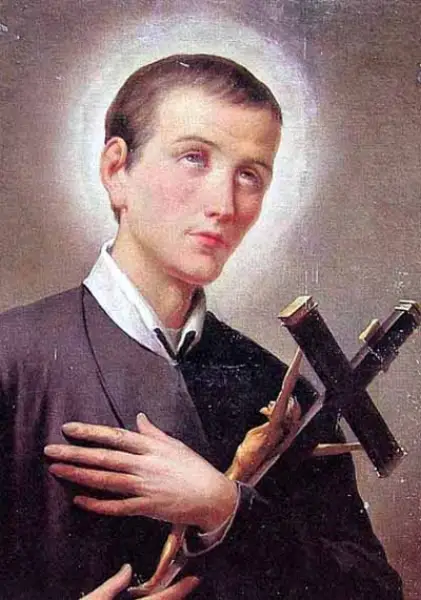
Overview
Gerardo Maiella was born at Muro Lucano in the Basilicata hills on 6 April 1726, youngest of five children of a tailor who died when the boy was twelve, leaving the family poor. Apprenticed to an uncle whose foreman treated him harshly, then serving the bishop of Lacedonia's household, he drifted through tailoring work that barely fed him. Twice he sought the Capuchins; frail health refused him both times. In 1749 the Redemptorists, the young missionary congregation Alphonsus Liguori had founded to preach to the rural poor, received him as a lay brother. Inside the community he turned his hand to everything — gardening, sewing, sacristy, porter's duty, cooking, carpentry, and clerk of works — and became a familiar, trusted figure among the Neapolitan peasantry. At twenty-seven a pregnant young woman named him as her child's father; he bore the charge in silence, submitting to a ban from Holy Communion, until she withdrew the accusation. Tuberculosis killed him at twenty-nine in Materdomini on 16 October 1755. A dropped handkerchief, kept by a girl who years later survived a dangerous childbirth, fixed his patronage among expectant mothers for generations after.
The Complete Life
Early Life
Gerardo Maiella was born at Muro Lucano, in the hills of Italy's Basilicata region, on 6 April 1726, the fifth and youngest child of a tailor; he was apparently frail from birth, and was baptized the day he was born. His father died when the boy was twelve, leaving the family in poverty, and Gerard was apprenticed to a tailor uncle whose foreman treated him harshly — the suffering borne in silence that his biographers set at the start of his story. He served for a time in the household of the bishop of Lacedonia, and drifted through tailoring work that barely fed him. Twice he sought the Capuchins; his frail health refused him both times. The pattern of his early life — poverty, exclusion, and the desire for religion — is the ordinary background of the southern Italian laity of his century.
§ Introduction
The Redemptorist Brother
In 1749 the Redemptorists — the young missionary congregation Alphonsus Liguori had founded to preach to the rural poor — received Gerard as a lay brother at Scala. Inside the community he turned his hand to everything: gardening, sewing, sacristy, the porter's duty, cooking, carpentry, and clerk of works for the houses being built. He became a familiar, trusted figure among the Neapolitan peasantry, who came to him with their sicknesses and their troubles, and the early accounts of his life record the graces they sought through him — healings, bilocation, the reading of hearts — that his cause would later sift. His letters of spiritual direction, to the laypeople and religious who wrote to him, survive and are his own monument.
§ Life
The False Accusation and Death
In 1753, at twenty-seven, Gerard was falsely accused: a pregnant young woman named him as her child's father. He bore the charge in silence, submitting to a ban from Holy Communion — the answer that has made him the patron of the falsely accused — until Alphonsus, convinced by his obedience, pressed the woman and she withdrew the accusation. Gerard's own word to the enquirer was that God was not allowing him to defend himself. The episode behind him, his health collapsed: tuberculosis killed him at Materdomini on 16 October 1755, twenty-nine years old. He had been a religious for six years. A dropped handkerchief, kept by a girl who years later was delivered of a dangerous labor after praying with it, became the seed of his patronage of childbirth.
§ Life
Canonization
Gerard was beatified in Rome by Pope Leo XIII on 29 January 1893, and canonized by Pope Pius X on 11 December 1904. The shortness of his life and the modesty of his office — a lay brother of six years' standing — made his canonization a statement about the holiness of the ordinary religious life. His feast is 16 October, and his shrine at Materdomini, in the hills above Naples, remains a great center of pilgrimage.
§ Introduction
Legacy
Gerard Majella is the patron of children and unborn children in particular, of childbirth, of mothers and expectant mothers, of the falsely accused, of good confessions, and of lay brothers — a patronage list that compresses his life into a single line. The patronage of childbirth, growing from the handkerchief story and the letters of mothers who invoked him, has made him one of the most invoked saints of the Catholic home; his medals and his novena circulate wherever there are expectant mothers. For religious he remains the model of the lay brother: the handyman of the community whose hidden obedience was, on the evidence of his cause, the vehicle of extraordinary grace.
§ Introduction
Timeline
- 6 Apr 1726
Born at Muro Lucano, youngest of five children of the tailor Domenico Maiella, and baptized the same day.
§ Life
- 1738
Domenico Maiella died, leaving the family in poverty; twelve-year-old Gerard was sent to learn sewing from his mother's brother.
§ Life
- 1749
After two failed attempts to join the Capuchins, he entered the Congregation of the Most Holy Redeemer as a lay brother.
§ Life
- 1753
At about twenty-seven he was named by a pregnant woman as her child's father and silently accepted a ban from Holy Communion.
§ Life
- 16 Oct 1755
Died of tuberculosis at Materdomini, aged twenty-nine, leaving a note on his cell door as his last will.
§ Life
- 29 Jan 1893
Beatified in Rome by Pope Leo XIII.
§ Veneration
- 11 Dec 1904
Canonized by Pope Pius X, less than twelve years after his beatification.
§ Veneration
- 1908
Four years after his canonization, a church of the Redemptorists in Wellington, New Zealand, was dedicated in his honour, perhaps the first anywhere.
§ Veneration
- 1977
A chapel in Newark, New Jersey, at St. Lucy's Church, was dedicated as a national shrine in his name.
§ Veneration
- May 2005
An Italian postage stamp of 45-eurocent value carried his likeness.
§ Namesakes
In Their Own Words
Here the will of God is done, as God wills, and as long as God wills.
The Record
- Patron of
- Children, especially the unborn·Childbirth·Mothers and expectant mothers·The falsely accused·Good confessions·Lay brothers·Muro Lucano
- Symbols
- Young man in a Redemptorist habit·Skull·Handkerchief (the patron of mothers)
- Canonization
- Beatified 29 January 1893 by Pope Leo XIII; canonized 11 December 1904 by Pope Pius X
Prayer
Bibliography
Show 12 sources
- 1 2 3 "St. Gerard Majella | Christian Apostles.com" . christianapostles.com . 2020-12-19 . Retrieved 2021-01-09 .
- 1 2 3 "Liguori Publications:Saint Gerard Majella" . liguori.org . Archived from the original on 2013-01-17.
- ↑ "St. Gerard Majella", The Redemptorists, Baltimore Province
- ↑ "St. Gerard Majella - Saints & Angels" . Catholic Online . Retrieved 2021-01-09 .
- 1 2 J. Magnier (1913). "St. Gerard Majella" . In Herbermann, Charles (ed.). Catholic Encyclopedia . New York: Robert Appleton Company.
- ↑ Carr, John, "St. Gerard Majella", A Treasury of Catholic Reading , ed. John Chapin (New York: Farrar, Straus & Cudahy, 1957)
- ↑ "È il giorno della festa di San Gerardo, l'angelo di mamme e bambini: le foto del dono dell'olio" . Avellino Today . 16 October 2020 . Retrieved 21 February 2021 .
- ↑ "St Gerard's Church" . www.heritage.org.nz . Retrieved 2025-10-28 .
- ↑ St. Lucy's Church Archived 2013-10-23 at the Wayback Machine , Newark, NJ.
- ↑ "St Gerard's Family League" . redemptoristsdundalk.ie . Archived from the original on 2014-09-03.
- ↑ Salerno, Redazione (2017-06-18). "Il Santuario di San Gerardo Maiella alle Porte del Territorio Salernitano" . AmalfiNotizie.it (in Italian). Archived from the original on 2018-01-18 . Retrieved 2019-03-10 .
- ↑ "Redemptorist" . cssr.com . Archived from the original on 2003-05-11 . Retrieved 2016-03-16 .
Profile text adapted from the Wikipedia article, licensed CC BY-SA 4.0.
Pray with this saint every day
Save St. Gerard Majella to your favorites, read the full profile, and get feast-day reminders in the Saints app.
Get the Saints AppFree on the App Store for iPhone and iPad