
c. 895 – 959·Feast October 3
St. Gérard of Brogne
Restorer of Benedictine monasticism in the Low Countries
Overview
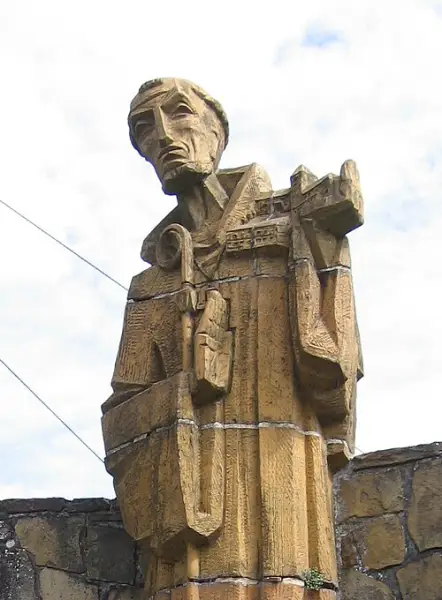
Gérard of Brogne, born at Staves near Namur around 895, was a noble soldier who became one of the foremost monastic reformers of the tenth century. His father Stance belonged to the family of the dukes of Lower Austrasia, and his mother Plectrude was sister to Bishop Stephen of Liège. As a young man Gérard rebuilt a family chapel at Brogne into a large church served by canons, but a stay at the Abbey of Saint-Denis in Paris about 917 changed his course: so impressed was he by the monks' life that he joined their number, carrying back in due course a relic of Saint Eugenius for Brogne. By a charter of 923, estates in Hesbaye were conveyed to that church. Ordained a priest around 928, he returned to Brogne, replaced its lax clerics with monks, and withdrew to a nearby cell for a stricter discipline. Summoned by the Archbishop of Cambrai, he reformed Saint-Ghislain in Hainault and in time became head of eighteen abbeys across present-day Belgium, imposing strict observance — at Saint-Bertin in 944 so firmly that dissident monks fled to King Edmund I of England. After securing a papal bull confirming Brogne's privileges, he made a final visitation of his communities and died at Brogne in October 959.
The Complete Life
A Nobleman of the Meuse
Gérard was born at Staves in the Namur country around 895, into the highest circle of Lotharingian aristocracy. His father Stance was a member of the family of the dukes of Lower Austrasia, and his mother Plectrude was the sister of Bishop Stephen of Liège, so that the boy grew up at the meeting point of military and ecclesiastical power in the Meuse valley. The tenth century in that region was an age of Viking raids, contending princes and decaying religious discipline, and a young noble of his station would naturally have taken up the soldier's trade; the sources describe Gérard as originally a soldier. Yet his first recorded act pointed another way: he took a family chapel at Brogne, near his home, and rebuilt it into a large church staffed by canons, endowing it as a place of prayer on the family lands. Even before any conversion experience, then, Gérard was a founder. The chapel of Brogne would become the axis of his whole life, the place to which the soldier, the monk and the abbot alike would return, and which would one day bear his own name as Saint-Gérard.
§ Life
The Turn to Saint-Denis
About 917 Gérard travelled to Paris on business and lodged, by chance or providence, at the great royal abbey of Saint-Denis. What he found there decided his life. The regular observance of the monks — their ordered prayer, their discipline, their freedom from the worldliness he knew among the secular clergy — impressed him so deeply that he resolved to join them. He set his affairs in order, became a monk of Saint-Denis, and remained bound to the abbey that had converted him while keeping a careful interest in the church he had built at Brogne. From Saint-Denis the abbot sent him back with a relic of Saint Eugenius for the community at his Namur foundation, a sign that the royal abbey blessed the work and tied it to the broader reforming world. Estates in Hesbaye were conveyed to the Brogne church by charter in 923, proof that the foundation grew even while its founder was away. Around 928 Gérard was ordained a priest, and with priesthood came the return: he went back to Brogne to make of his chapel-church what he had seen at Saint-Denis.
§ Life
Reformer of Eighteen Abbeys
At Brogne Gérard did what he had learned in Paris: the easygoing clergy who served his church were dismissed and monks installed in their place, and he withdrew afterwards to a hut close by the monastery to keep a stricter rule himself. The fame of what he had done travelled. Cambrai's archbishop summoned him to set the community of Saint-Ghislain in Hainault to rights; there too the canons gave way to monks; and from that beginning his mission spread, until he stood at the head of eighteen other abbeys across the region of present-day Belgium, enforcing strict monastic discipline wherever he went. Not every house received him gladly. When he reformed the Abbey of Saint-Bertin in 944, the resistance was such that dissident monks fled across the Channel to King Edmund I of England — an exodus whose consequences for English monasticism were lasting, since the refugees carried continental observance to a land then rebuilding its own monastic life. Gérard's work thus joined the great tenth-century movement of monastic restoration on both sides of the sea: a soldier's firmness joined to a monk's prayer, renewing houses that had forgotten their rule.
§ Life
Strictness and Solitude
The discipline Gérard imposed was his own before it was anyone else's. Even as abbot over a family of eighteen houses he withdrew to a cell near the monastery of Brogne for a stricter way of life, keeping the monk's separation from the world beneath the administrator's burdens. The Rule he enforced was demanding by design: the displacement of canons who had lived lightly in the world by communities bound to common prayer, poverty and obedience was the whole point of his reform, and he pursued it without regard for local convenience or the feelings of established clergy. Opposition at Saint-Bertin, where monks chose exile in England rather than accept his observance, shows how uncompromising the standard was. Yet strictness was paired with a fugitive's modesty: he sought papal confirmation not of his own authority but of the privileges of Brogne, the one house that was wholly his own, travelling to Rome for the bull that secured its independence. As his strength waned he set vicars and abbots to govern in his place in the houses charged to him — a reformer who worked to make himself unnecessary, content to let the Rule govern where he had governed.
§ Life
Rome, Farewells and Death
In his last years Gérard set in order everything he had built. Having provided governors — vicars and abbots — for every community entrusted to him, he undertook the journey to Rome and obtained from the pope a bull confirming the privileges of Brogne Abbey — legal security for the house that had been the starting point of it all. Coming back, he made a last round of all the houses his reform had touched, a farewell tour through the monasteries of Flanders, Hainault and the Namur country that owed their renewed life to him. Then he retired to Brogne, the church he had raised from a family chapel, and there he died in October 959, on the third day of the month that his feast still keeps. He had turned from soldier to monk, from monk to abbot of abbeys, and back at the last to the solitary quiet of the place where his conversion had borne first fruit. The abbey outlived him under a new name, Saint-Gérard, so that the map itself kept his memory green. The quiet ending closed a career that had redrawn the monastic map of the whole region.
§ Life
Veneration at Namur and Beyond
Gérard's cult took root immediately in the dioceses his reform had touched. Each 3 October his memory is kept liturgically at Namur, Ghent and Liège, and for that day he is listed in the Roman Martyrology — the Church's official register of those it honours as saints. The physical memory of the saint endured in his relics, considered authentic, which were preserved at Saint-Gérard in Namur, at the abbey of Maredsous, at Aubange, and at Ghent in the church of Notre-Dame: a distribution tracing the geography of his reform from the Meuse to the Flemish coast. The abbey he founded at Brogne was renamed Saint-Gerard Abbey in his honour, and the village that grew beside it still bears his name. His larger monument was the revival he left behind him — the eighteen houses of strict observance whose discipline shaped Belgian monasticism for generations, and the unexpected harvest at Saint-Bertin, whose exiled monks carried continental reform to the English king Edmund and so joined his name to the renewal of monasticism in England as well as in the Low Countries.
§ Veneration
Timeline
- 895
Born at Staves in the Namur region, son of Stance and of Plectrude, sister of Bishop Stephen of Liège
§ Life
- 917
While in Paris on business, stays at the Abbey of Saint-Denis and resolves to become a monk there
§ Life
- 923
Estates in Hesbaye are conveyed to the Brogne church by charter
§ Life
- 928
Ordained a priest and returns to Brogne, where he replaces the lax clerics with monks
§ Life
- 944
Reforms the Abbey of Saint-Bertin; dissident monks flee to King Edmund I of England
§ Life
- 3 Oct 959
Dies at Brogne after a final visit to the abbeys he had reformed
§ Life
The Record
- Major works
- Brogne Abbey (later Saint-Gérard Abbey), Namur·Reform of Saint-Ghislain, Saint-Bertin and eighteen abbeys in present-day Belgium
- Patron of
- Saint-Gérard, Namur
- Canonization
- Ancient cult; listed in the Roman Martyrology with feast on October 3
Prayer
Bibliography
Show 4 sources
- Clugnet, Léon. 'St. Gérard, Abbot of Brogne.' The Catholic Encyclopedia, Vol. 6. New York: Robert Appleton Company, 1909
- Monks of Ramsgate. 'Gerard of Namur'. Book of Saints, 1921. CatholicSaints.Info, 3 October 2016
- Wormald, Patrick (1988). 'Æthelwold and his Continental Counterparts: Contact, Comparison, Contrast'. In Yorke, Barbara (ed.), Bishop Æthelwold: His Career and Influence. Woodbridge, UK: The Boydell Press, p. 26. ISBN 978-0-85115-705-4
- Herbermann, Charles, ed. (1913). 'St. Gérard, Abbot of Brogne'. Catholic Encyclopedia. New York: Robert Appleton Company
Profile text adapted from the Wikipedia article, licensed CC BY-SA 4.0.
Pray with this saint every day
Save St. Gérard of Brogne to your favorites, read the full profile, and get feast-day reminders in the Saints app.
Get the Saints AppFree on the App Store for iPhone and iPad