
977/1000 - 1046·Feast September 24
St. Gerard of Csanád
Apostle of Hungary, Bishop and Martyr of Buda
Overview
Gerard of Csanád, known in Hungarian as Gellert and in Italian as Gerardo di Sagredo, held the newly created see of Csanád as its first bishop, from about 1030 to his martyr's end in 1046. Born in Venice into a noble family - later writers linked him to the Sagredo or Morosini houses - he was offered as a child to the Benedictine monastery of San Giorgio after a grave illness at the age of five, and there received a wide education in grammar, music, philosophy and law. He served as prior of San Giorgio in 1012 and was sent abroad for study before civil strife drove him from the city on pilgrimage toward the Holy Land around 1018 or 1021. A storm diverted him to Istria, and the persuasion of a monk named Rasina and of Bishop Maurus of Pécs brought him instead to Hungary, where King Stephen I made him tutor to his son and heir, Emeric. After years as a hermit in the Bakony Hills, Gerard was named first bishop of the new Diocese of Csanád, where Hungarian-speaking Benedictine monks helped him preach to the local inhabitants. He suffered martyrdom at Buda on 24 September 1046, when the pagan rising called the Vata uprising swept the kingdom, and in 1083 he was canonized alongside Stephen and Emeric as one of the patron saints of Hungary.
The Complete Life
A Venetian Noble Born on St George's Day
Gerard was born at Venice into a noble family, at some point between 977 and 1000. His parents - the father also named Gerard, the mother Catherine - had awaited a child for three years, and because the boy arrived on the feast of Saint George, 23 April, they baptized him George; only later did he take his father's name instead, for the elder Gerard had died while travelling — a pilgrim's voyage, or perhaps a journey of another kind; the later legend calls it, anachronistically, a crusade. Which noble house he belonged to was disputed even among later writers: an expanded edition of Petrus de Natalibus's Catalogue of Saints printed in 1516 claimed him for the Sagredo family, though that house received Venetian nobility only in the fourteenth century, while the historian László Szegfű argued that he was in fact a Morosini. At the age of five the child fell seriously ill. The Benedictine monks of San Giorgio took the sick child into their intercessions, and when he recovered his family, in gratitude, soon offered him to the spiritual life and placed him in that house. The two chapters his Long Life devotes to his childhood abound in the conventional motifs of medieval hagiography - its author borrowed freely from models such as the Life of Saint Adalbert of Prague - so every detail must be weighed with care.
§ Family and youth
Monk, Prior and Student Abroad
Within San Giorgio the young monk observed the rule with severity; his legend emphasises that he wore coarse cloths to mortify his body and immersed himself in the prophetic books and the discourses of the apostles. Certain Greek expressions in his surviving writing - above all a phrase meaning leader of the Word - suggest that he read Pseudo-Dionysius the Areopagite in the original language. When John Morosini, the monastery's founding abbot, died in 1012, Gerard was appointed prior and administered the house until the election of the new abbot, Guglielmo. Guglielmo then sent him abroad to study grammar, music, philosophy and law - the sources say Bologna, though Gerard's own mention of a stay in Gaul, where he read Plato, hints that Burgundy was the true setting. After five years he returned to San Giorgio. His legend states that he was made abbot although he opposed his own election, but since nothing of his conduct in that office was ever recorded, scholars suspect he never actually held it. Around 1018 or 1021, as armed conflicts between the Orseolos and their adversaries convulsed the city, he departed on pilgrimage to the Holy Land, wishing, his legend says, to follow the example of Saint Jerome.
§ Benedictine monk
Tutor of a Crown Prince, Hermit, First Bishop of Csanad
A storm drove Gerard's ship to shelter on an island close to Istria, at a Benedictine house, and there he met a monk named Rasina, who persuaded him to come to Hungary instead, insisting that for winning souls to the Lord no place in today's world was better suited. Travelling by way of Zara, Knin and Senj, Gerard reached Pecs, where Bishop Maurus and Abbot Anastasius of Pécsvárad heard him preach, pronounced him a master of the word such as Hungary had never seen, and pressed him to meet King Stephen I at Székesfehérvár. The king declared his realm the fittest place for Gerard to serve God, promised him license to preach anywhere in the kingdom, and hinted that he might yet make him a bishop. Gerard stayed. On the feast of the Assumption he preached in honour of the woman clothed with the sun — the earliest recorded trace of Marian devotion anywhere in Hungary, and he was set over the education of the heir, Emeric. When that work ended he withdrew to the Bakony Hills near Bakonybel, where the holy Gunther of Bohemia had once lived, raised a chapel at the base of a hill, wrote theological studies and homilies now lost - including commentaries on the Epistle to the Hebrews and the Prologue to John's Gospel - and lived as a hermit for seven years.
§ Royal tutor and hermit
Haircloth Beneath the Bishop's Charge
Even as a bishop Gerard kept the habits of a hermit. He continued to wear cilice or goat skins, would pass whole days alone in the woods that lay near his see, and, his legend says, often took the axe to cut wood himself - both to mortify his flesh and to ease the labour of those for whom such work was compulsory. He shared a single house with the twelve Benedictine monks King Stephen had appointed to accompany him, allowing none of them outside without his permission, and requiring that all be present at the morning service and their wearing of the monastic habit. Yet the asceticism never hardened into severity toward others. Journeying once from Csanad toward the royal court at Székesfehérvár or Esztergom with his cleric Walther, he lodged at a manor where a slave woman sang as she ground flour, likened the rhythm to the drum of the Hungarians, and, touched by her cheerfulness under crushing toil, gave her precious gifts. The scene discloses the man: an ascetic in haircloth who nevertheless noticed joy in a captive's song and answered it with generosity, finding in the sound of a hand-mill something worthy of a bishop's attentive ear.
§ Bishop of Csanad
Refusal, Prophecy and Martyrdom
Stephen I died on 15 August 1038, and the succession brought turmoil to the kingdom he had built. His Venetian nephew Peter Orseolo took the throne, was driven out in 1041, and was replaced by Samuel Aba, a ruler who put many lords to death. Aba came to Csanad and asked Gerard to place the crown on his head during the mass of Resurrection Sunday. Gerard refused; the bishops in the king's train performed the coronation, and Gerard went to the pulpit to declare that the sword of vengeance would fall on Aba's head before three years had run, since the kingdom had come to him through deceit. Scholars debate whether the episode occurred as the Long Life recounts it, but the century bore the story out. Emperor Henry III crushed Aba at the Battle of Ménfő in 1044 and restored Peter, whose favouritism toward his German and Italian retainers embittered the magnates. In 1046 the Vata pagan uprising broke out, and on 24 September Gerard was killed at Buda together with his co-martyrs Bystrik and Buldus. One account has him stoned, pierced with a lance and hurled from the cliff called Blocksberg into the Danube; another, hauled to the hilltop on a cart and rolled down the height now named Gellert Hill, then beaten to death at the bottom; a third, sealed in a spiked barrel and rolled down amid the revolt.
§ Martyrdom
Raised to the Altars in 1083
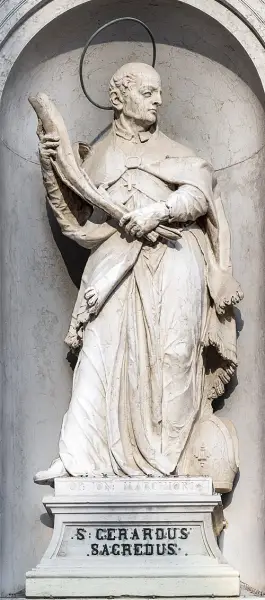
Thirty-seven years after his martyrdom Gerard was raised to the altars. In 1083 he was canonized together with King Stephen I and the prince Emeric, the royal father and the pupil whose story his own life had touched, in an act attributed to Pope Gregory VII. The canonizations of that year gave the young Hungarian kingdom its founding host of saints, and Gerard has remained ever since one of the patron saints of Hungary, honoured in both the Catholic Church and the Eastern Orthodox Church. His feast is kept on 24 September, the anniversary of his death. His memory took root in the very stone of the capital: the hill from which, by the most often told account, his body was hurled toward the river bears to this day his Hungarian name, Gellert. In Venice his figure stands among the saints of San Rocco, a statue recalling the noble-born Venetian who left the lagoon for the plains of the Danube, served a foreign church as hermit, tutor and bishop, and died there a martyr in the uprising of 1046. The three names of 1083 - Gerard, Stephen and Emeric - have been spoken together in Hungary ever since, the bishop, the king and the prince honoured in a single breath.
§ Introduction
Recovering the Man Behind the Legends
Everything known of Gerard reaches the present through a difficult body of texts. His own Deliberatio supra hymnum trium puerorum survives and reflects both his life and his learning. The Short Life of Saint Gerard, composed around 1100 as an abridgement of a lost earlier biography, presents him chiefly as a bishop and is regarded by most scholars as the most reliable witness to his course. The Long Life, a compilation finished in the late thirteenth or fourteenth century, was for centuries treated as absolutely trustworthy, but twentieth-century scholarship turned sharply against it: György Györffy called it a forgery outright, Gábor Klaniczay points to plainly anachronistic elements within it, and C. A. Macartney, against the current, argued that it had kept safe the shape of Gerard's earliest life, the one now lost. Simon of Kéza's chronicle and the Illuminated Chronicle preserve fragments of the source the two Lives shared, and a thirteenth-century rhymed chant of the legend adds nothing beyond the Short Life. Gerard thus stands at the head of Hungarian hagiography and of Hungarian letters alike - first bishop of Csanad, first master of the word in the kingdom's memory, and a saint whose historical face must be patiently recovered from legends written long after his death.
§ Sources
Timeline
- 1012
Appointed prior of the San Giorgio Monastery in Venice to administer the house after the death of its founding abbot, John Morosini
§ Benedictine monk
- 1018
Left Venice on pilgrimage toward the Holy Land as armed factional strife convulsed the city, before a storm forced him to shelter near Istria
§ Benedictine monk
- 1024
Withdrew from the royal court to live as a hermit near Bakonybél in the Bakony Hills, after tutoring Prince Emeric
§ Royal tutor and hermit
- 1030
Consecrated first bishop of the newly established Diocese of Csanad, an ordination the Annales Posonienses records for this year
§ Bishop of Csanad
- 15 Aug 1038
King Stephen I of Hungary died; his Venetian nephew Peter Orseolo mounted the throne
§ Martyrdom
- 1041
Peter Orseolo was dethroned and succeeded by Samuel Aba
§ Martyrdom
- 1044
Holy Roman Emperor Henry III defeated Samuel Aba at the Battle of Ménfő and restored Peter Orseolo to an unpopular rule
§ Martyrdom
- 24 Sep 1046
Martyred at Buda during the Vata pagan uprising, with Bystrik and Buldus; his body was cast down a cliff toward the Danube
§ Martyrdom
- 1083
Canonized alongside Stephen I and Emeric, becoming one of the patron saints of Hungary
§ Martyrdom
In Their Own Words
sword of vengeance will descend
The Record
- Major works
- Deliberatio supra hymnum trium puerorum·Commentaries on the Epistle to the Hebrews and the Prologue to the Gospel of John (lost)·Theological studies and homilies written in the Bakony Hills (lost)
- Patron of
- Hungary·Budapest
- Canonization
- Canonized in 1083 by Pope Gregory VII, together with Stephen I and Emeric
Prayer
Bibliography
Show 7 sources
- ↑ Györffy, György (1994). King Saint Stephen of Hungary. Atlantic Research and Publications. ISBN 0-88033-300-6.
- ↑ Jékely, Zsombor (2004). "Gerard of Csanád". In Jestice, Phyllis G. (ed.). Holy People of the World: A Cross-Cultural Encyclopedia, Volume I: Entries A to G. ABC Clio. p. 304. ISBN 1-57607-355-6.
- ↑ Kristó, Gyula (2001). "The Life of King Stephen the Saint". In Zsoldos, Attila (ed.). Saint Stephen and His Country: A Newborn Kingdom in Central Europe – Hungary. Lucidus Kiadó. pp. 15–36. ISBN 963-86163-9-3.
- ↑ Macartney, C. A. (1953). The Medieval Hungarian Historians: A Critical & Analytical Guide. Cambridge University Press. ISBN 978-0-521-08051-4.
- ↑ Mezey, László (1996). "Gellért-problémák [Problems in connection with Gerard]". In Horánszky, Nándor (ed.). Szent Gellért Emlékkönyv (in Hungarian). Szent Gellért Plébánia. pp. 55–64. ISBN 963-00-1972-8.
- ↑ Szegfű, László (1994). "Gellért, Szent [St Gerard]". In Kristó, Gyula; Engel, Pál; Makk, Ferenc (eds.). Korai magyar történeti lexikon (9–14. század) (in Hungarian). Akadémiai Kiadó. p. 231. ISBN 963-05-6722-9.
- ↑ Turcuș, Șerban (2006). Saint Gerard of Cenad: The Destiny of a Venetian around the Year One Thousand. Romanian Cultural Institute, Center for Transylvanian Studies. ISBN 978-973-7784-10-0.
Profile text adapted from the Wikipedia article, licensed CC BY-SA 4.0.
Pray with this saint every day
Save St. Gerard of Csanád to your favorites, read the full profile, and get feast-day reminders in the Saints app.
Get the Saints AppFree on the App Store for iPhone and iPad