
c. 935 - 994·Feast April 23
St. Gerard of Toul
Bishop of Toul, Builder and Reformer of the Diocese
Overview
Gerard of Toul was a German prelate who governed the Diocese of Toul from 963 until his death in 994. Born about 935 at Cologne to the nobles Ingranne and Emma, he was known for piety from his youth and was educated in his native city. The lightning strike that killed his mother became, in his own reading of it, both a judgment on his sins and a summons to serve God, and it drove him to ordination; he became a canon of the Cologne Cathedral. Appointed to Toul on 3 March 963 by Bruno the Great on behalf of Pope John XII, and consecrated at Trier on 19 March, he proved a capable and respected leader in a diocese that enjoyed great independence under its bishops. His chief concerns were the recovery of the Church's properties and the exclusion of secular interference from ecclesial affairs. He established religious schools, invited scholars from across Europe - Greeks above all, and monks from Ireland - to teach in them, rebuilt churches, consecrated the restored Toul Cathedral in 981, and founded a convent for nuns, while quietly evading Emperor Otto II's desire to keep him at court. Miracles were recorded at his tomb, and in 1050 Pope Leo IX, himself a former holder of the see, canonized him in Rome.
The Complete Life
A Conversion Forged in Lightning
Gerard was born about 935 at Cologne, in the Kingdom of Germany, to the nobles Ingranne and Emma. The city gave him both his upbringing and his formation: he was educated at Cologne, and already in youth his piety was remarked upon by those around him. The decisive event of his early life came as a shock. Lightning struck his mother and killed her, and Gerard read the catastrophe as divine judgment for his own sins and, at the same time, as a call to God's service. Medieval minds could hear a summons in catastrophe, and in Gerard's case the conviction proved durable: he entered the priesthood and upon his ordination became a canon of the Cologne Cathedral. Whatever terror and guilt accompanied that first interpretation of his mother's death, it bore fruit in a lifetime of ecclesial labour. Nothing further is recorded of his family circumstances or of the years between his ordination and his appointment to Toul, but the pattern was set - a man who took tragedy as instruction and turned the weight of it into the disciplined service of the Church that would define the remainder of his life.
§ Life
Called to Toul Against His Inclination
In 963 the see of Toul fell to Gerard through the combined action of church and empire. Bruno the Great, acting on behalf of Pope John XII, appointed him to the diocese, and Gerard was named its bishop on 3 March 963, receiving consecration at Trier on the following 19 March. The sources note that he accepted the position despite his own reluctance; the priesthood had already cost him what he loved, and the burden of a frontier diocese was not lightly assumed. The see he inherited was an unusual one. Toul enjoyed great independence under its bishops, and its holder needed to be both a spiritual father and a capable ruler. Gerard proved to be exactly that - a successful and respected leader whose reputation for holiness was evident throughout his life. Predecessors and successors alike shaped the ancient diocese on the Moselle, but Gerard's thirty-one years of tenure gave it the shape later generations most honoured, and the memory of the reluctant canon of Cologne who became one of its greatest bishops remained alive in the city he served.
§ Life
Schools, Stones and the Freedom of the Church
Gerard's programme for Toul joined learning, building and the defence of ecclesial liberty. Religious schools arose across the diocese at his initiative, their doors thrown open to scholars from across Europe, Greeks above all, and also welcomed monks from Ireland to come and teach; he gave his own hours to Scripture and to the lives and teaching of the saints. He rebuilt the churches of the diocese, the most notable example being the Toul Cathedral, which he consecrated with his own hands in 981, and he founded a convent for nuns. Politically he walked a careful line: Emperor Otto II desired the bishop as an advisor close to his person, and Gerard avoided meeting with him - a reserve consistent with his general campaign against secular involvement in Church affairs. As bishop he laboured to recover every property in the Church's keeping and to shut out lay interference in its governance. Even in medicine his name endured: he is credited with introducing the use of goutweed, long known as herb Gerald, which medieval healers employed against gout. Administration, instruction, construction and quiet resistance to power were, in his hands, a single coherent service.
§ Life
Illness, Relics and a Quiet Death
The last recorded act of Gerard's life concerned the saints who had gone before him in the see of Toul. The Vita Sancti Gerardi relates that during an illness he summoned the relics of the diocese's two earlier bishops, Mansuetus and Aprus, and had them installed in the church of Saint John the Baptist - a dying man's gesture of communion with his predecessors and an act of provision for the church that would outlive him. He died during the night of 23 April 994, at the age of fifty-eight or fifty-nine, having led the diocese for just over three decades. His body was interred in the diocesan cathedral, laid in the choir loft, where the faithful could gather around the grave of the bishop who had rebuilt their church in stone and in spirit. Miracles began to be recorded at his tomb after his death, the first sign of the veneration that would follow. He had avoided the emperor's court in life; in death he remained in his cathedral, at the heart of the diocese he had served for thirty-one years.
§ Life
A Successor Raises His Predecessor
Devotion to Gerard grew at his tomb until it reached the papacy - and the pope who answered was peculiarly well placed to judge him. Leo IX had himself held the see of Toul before his election to Rome and venerated the memory of the late bishop. On 21 October 1050 he canonized Gerard in a ceremony at Rome. A year later came a further solemnity: on the night of 20 October 1051 Gerard's remains were exhumed at Toul in Leo's own presence and were found in good preservation, the white hair of the aged bishop still intact. The recognition joined the two halves of the diocese's history, the tenth-century reformer and the eleventh-century reforming pope, and gave Toul a canonized bishop as the pattern for its clergy. Leo's double gesture - canonization in Rome, exhumation at Toul - shows how the eleventh century understood the communion of saints: the holy bishop belonged at once to the universal Church and to the city whose cathedral held his bones, and both Pope and diocese acted accordingly in those October days of 1050 and 1051.
§ Sainthood
Patron of Toul and Gerardmer
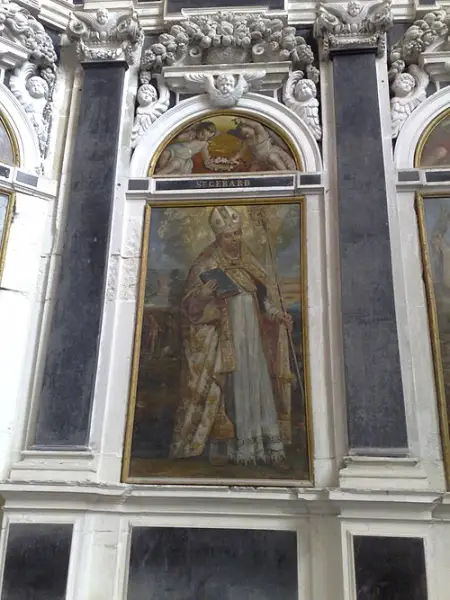
Gerard's afterlife in the region he governed has been durable. The diocesan cathedral he rebuilt and consecrated in 981 kept his tomb in its choir, a centre of pilgrimage and of the miracles recorded there from the time of his death. He is venerated in both the Roman Catholic Church and the Eastern Orthodox Church, his feast kept on 23 April, the day of his death. Two communities in particular claim his patronage: the city of Toul itself, whose schools, churches and convent bore the impress of his episcopate, and the town of Gerardmer in the Vosges, which carries a form of his very name. His emblem in art is the episcopal attire of a bishop, the outward sign of the office he accepted reluctantly and filled for thirty-one years. The story of his mother's death by lightning, which he read as judgment and call, passed into the memory of a diocese that saw in their bishop a man formed by tragedy into mercy. Scholar, builder, founder and quiet resister of secular power, he remains the model of a prelate who served the Church's freedom without serving himself.
§ Sainthood
Timeline
- 935
Born at Cologne to the nobles Ingranne and Emma and educated in that city
§ Life
- 3 Mar 963
Appointed Bishop of Toul by Bruno the Great on behalf of Pope John XII
§ Life
- 19 Mar 963
Consecrated bishop at Trier
§ Life
- 981
Consecrated the rebuilt Toul Cathedral, the most notable of the churches he restored
§ Life
- 23 Apr 994
Died during the night at Toul and was interred in the choir of the diocesan cathedral
§ Life
- 21 Oct 1050
Canonized in Rome by Pope Leo IX, who had succeeded to the same see of Toul
§ Sainthood
- 20 Oct 1051
Remains exhumed at Toul in Leo IX's presence and found well preserved, his white hair intact
§ Sainthood
The Record
- Major works
- Religious schools established in the Diocese of Toul·Reconstruction and consecration of the Toul Cathedral (981)·Foundation of a convent for nuns·Translation of the relics of Saints Mansuetus and Aprus to the church of Saint John the Baptist
- Patron of
- Toul·Gérardmer
- Symbols
- Episcopal attire
- Canonization
- Canonized by Pope Leo IX in Rome on 21 October 1050
Prayer
Bibliography
Show 4 sources
- ↑ "Saint Gerard of Toul". Saints SQPN. 24 April 2017. Retrieved 4 October 2017.
- ↑ "Gerard of Toul, St.". New Catholic Encyclopedia. Encyclopedia.com. 2003. Retrieved 4 October 2017.
- ↑ "St. Gerard, Bishop of Toul". Catholic Online. Retrieved 4 October 2017.
- ↑ Karl Leyser & Timothy Reuter (1992). Warriors and Churchmen in the High Middle Ages: Essays Presented to Karl Leyser. Continuum International Publishing Group. p. 56.
Profile text adapted from the Wikipedia article, licensed CC BY-SA 4.0.
Pray with this saint every day
Save St. Gerard of Toul to your favorites, read the full profile, and get feast-day reminders in the Saints app.
Get the Saints AppFree on the App Store for iPhone and iPad