
1633 - 1714·Feast January 16
St. Gerasimos Palladas
Patriarch of Alexandria and Preacher of the Divine Word
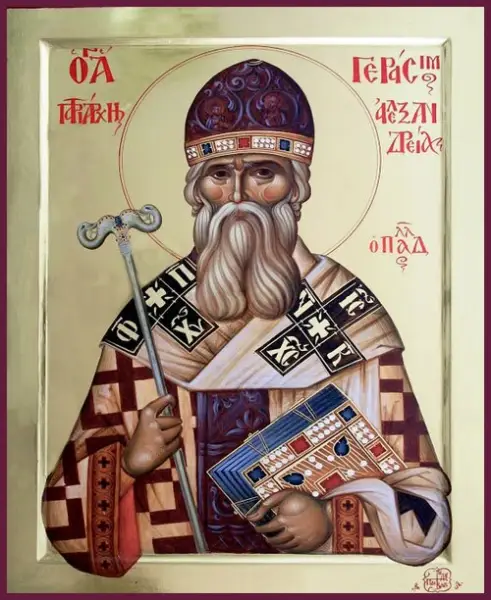
Overview
Gerasimos Palladas, honoured as Gerasimos II, served as Greek Orthodox Patriarch of Alexandria from 1688 to 1710 and is commemorated as a saint in the Eastern Orthodox Church on 16 January. He was born in 1633 at Skillous in Pediados, Crete, to parents of noble and devout character; the father, Theodoros, held the office of Protopriest and Preacher at Handaka, where a sermon of his from 1633 in honour of the Ten Holy Martyrs of Crete is still extant. Educated first by his father and then at Kerkyra and Venice, Gerasimos mastered Greek, Latin and Hebrew. Blocked from returning to Crete after it passed under Turkish rule, he taught and preached across the Greek lands - the Peloponnese, Ioannina, Arta and Paramythia - becoming known for wisdom and holiness. Elevated to the Metropolis of Kastoria at a date the record does not preserve, he was appointed Metropolitan of Adrianople in May 1686 and elected Patriarch of Alexandria on 25 July 1688, succeeding Parthenius, who had perished in the earthquake at Smyrna. His patriarchate was devoted above all to the dissemination of the divine word; many of his written homilies survive. Burdened by the Patriarchate's debts, he journeyed to Romania and Russia to raise funds, receiving honour and generous gifts, which made it possible for the Patriarchate to plant dependencies in both regions. He resigned his office in January 1710 and died on 15 January 1714 at the Vatopedi Monastery on Mount Athos.
The Complete Life
A Cretan Household of Priests and Preachers
Gerasimos first saw light in 1633 at Skillous, a village of Pediados on the island of Crete, born to parents of noble and devout character. The household was formed by the Church: the father, Theodoros, was Protopriest and Preacher at Handaka, and a sermon of his from that same year, given in honour of the Ten Holy Martyrs of Crete, is still extant - a glimpse of the liturgical and literary culture into which the boy was born. His first education came from his father, in the pattern of many clerical families of the period, but his gifts carried him further afield. He pursued advanced studies at Kerkyra, the Ionian island that stood in contact with the learning of Italy, and at Venice itself, the great centre of the Greek diaspora. There he became proficient in the three languages of the Christian classics - Greek, Latin and Hebrew - a preparation that would later serve his preaching and, perhaps, his theological writing. Crete at that moment stood on the edge of catastrophe; the long war between Venice and the Ottoman Empire was nearing its end, and the island's Christian civilization, in which the boy had been raised, was about to pass under Turkish rule.
§ Introduction
Teacher and Preacher in Exile
When Gerasimos sought to return to Greece, the way home was barred: Crete had fallen to the Ottomans, and access to his native island was no longer possible for him. The exile became his vocation. He gave himself instead to teaching and preaching across the Greek mainland and peninsula, labouring in the Peloponnese, at Ioannina, at Arta and at Paramythia - a circuit that carried the word to communities scattered and unsettled by the Ottoman advance. In these years his teaching won him a name for wisdom and holiness, the two qualities that would carry him to the hierarchy. His elevation to the Metropolis of Kastoria remains undocumented as to its date and circumstances, but the see marked his entry into the episcopate and gave weight to his reputation. It was a career shaped by displacement: the Cretan who could not go home became a preacher to all of Greece, and the learning gathered in Venice and Kerkyra was spent not in a library but in the villages and towns of a Church under pressure, where a sermon in the mother tongue was itself an act of consolation and resistance.
§ Introduction
Metropolitan, Patriarch and Almoner of a Burdened Church
In May 1686 Gerasimos was appointed Metropolitan of Adrianople, and there his intellect and leadership won wider recognition. Two years later the throne of Saint Mark fell vacant: Patriarch Parthenius, who had led the Church of Alexandria from 1678, perished in the earthquake at Smyrna, and on 25 July 1688 Gerasimos was elected to succeed him. His patriarchate, which lasted until 20 January 1710, was devoted above all to the dissemination of the divine word; preaching and teaching remained the axis of his labours, and many written homilies of his are still preserved in witness to it. The Patriarchate he inherited carried significant debts, and Gerasimos confronted them in person, travelling to Romania and to Russia to raise funds. In both lands he was received with honour and presented with generous gifts, and the contacts he forged bore institutional fruit in the establishment of dependencies of the Patriarchate of Alexandria in those regions - a widening of the Apostolic See's reach into the Orthodox north that outlasted his own tenure. Administrator, fundraiser and preacher at once, he sustained an ancient see through a difficult age.
§ Introduction
Resignation and Death on Athos
Gerasimos resigned the patriarchal throne on 20 January 1710, after more than twenty-one years of office. The closing chapters of his life were spent away from Alexandria, and their quietness contrasts with the travels of his patriarchate: the man who had crossed to Romania and Russia in search of help for his see ended his days as a monk at prayer on the Holy Mountain. He died on 15 January 1714 at the Vatopedi Monastery on Mount Athos, one of the great imperial foundations of Byzantine monasticism and a fitting place of rest for a patriarch of the Greek Church. He was in his eighty-first year. The date of his death, 15 January, falls on the eve of the day on which his memory would afterwards be kept, 16 January, and the monastery that received his last days became linked to his veneration. Of his final years little else is recorded - a silence in keeping with how much of the Orthodox East's seventeenth-century history rests on slender documentation and the survival of a few sermons.
§ Introduction
Ranked Among the Holy Hierarchs
Veneration of Gerasimos grew within the Church he had governed. The Eastern Orthodox Church numbers him among its saints under the title of Patriarch and Holy Hierarch, and his memory is celebrated annually on 16 January. Formal recognition came in modern times: in 2003 the Greek Orthodox Patriarchate of Alexandria inscribed him among its saints at Alexandria, restoring to the calendar of the Apostolic See a patriarch whose written homilies had continued to circulate among the faithful. His canonization belongs to a wider pattern by which the Alexandrian Church in recent centuries has commemorated the shepherds of its Ottoman-era history, men whose sanctity was attested by their teaching, their endurance and their care for a scattered flock. For the monastery of Vatopedi, where he died, and for the communities of Crete that remember their native son, his feast is a double homecoming - the islander who died an exile on Athos is now prayed to wherever Greek is spoken, from the Peloponnese where he preached to the African throne he adorned. In his lifetime his homilies had fed the faithful of Alexandria; the canonization acknowledged that both the preaching and the preacher had endured.
§ Introduction
Timeline
- 1633
Born at Skillous in Pediados, Crete, to the priest Theodoros, whose sermon on the Ten Holy Martyrs of Crete still survives
§ Introduction
- May 1686
Appointed Metropolitan of Adrianople, where his intellect and leadership won recognition
§ Introduction
- 25 Jul 1688
Elected Patriarch of Alexandria, succeeding Parthenius, who had perished in the earthquake at Smyrna
§ Introduction
- 20 Jan 1710
Laid down the patriarchal office of Alexandria after twenty-two years of service
§ Introduction
- 15 Jan 1714
Died at the Vatopedi Monastery on Mount Athos
§ Introduction
- 2003
Canonized by the Greek Orthodox Patriarchate of Alexandria at Alexandria
§ Introduction
The Record
- Major works
- Written homilies from his patriarchate, many of which survive
- Canonization
- Canonized in 2003 at Alexandria by the Greek Orthodox Patriarchate of Alexandria
Prayer
Bibliography
Show 2 sources
- ↑ Great Synaxaristes: (ὥn Greek) Ὡ ἁγιος Γεράσιμος ὁ ΠαλλαδṰς Πατριάρχης Ἀλεξανδρείας. 16 Ἰανουαρίου. ΜΕΓΑΣ ΣΥΝΑΞΑΡΙΣΤΗΣ.
- ↑ "Gerasimos II Paladas (1688–1710)". Official web site of the Greek Orthodox Patriarchate of Alexandria and All Africa. Retrieved 7 February 2011.
Profile text adapted from the Wikipedia article, licensed CC BY-SA 4.0.
Pray with this saint every day
Save St. Gerasimos Palladas to your favorites, read the full profile, and get feast-day reminders in the Saints app.
Get the Saints AppFree on the App Store for iPhone and iPad