
1509 - 1579·Feast August 16
St. Gerasimos of Kefalonia
Patron of Kefalonia and Founder of New Jerusalem
Overview
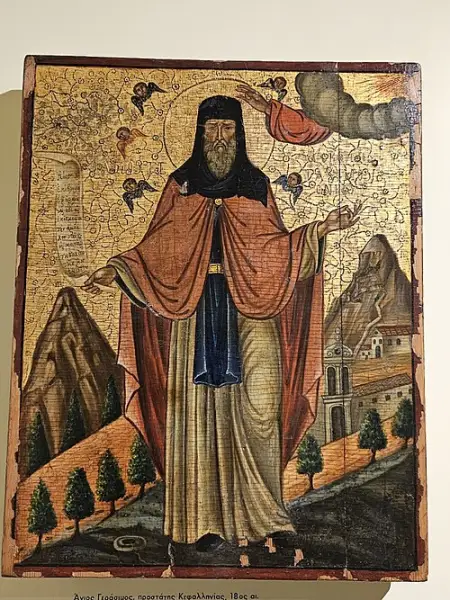
Gerasimos of Kefalonia is the patron saint of the Ionian island of Kefalonia in Greece. Born in 1509 into the aristocratic and wealthy Notaras family at Trikala in Corinthia, he embraced the monastic life, receiving his habit on Mount Athos and then spending twelve years in Jerusalem, with further time in Crete and Zakynthos. In 1555 he arrived on Kefalonia, where he lived his first five years as a hermit in a cave in the area of Lassi before settling in the district near Valsamata. There he cultivated the ground on which the monastery of Saint Gerasimos now stands and founded the Monastery of the Dormition of the Theotokos, called the New Jerusalem, which cared for the poor and became a centre of charity on the island. He died there on 15 August 1579. Twice buried and twice exhumed, his body was found incorrupt, and the Church ranked him among the saints. His relics remain at the monastery for veneration, and during his feasts - 16 August and 20 October, the translation of his relics - they are carried over the sick for their healing. Islanders credit him with protecting them in calamity, and many Kefalonian children bear his name.
The Complete Life
From the Notaras Family to the Holy Mountain
Gerasimos came from the Notaras family, an aristocratic and wealthy house of the Greek world whose name recalled the last ages of Byzantium. He was born in 1509 at Trikala in Corinthia, in the Peloponnese. Rank and wealth did not hold him: he sought the monastic life and was ordained to it on Mount Athos, the great centre of Orthodox monasticism, where he took up the ascetic discipline that would shape the rest of his days. From the Holy Mountain his path led to the Holy Places; he spent twelve years in Jerusalem, in the city of the Resurrection, in prayer and service among its shrines. His wanderings then carried him westward across the Greek world - he spent some time in Crete and in Zakynthos, moving among the islands and monasteries where Orthodox life persisted under Venetian and Ottoman rule. Each stage of the journey stripped away another attachment: family, homeland, and finally any fixed dwelling. It was the formation of a hermit and founder in one - a monk trained on Athos, deepened in Jerusalem, and ripened by years of movement - who in middle age would at last plant a permanent work on a single island.
§ Life
A Cave at Lassi and a Monastery at Valsamata
In 1555 Gerasimos arrived on Kefalonia, the largest of the Ionian islands. For his first five years there he kept to a cave in the Lassi district, living as the hermit his Athos and Jerusalem years had formed him to be. Then he came down from solitude to cultivation: he took up land in the district near Valsamata, tilled it with his own hands, and raised upon it the monastery that bears his name - the Monastery of the Dormition of the Theotokos, which he called the New Jerusalem, in memory of the holy city where he had spent twelve years. The foundation was ordered outward as well as upward: the monastery cared for the poor and became a centre for charity on the island, feeding and sheltering those in need. Gerasimos thus joined in one work the two halves of his life, the contemplative solitude of the cave and the active charity of the cultivated estate. He remained at his foundation until his death on 15 August 1579, the feast of the Dormition he had honoured in his monastery's name, and was buried there, beginning the chain of wonders that would make him Kefalonia's patron.
§ Life
Twice Exhumed, Found Incorrupt
After Gerasimos died, his body was buried twice and exhumed twice, and on each exhumation it was found intact - a sign that Orthodox tradition reads as the seal of holiness. On that evidence the Church canonized him among the saints. His remains were never returned to the grave: they rest at the monastery he founded, exposed for the veneration of the faithful, having never decomposed. The Church displays the relics during the liturgy at the monastery on many occasions through the year, and above all at his two feasts. On 16 August - kept on the day after the Dormition, whose feast of 15 August he died on - and on 20 October, the feast of the translation of his relics, the body of the saint is carried in procession and passed over the ill and the sick who gather beneath it, that they may be healed. The practice continues a relationship that began on the island four and a half centuries ago: the monk who tilled the ground of Valsamata remains present in the midst of his people, his incorrupt body an argument that death did not end his care for them.
§ Veneration
Protector of the Island
Natives of Kefalonia believe that Saint Gerasimos protects them and heals them of illness, and their attachment to him is written into their family life: many islanders name their children after the saint as a tribute to the protector they invoke. His guardianship of Kefalonia became concrete in modern memory in 1953, when a powerful earthquake destroyed ninety per cent of the island. In the days of ruin that followed, many islanders reported sightings of Saint Gerasimos throughout Kefalonia, believing that he moved among the destroyed villages comforting and tending the injured trapped inside homes and collapsed buildings. Devotion has followed the Kefalonian diaspora as well: a church named in his honour was established in New York City by Kefalonians who emigrated there in the early twentieth century, and Kefalonians throughout the world still revere him and pray to him. The monastery he founded remains the heart of it all, holding his relics, keeping his feasts, and carrying his body over the sick twice each year - the continuing charity of the poor man's monastery, four centuries after its founder's death.
§ Veneration
Timeline
- 1509
Born into the aristocratic Notaras family at Trikala in Corinthia
§ Introduction
- 1555
Arrived on Kefalonia after monastic life on Mount Athos, twelve years in Jerusalem, and time in Crete and Zakynthos
§ Life
- 15 Aug 1579
Died at the Monastery of the Dormition of the Theotokos (the New Jerusalem) near Valsamata
§ Introduction
- 1953
Believed by islanders to have appeared across Kefalonia, comforting and tending the injured after the earthquake that destroyed ninety per cent of the island
§ Veneration
The Record
- Major works
- Monastery of the Dormition of the Theotokos (the New Jerusalem) near Valsamata, Kefalonia
- Patron of
- Kefalonia·against illness
- Canonization
- Canonized after his body, twice exhumed, was found incorrupt; the source records no date for the act
Prayer
Bibliography
Show 6 sources
- ↑ Great Synaxaristes: (in Greek) Ὡ Ὥσιος Γεράσιμος ὁ νέος ἀσκητὴς ὁ ἐν Κεφαλληνίᾳ. 16 Ἀυγούστου. ΜΕΓΑΣ ΣΥΝΑΞΑΡΙΣΤΗΣ.
- ↑ "Venerable Gerasimus the New Ascetic of Cephalonia". OCA - Lives of the Saints.
- ↑ Monastiriaka website
- ↑ Kefalonia website
- ↑ Athonian website
- ↑ St Gerasimos NY website
Profile text adapted from the Wikipedia article, licensed CC BY-SA 4.0.
Pray with this saint every day
Save St. Gerasimos of Kefalonia to your favorites, read the full profile, and get feast-day reminders in the Saints app.
Get the Saints AppFree on the App Store for iPhone and iPad