
early 5th century - 475·Feast March 4
St. Gerasimus of the Jordan
Desert Father of the Jordan and Tamer of the Lion
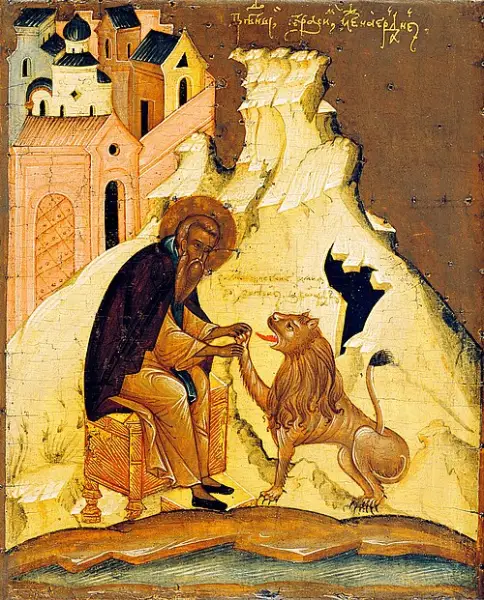
Overview
Gerasimus of the Jordan, also spelled Gerasimos and known as Abba Gerasimus, was a Christian monk and abbot of the fifth century. His birth, early in the fifth century, came to a family of wealth in Lycia, the southern province of Asia Minor; he abandoned his family's riches and worldly affairs to become a monk. His ascetic apprenticeship took him first to the Thebaid, the harsh desert of upper Egypt where the monastic movement began, and later back to his native Lycia. Around the middle of the fifth century he made his way to Palestine, choosing solitude in the wilderness by the Jordan River; there he founded a monastery and became renowned for a life of asceticism and prayer. He is reputed to have attended the Fourth Ecumenical Council at Chalcedon in 451. The best-known story attached to him tells how he tamed a lion by drawing a thorn from its paw and taught the beast obedience; the anecdote spread through the whole Christian world, and a parallel tale about Saint Jerome may in fact derive from a confusion with Gerasimus. He died in 475, though other accounts give 451. The Greek Orthodox monastery of Deir Hajla near Jericho commemorates him, and the Eastern Church keeps his feast on 4 March, the Roman Church on 5 March.
The Complete Life
Wealth Renounced in Lycia
Gerasimus was born early in the fifth century to a family of considerable wealth at Lycia, a province of southern Asia Minor within the Eastern Roman Empire. His life turned on a single renunciation: he left his family's wealth and the affairs of the world to become a monk. That decision, ordinary in its wording, was radical in its setting - a man of property in the late Roman East walking away from estate, status and expectation to join the ascetic movement that was reshaping Christianity from the deserts outward. The sources record nothing of his parents, his education or the occasion of his conversion; the silence itself belongs to the type, for the desert fathers were remembered chiefly for what they left behind, not for what they had been. What is known is the sequence of his formation: first the Egyptian desert, then Lycia again, then Palestine. The wealthy young man of Lycia became, step by step, the abba of the Jordan - a title of spiritual fatherhood earned not by inheritance but by the long discipline of dispossession that began when he first turned his back on his patrimony.
§ Biography
Thebaid and Return
The first stage of Gerasimus's monastic apprenticeship was the Thebaid, the desert region of upper Egypt where Antony and the earliest fathers had planted monasticism and where the severest forms of the ascetic life were still practised. There the monk from Asia Minor learned in the original school the discipline of fasting, vigil and unceasing prayer that the Church's hymns would later celebrate in his honour. From Egypt he returned to his native Lycia, carrying the desert tradition back to his own province - a common pattern by which the monastic movement spread from Egypt across the Christian world through the disciples it formed. But Lycia did not hold him either. About the middle of the fifth century he set out for Palestine, the land of the Gospel, and took up his dwelling in the wilderness near the Jordan River, in the same Judean desert where monastic colonies had flourished since the days of Chariton and Euthymius. The itinerary - Egypt, Lycia, Palestine - reads like a map of fifth-century monasticism itself, and Gerasimus moved across it as one of the generation that carried the desert ideal to its permanent homes.
§ Biography
Lavra by the Jordan and the Council of Chalcedon
In the wilderness near the Jordan, Gerasimus established a monastery and gave himself to the righteous life of asceticism and prayer for which he became known throughout the region. The settlement he founded stood in the country near the river, and the Greek Orthodox monastery of Deir Hajla, near Jericho, commemorates him to this day on the site where his lavra was nearby. His reputation drew disciples to the desert, and his name drew the attention of the wider Church: he is reputed to have attended the Fourth Ecumenical Council at Chalcedon in 451, the assembly that defined the union of divinity and humanity in Christ. Whatever the exact character of his presence there, the tradition links the desert abbot to the great doctrinal crisis of his age. He died in 475, though other accounts place his death in 451 - the same year as the council - a divergence that shows how early and how unevenly the record of even famous monks was fixed. His feast is kept on 4 March in the Eastern Orthodox Church and on 5 March in the Roman Catholic Church.
§ Biography
The Lion, the Monastery and the Hymns
The story that carried Gerasimus's name across the Christian world is the anecdote of the lion: the saint came upon the beast suffering from a thorn in its paw, removed it, and tamed the animal, teaching it obedience; according to the tradition preserved in the Church's hymnography, the lion served him until his death and died in grief upon his grave. The tale became widely known, and a parallel story is told of Saint Jerome; scholars have argued that the Jerome version may derive from a confusion with Gerasimus, since Jerome's name in later Latin, Geronimus, resembled his. In art the tamed lion became the saint's defining attribute. His monastery endured in memory and in stone: the Greek Orthodox monastery of Deir Hajla near Jericho commemorates the saint whose lavra stood nearby, and its history is joined to another narrative - the cave there where the Holy Family is said to have found refuge during the flight from Herod the Great, marked by an underground chapel. The East still sings his troparion and kontakion, honouring the dweller of the desert, angel in the body, whose fasting and vigil received heavenly gifts and healing for those drawn to him in faith.
§ Monastery of St. Gerasimus
Timeline
- 451
Reputed to have been present at the Fourth Ecumenical Council, held at Chalcedon in this year.
§ Biography
- 475
Died at the Monastery of St. Gerasimus, though an alternative tradition dates his death to 451.
§ Biography
In Their Own Words
Dweller of the desert and angel in the body, / you were shown to be a wonderworker, our God-bearing Father Gerasimus. / You received heavenly gifts through fasting, vigil, and prayer: / healing the sick and the souls of those drawn to you by faith. / Glory to Him who gave you strength! / Glory to Him who granted you a crown! / Glory to Him who through you grants healing to all!
Father, you burned with heavenly love, / preferring the harshness of the Jordan desert to all the delights of the world. / Therefore, a wild beast served you until your death; he died in obedience / in grief on your grave. / Thus God has glorified you, / and when you pray to Him / remember us, Father Gerasimus.
The Record
- Major works
- Monastery (lavra) in the wilderness near the Jordan River, commemorated by the Greek Orthodox monastery of Deir Hajla near Jericho
- Symbols
- Taming a lion
- Canonization
- Pre-congregation; venerated as a saint since antiquity in the Eastern Orthodox and Roman Catholic Churches
Prayer
Bibliography
Show 7 sources
- ↑ "Saint Gerasimus", from the Russian Lives of the Saints based on the Menologion of St. Dimitry of Rostov, Orthodox Church in America
- ↑ A. Mertens, "Gerasimus near the Jordan", "Who was a Christian in the Holy Land?" - Encyclopedia, Studium Biblicum Franciscanum, Jerusalem
- ↑ "St. Gerasimus", The Society of Clerks Secular of Saint Basil, The Orthodox Catholic Church of the Americas, Holy Inocents Orthodox Church BBS
- ↑ Hope Werness, Continuum encyclopaedia of animal symbolism in art, 2006
- ↑ "Saint Gerasimus", Patron Saints Index, Star Quest Production Network
- ↑ Winter, Dave (1999). Israel handbook: with the Palestinian Authority areas (2nd ed.). Footprint Handbooks. ISBN 0658003682
- ↑ "Venerable Gerasimus of the Jordan", Orthodox Church in America
Profile text adapted from the Wikipedia article, licensed CC BY-SA 4.0.
Pray with this saint every day
Save St. Gerasimus of the Jordan to your favorites, read the full profile, and get feast-day reminders in the Saints app.
Get the Saints AppFree on the App Store for iPhone and iPad