
died c. 690·Feast December 7
St. Gerbold
Monastic Founder and Bishop of Bayeux
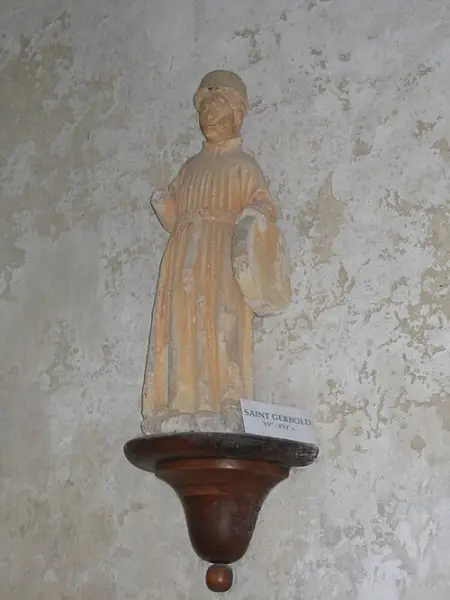
Overview
Gerbold, whose name surfaces in French as saint Gerbaud or saint Gerbold, died around the year 690 and is honored as a saint by the church. The medieval notice of his career is remarkably compressed: he embraced monastic life, established the abbey of Livry amid the Norman countryside, and in due course took up the government of the diocese of Bayeux as its bishop. A place remembered as the Hermitage of Saint Gerbold keeps his name attached to the Norman landscape, hinting at a tradition of solitary prayer that no surviving text now describes. His memory has been strong enough to draw scholarly interest in modern times, and his feast is kept on December 7. He stands among those early bishops of whom the church preserved the essentials — office, foundation, sanctity — while the rest of the story was lost.
The Complete Life
From Cloister to Cathedral
The Gerbold whom the sources remember was, first of all, a monk. In the seventh century, when the Frankish church was still knitting its institutions together, he founded the abbey of Livry in the Normandy of his day, planting monastic prayer in a region that would keep his memory for centuries. Establishing an abbey demanded land, patronage, and endurance; the compression of the surviving notice tells how much of the ordinary toil behind such a foundation has simply dropped out of the written record. From the cloister he passed to the cathedral: he became bishop of Bayeux, one of the ancient sees of northwestern Gaul, and carried the disciplines of monastic life into the government of a diocese. No dates for his abbacy, no account of his consecration, and no episodes from his episcopal administration survive — only the fact of the office itself, held until his death around 690. Yet that pairing of roles was not recorded casually. Medieval memory judged it worth preserving that a man formed in the common life and the daily office was found worthy to shepherd a whole church, and the double vocation of founder and bishop remains the clearest outline of who Gerbold was.
§ Introduction
A Quiet and Durable Memory
Gerbold's cult is old enough to be counted pre-congregational: he has been honored as a saint since an age long before the formal process existed, and his feast is kept on December 7. Material memory of him endures in the Norman landscape at a site known as the Hermitage of Saint Gerbold, which points to a local tradition of eremitical prayer bound up with his name even where the documents fall silent. His figure also passed into the wider imagination of the region — one modern study links his cult with Norman folklore surrounding cider and the giant Gargantua, a reminder that the saints of the countryside lived in oral tradition as much as in liturgy. Care is needed to distinguish him from Gerebald, a ninth-century bishop of Châlon-sur-Saône whose similar name has invited confusion across the centuries. Modern scholarship has not wholly forgotten him either: a monograph on the saint by Jean Fournée and Christiane Daireaux, published in 1991, shows that even a slender record can sustain serious historical attention. What remains is the essential shape — monk, founder, bishop, saint — and a memory that outlasted the loss of nearly every detail.
§ Introduction
The Record
- Major works
- Abbey of Livry, Normandy
- Symbols
- A hermitage bearing his name in the Norman countryside
- Canonization
- Pre-congregation; honored by the church since the seventh century
Prayer
Bibliography
Show 3 sources
- Jean Fournée and Christiane Daireaux, Saint Gerbold, évêque de Bayeux: (fin du VIIe siècle), Société d'archéologie et d'histoire de la Manche, 1991
- Patrice Lajoye, La Normandie, le cidre, Gargantua et saint Gerbold, sur academia.edu
- Saint Gerbaud ou Gerbold
Profile text adapted from the Wikipedia article, licensed CC BY-SA 4.0.
Pray with this saint every day
Save St. Gerbold to your favorites, read the full profile, and get feast-day reminders in the Saints app.
Get the Saints AppFree on the App Store for iPhone and iPad