
608 – 658·Feast September 24
St. Geremarus
Frankish Courtier Turned Abbot of Fly
Overview
Geremarus — also called Germer, Geremar, or Geremaro — was a Frankish noble who traded a career at the Merovingian court for monastic life and died as abbot of the monastery that still bears his name. Born in 608 at Vardes near Neuf-Marché, some thirty kilometers west of Beauvais, he was educated at the episcopal school of Beauvais and rose high in the service of kings Dagobert I and Clovis II. There he met the bishop Audoin, whose counsel redirected his life: first toward the founding of a monastery on the Isle-sur-Epte, then toward priesthood, and after a difficult abbacy and a period of retreat, toward the foundation at Fly, later Saint-Germer-de-Fly Abbey, around 655. He governed that house only briefly, dying about three years after its founding, on September 24, 658. The oldest life of Geremarus was written in the ninth century and revised three centuries later, so its details rest on shaky ground; later accounts differ on his wife, his children, and the order of his foundations. Yet the outline holds firm across the sources: a courtier who renounced rank, a founder twice over, and an abbot whose abbey became one of the great houses of the French medieval church.
The Complete Life
Noble Birth and the King's Service
The man the sources call Geremarus, Germer, or Geremar was born in 608, by the traditional account at Vardes in the Neuf-Marché, roughly thirty kilometers west of Beauvais. His parents, named in the older lives as Rigobert and Aga, belonged to the first nobility of the Beauvaisis, and the boy was sent to the Episcopal School in Beauvais for his education — a formation that joined rank to learning in the usual pattern for a future servant of the crown. His abilities brought him into the orbit of the Merovingian court: he held high positions under King Dagobert I, who reigned from 629 to 639, and continued in office under Dagobert's son Clovis II. The Monks of Ramsgate record that Dagobert made him a royal councillor alongside his friends Eloi and Ouen, two of the great figures of seventh-century Gaul. The older sources also speak of a marriage: Butler writes that he wed a pious woman named Domana, and the Ramsgate account credits the couple with three children. These family details sit awkwardly alongside one another — the brief modern life names two girls and a boy, each lost in infancy, while the Ramsgate account holds their youngest child, Amalberga, to be honored as a saint — and they illustrate how unevenly the two strands of his legend were woven.
§ Life
The Turn to Monastic Life
The decisive friendship of Geremarus's life was with Audoin, the bishop and royal servant known in French tradition as Ouen or Owen. The two met at Dagobert's court, and it was on Audoin's advice that Geremarus took the first step out of the world: the founding of a monastery on the Isle-sur-Epte, a house dedicated to Saint Peter that was later known as Saint-Pierre-Bois. Butler adds that he built this monastery while still a layman, financing it from his own means — a pattern common among Frankish aristocrats who founded houses before taking vows themselves. Audoin then ordained him a priest, sealing the break with his former life. His first experiment in monastic leadership ended badly. About 649 he moved to the abbey of Pental, in the territory of Rouen, where he became superior, but a revolt against his governance drove him out. Butler sharpens the story: finding the monks averse to regular discipline, he abandoned the abbacy and withdrew for five years and six months to a cave near the Seine, leading the hidden life of a hermit. The sources thus preserve, unusually intact, both the failure and the retreat — a reminder that in the hagiography of the founders, adversity was not edited out but read as providence.
§ Life
Founding Fly
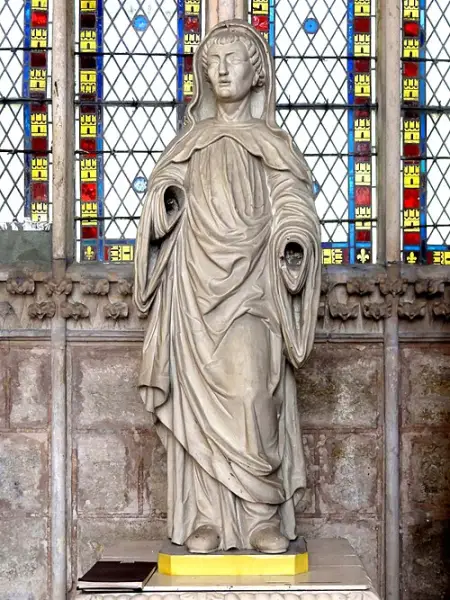
Restlessness settled into purpose when, once more on Audoin's counsel, Geremarus founded the house for which he is remembered. Butler dates the event to 655 and explains its financing with plain economic logic: when Germer's only son Amalbert died and was buried in the monastery of Saint Peter, the estate that reverted to the father from the child's death furnished the means for a new foundation. Five leagues from Beauvais, on the road toward Rouen, he established the monastery of Fley — Flaviacum in Latin — the future Saint-Germer-de-Fly Abbey, and gathered there a community of fervent monks. The choice of counsel is itself telling: twice the turning points of his life came at Audoin's advice, so that his vocation bears the marks of spiritual direction as much as personal resolve. He governed the new house only briefly — about three years and a half, by Butler's reckoning — but the foundation proved durable. The abbey took his name, became a significant religious house of the Île-de-France and Normandy borderlands, and kept his memory alive across the centuries, down to the statue of the saint that still stands in its chapel. Few founders could claim a house so closely identified with them for so long.
§ Butler's account
Death and Relics
Geremarus died on September 24, 658, a few years after planting the community at Fly, and was buried in the church of his own abbey, which soon took his name — the surest sign, in medieval custom, that a founder's cult had taken root. His peace after death was not undisturbed. When Norman raiders swept up the Seine in the ninth century, the monks, fearing plunder, smuggled his relics to safety in Beauvais. There they remained, kept in the cathedral, and Butler records that they were still venerated there in his own day — all but the bones of one arm, which had been restored to Saint-Germer-de-Fly as a partial return of the founder to his foundation. The abbey itself regained vigor in the seventeenth century: in 1643 Augustin Potier, bishop of Beauvais, settled monks of the congregation of Saint Maur in the house and established there a celebrated school of humane letters, carrying its students up through the whole course of rhetoric. Thus the founder's double legacy — his relics in the cathedral of his youth's diocese and his abbey renewed as a house of prayer and learning — extended far beyond his three brief years of governance at Fly.
§ Butler's account
A Saint Between History and Legend
Geremarus occupies a delicate place among the saints of seventh-century Gaul: widely venerated, yet hard to pin down. The oldest surviving life was composed in the ninth century, two hundred years after his death, and was revised three centuries later still, and its historical accuracy is very dubious. The consequences of that gap show themselves in every detail. The brief modern account has him born at Vardes and educated at Beauvais; Butler places his birth instead at his parents' castle in a village called Warandra, in the reign of King Clotaire. The modern life gives him two girls and a boy who died young; the Ramsgate account gives him three children and canonizes the youngest as Amalberga; Butler knows only a son, Amalbert. His movements — the Isle-sur-Epte, Pental, the cave near the Seine, Fly — are common to the sources, but their order and motive differ with each teller. What no version disputes is the shape of the story: a nobleman of the Beauvaisis, counselor to Dagobert I, who left the court to found monasteries and died an abbot on September 24, 658. His feast on that date keeps alive one of the great second careers of the Frankish church.
§ Monks of Ramsgate account
Timeline
- 608
Born at Vardes in the Neuf-Marché, west of Beauvais, to noble parents
§ Introduction
- 629
Enters royal service, holding high posts at the court of Dagobert I as his reign begins
§ Life
- 649
Moves to Pental Abbey around this date and becomes its superior, but departs after a revolt against his leadership
§ Life
- 655
Founds the monastery of Fley, the future Saint-Germer-de-Fly Abbey, near Beauvais, assembling a community of fervent monks
§ Butler's account
- 24 Sep 658
Dies at Fly on 24 September after governing the abbey for three and a half years, and is buried in its church
§ Butler's account
- 1643
Bishop Augustin Potier of Beauvais installs Maurist monks at his abbey and erects a school of humanities there
§ Butler's account
In Their Own Words
Having governed this house three years and a half, he happily died on the 24th of September, 658.
The Record
- Major works
- Isle-sur-Epte Abbey (later Saint-Pierre-Bois)·Saint-Germer-de-Fly Abbey
- Symbols
- Abbot's crozier·Monastic habit
- Canonization
- Pre-congregation; ancient cult centered on Saint-Germer-de-Fly Abbey
Prayer
Bibliography
Show 3 sources
- Butler, Alban (1866), The Lives of the Fathers, Martyrs, and Other Principal Saints, vol. 9, James Duffy
- Chlumský, Jan, "St. Geremar", catholica.cz (in Czech)
- St. Augustine's Abbey, Ramsgate (1921). The Book of saints: a dictionary of servants of God canonized by the Catholic Church. London: A. & C. Black, ltd. OCLC 671676136
Profile text adapted from the Wikipedia article, licensed CC BY-SA 4.0.
Pray with this saint every day
Save St. Geremarus to your favorites, read the full profile, and get feast-day reminders in the Saints app.
Get the Saints AppFree on the App Store for iPhone and iPad