
died c. 304·Feast October 10
St. Gereon of Cologne
Martyr of Cologne and the Theban Legion
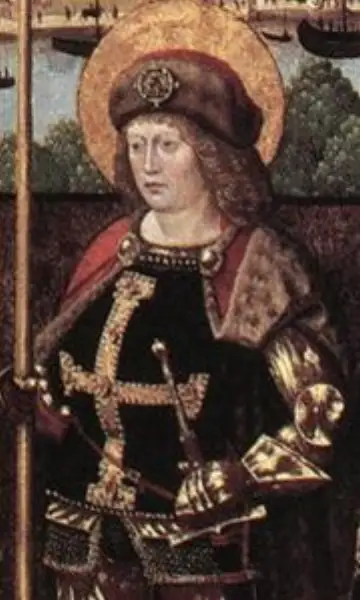
Overview
Gereon of Cologne died around the year 304, very probably by beheading, and may have been a soldier; on that slender certainty an entire devotional tradition has been built. The Roman Martyrology gives the official account in a single sentence: at Cologne, Gereon and his companions offered their necks to the sword with sincere piety and courage. Beyond that, nothing more can be affirmed with historical certainty. Legend supplies the rest. Gereon, styled the "Golden Saint", was said to belong to the Theban Legion, and Gregory of Tours, writing in the sixth century, described him as leader of a detachment of fifty of its men slaughtered at Agaunum on Maximian's orders because they would not offer sacrifice to the pagan gods. Later medieval imagination raised the number of his companions to 290 or even 319. Whatever the history, the cult was real and durable: a great basilica in Cologne bears his name, he was painted by Stefan Lochner, his figure appeared on a medieval convent seal, and he became one of the favored military saints of Christendom, invoked by those who suffer migraine headaches.
The Complete Life
A Soldier of the Theban Legion
Everything about Gereon's identity beyond the bare fact of his martyrdom comes by way of legend, and the legend makes him a soldier. He is called the "Golden Saint" and is said to have belonged to the Theban Legion, the entirely legendary but enduringly beloved corps of Christian soldiers from Egypt whose members were put to death for refusing to persecute their fellow believers. Gregory of Tours, the great sixth-century historian whose writings did so much to fix the shape of early medieval hagiography, gave the story its classic form: Gereon commanded a detachment of fifty men of the legion who were massacred at Agaunum, in the Swiss Alps, on the orders of Emperor Maximian, because they would not sacrifice to the pagan gods to obtain victory in battle. Medieval devotion was not content with fifty. Later legend swelled the number of Gereon's companions to 290, then to 319, and gave some of them names — Cassius, Gregorius Maurus, Florentius, Innocentius, Constantinus, and Victor — individuality added to anonymity in the manner of popular cult. All of this is legend; history knows only a Gereon who died at Cologne. But the soldier-saint of the legion became the figure under whom generations of the faithful knew and invoked him.
§ Legend
Martyrdom at Cologne
What the church officially holds about Gereon is contained in the line of the Roman Martyrology: at Cologne in Germany, Gereon and his companions, martyrs, with sincere piety and courage offered their necks to the sword. He died by beheading, most likely in the early fourth century, in an era when the Roman state was still capable of executing Christians for their faith, and he died not alone but at the head of a group — a certain number of fellow believers whose names, numbers, and circumstances have not survived. History can establish nothing further about them. That silence has not made the witness less powerful. A Christian leader put to death in one of the chief cities of the Rhine frontier, remembered precisely for the manner of his dying, became a fixed point in the calendar of the Western church. The Venerable Bede records that the feast of Gereon and his companions was kept in the Sarum calendar and in the calendars of Barking and Durham — evidence that the cult had crossed from the Rhine to England well before the Norman Conquest. The martyrdom at Cologne thus became not a local memory but a shared possession of the medieval church.
§ Sources
Basilica, Paintings, and Devotion
Few martyrs of the early centuries left so visible a mark on a city's fabric. St. Gereon's Basilica in Cologne stands dedicated to him, one of the great Romanesque churches of the city and the architectural anchor of his cult. In the fifteenth century Stefan Lochner, the master of the Cologne school of painting, made a triptych whose central panel shows the adoration of the Magi in nearly life-size figures, while the side panels present Ursula with her companions on one side and Gereon with his warriors on the other — the martyr installed beside the city's most beloved virgin saint. In 1810 the painting left the town hall for the cathedral's choir chapel, and there it has stayed among the city's treasures. The martyr also appears on the thirteenth-century seal of the Convent of St. Gereon in Cologne, testimony to his place in the city's institutional religious life. Norbert of Xanten is said to have been shown in a vision the resting place where the remains of Ursula's company, of Gereon, and of other martyrs lay concealed. His fame even crossed borders of language and nation: Saint-Géréon, a small town in the Loire-Atlantique of France, carries his name. Along with other beheaded saints he is invoked against migraine — the popular logic that joined the place of his wound to the ailments of the head.
§ Legacy
Timeline
- 304
Martyred at Cologne by beheading, probably in the early fourth century, at the head of a band of Christian companions.
§ Introduction
- 1810
The triptych showing Gereon and his warriors left the town hall for the choir chapel of the Cologne cathedral.
§ Legacy
In Their Own Words
In Cologne in Germany, the Saints Gereon and his companions, martyrs, who with sincere piety, courageously offered their necks to the sword.
The Record
- Patron of
- Against migraine headaches
- Symbols
- Attire of a medieval knight or a Roman legionary
- Canonization
- Pre-congregation; ancient martyr cult at Cologne
Prayer
Bibliography
Show 6 sources
- Arduino, Fabio, "San Gereone e Compagni Martiri", Santi e Beati, December 7, 2005
- "St. Gereon", Köln Tourismus
- Geudens, Francis Martin. "St. Norbert." The Catholic Encyclopedia. Vol. 11. New York: Robert Appleton Company, 1911
- Gietmann, Gerhard. "Stephen Lochner." The Catholic Encyclopedia. Vol. 9. New York: Robert Appleton Company, 1910
- "Des villages de Cassini aux communes d'aujourd'hui: Commune data sheet Saint-Géréon", EHESS (in French)
- Tillotsin, Dianne. "Seals of Ecclesiastical Institutions", Medieval Writing, archived from the original on 2020-02-09
Profile text adapted from the Wikipedia article, licensed CC BY-SA 4.0.
Pray with this saint every day
Save St. Gereon of Cologne to your favorites, read the full profile, and get feast-day reminders in the Saints app.
Get the Saints AppFree on the App Store for iPhone and iPad