
c. 496 – 576·Feast May 28
St. Germain of Paris
Bishop of Paris and Father of the Poor
Overview
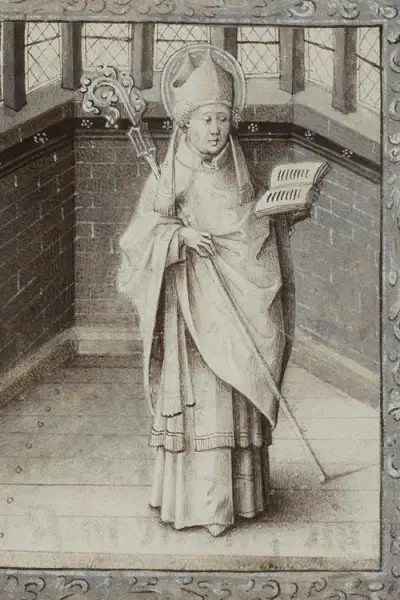
Germain, known in Latin as Germanus and in his early life as Germain d'Autun, served as bishop of Paris from 555 until his death on May 28, 576, and became one of the most consequential churchmen of sixth-century Gaul. Born around 496 near Autun to noble Gallo-Roman parents, two decades after the collapse of the Western Roman Empire, he studied at Avallon and at Luzy under his cousin the priest Scallion. Ordained at thirty-five, he led the Abbey of St. Symphorian near Autun until his famously generous alms-giving provoked his own monks to rebellion. Summoned to Paris, he was consecrated bishop of the city in 555 at the instance of King Charibert. In office he kept his monastic austerities, labored to soften the miseries of incessant Frankish warfare, attended the great councils of Paris and Tours, and did not hesitate to excommunicate a king — Charibert himself, in 568, for immorality. He spent his last decade trying to restrain the ruinous feud between Sigebert and Chilperic, and died in 576 before peace was restored. Nine centuries of Parisians carried his relics in procession in times of plague, and his name lives in Saint-Germain-des-Prés and Saint-Germain-en-Laye.
The Complete Life
A Gallo-Roman Youth Near Autun
Germain was born around 496 near Autun, in territory then under Burgundian control, into a family of noble Gallo-Roman stock. He entered the world scarcely twenty years after the Western Roman Empire had collapsed, in a Gaul where the old Roman aristocracy was finding its future not in imperial service but in the church — a trajectory his own life would trace exactly. His education was careful and local: he studied at Avallon in Burgundy and then at Luzy, where his cousin Scallion, a priest, took charge of his education. The sources give no picture of his temperament as a young man, but its fruits appeared soon enough. At the age of thirty-five he was ordained by Agrippinus, bishop of Autun, and was immediately made abbot of the nearby Abbey of St. Symphorian, one of the ancient religious houses of the region. There the qualities that would define his episcopate first showed themselves: he was hardworking to the point of austerity, and his alms-giving was so reckless in its generosity that his monks, fearing he would one day disperse the entire wealth of the abbey, rose in rebellion against their own superior. It is a revealing episode — the future bishop's charity was already so extreme that it looked, to more prudent eyes, like madness.
§ Biography
From Abbot to Bishop of Paris
The rebellion of his monks did not end Germain's career; it announced it. The abbot whose giving alarmed his community came to the attention of the court, and in 555, while he was in Paris, the bishop of that city, Sibelius, died. King Charibert I had Germain consecrated as the new bishop of Paris — the translation of a provincial abbot to the episcopate of the chief city of the Frankish west. He brought to the office, the sources emphasize, everything the abbey had taught him: the same virtues and the same austerities of monastic life, now exercised on a wider stage. His influence at court proved remarkable. Under it, King Childebert is reported to have mended his ways, and the bishop persuaded the crown to suppress the pagan practices that still persisted in Gaul and to forbid the excesses that accompanied the celebration of Christian festivals. His standing in the church of Gaul is measured by the councils he attended: the Third Council of Paris in 557, the Second Council of Tours in 566, and the Fourth Council of Paris in 573. An early biography records that he was known as Germain d'Autun, and that later ages called him the Father of the Poor — the poor being, from the beginning, the mark of his ministry.
§ Biography
A Bishop Against the Wars of Kings
The second half of Germain's episcopate was consumed by the self-destruction of the Merovingian house. When Childebert died in 558 — on the very day Germain dedicated the church of St. Vincent — his realms passed briefly to Clotaire, who divided the royal demesnes among four sons, with Charibert becoming king of Paris. Germain's response to royal misconduct was without compromise: in 568 he excommunicated Charibert for immorality, an act of discipline against his own consecrator that few bishops of the age would have dared. Charibert died in 570, and the struggle over his possessions set his surviving brothers against each other. Sigebert and Chilperic, stirred up by their wives Brunehaut and Fredegund, took up arms; defeat overtook Chilperic, and Paris passed into Sigebert's hands. The bishop spent himself trying to establish peace and met with little success. He wrote to Brunehaut, urging her to use her influence to stop the fighting, but Sigebert refused all counsel and, in defiance of Germain's explicit warning, marched to attack Chilperic at Tournai. Chilperic fled, and Sigebert was cut down at Vitry in 575 at Fredegund's instigation. Germain's own death came the next year, before any peace had returned — a bishop whose final public act had been to place himself, in vain, between the warring sons of Clovis's heirs.
§ Biography
Monastic Austerity in a Bishop's Office
What set Germain apart among the bishops of sixth-century Gaul was the persistence of the monastery within the man. Elevated to the richest see in the Frankish world, he held fast to the disciplines and austerities of his abbacy at Saint-Symphorian: the hard work, the plain living, the uncalculating generosity that had once driven his monks to mutiny. His early biography records the epithet by which the people knew him — the Father of the Poor — and the sources present his alms-giving as the distinguishing note of his sanctity, carried now from a small Burgundian abbey to the gates of Paris. His spirituality was also public and pastoral. He worked to diminish the suffering that the incessant wars of the Frankish kings inflicted on ordinary people, interceding with queens and refusing to bless the ambitions of kings. He pressed for the uprooting of surviving pagan practices in Gaul and for the reform of Christian feasting, seeking a religion whose celebration matched its profession. Tradition even ascribed to him a treatise on the ancient Gallican Liturgy, and whether or not the attribution stands, it fits the figure the sources describe: a churchman formed in the daily office, attentive to worship, austere toward himself, and boundlessly open-handed toward everyone beneath him.
§ Biography
The Unhealed Feud and a Bishop's Death
Germain's last years were a study in futility borne with dignity. After Charibert's death in 570, the bishop found himself the one figure in Paris with any standing in both hostile camps, and he used it — writing to Brunehaut, warning Sigebert, laboring for a peace that never came. The warning went unheeded. Sigebert marched on Tournai, Chilperic fled, and the victorious king was cut down at Vitry in 575 by assassins in Fredegund's pay. The assassination did not end the feud; it inherited it to the next generation. Germain died on May 28, 576, aged about eighty, before any peace had been restored, and the sources leave the impression of a man who outlived his hopes for his country but not his fidelity to it. His body was laid in a tomb chamber within the chapel of Saint Symphorian, in the forecourt of his church of Saint Vincent beyond the Paris walls. It rested there for two centuries, until, according to the account of his translation, he appeared in a vision to a pious woman; in 756 his relics were raised and moved to a more prominent position within the main church, and the building was reconsecrated under his own name, Saint-Germain-des-Prés.
§ Abbey church of Saint-Germain-des-Prés
The Abbey, the City, and the Saint's Long Shadow
Germain's name attached itself permanently to Paris. The church he dedicated in 558 to house the gift of St. Vincent's stole became the nucleus of the Abbey of Saint-Germain-des-Prés, whose abbots exercised both spiritual and temporal jurisdiction over the city's left-bank suburbs until about 1670. The church itself had a battered history — plundered and set afire repeatedly by the Normans in the ninth century, rebuilt in 1014, and in 1163 dedicated anew by Pope Alexander III — yet it still stands, the oldest abbey church of Paris, under the saint's name. For nine hundred years, whenever plague or crisis struck, his relics were borne in procession along the streets of the city he had governed, making him one of Paris's principal protectors in popular religion. The poet Venantius Fortunatus, who visited him in Paris and wrote a eulogy of his life, assured his fame among the literate; legend added marvels, claiming his first miracle occurred in the womb, where he was said to have prevented his mother's abortion. Two stained-glass panels depicting scenes from his life survive in the Cloisters Collection of the Metropolitan Museum of Art in New York. The commune of Saint-Germain-en-Laye and the Paris church of Saint-Germain de Charonne keep his name in the geography of the Île-de-France.
§ Legacy
Timeline
- 496
Is born around this year near Autun, in Burgundian territory, to noble Gallo-Roman parents
§ Biography
- 542
King Childebert, besieging Zaragoza in his Spanish war, spares the city and receives the stole of St. Vincent, later enshrined at Paris
§ Abbey church of Saint-Germain-des-Prés
- 555
On the death of Bishop Sibelius, is consecrated bishop of Paris at King Charibert's behest
§ Biography
- 557
Attends the Third Council of Paris
§ Biography
- 23 Dec 558
Dedicates the completed church of St. Vincent in Paris on December 23; King Childebert dies the same day
§ Abbey church of Saint-Germain-des-Prés
- 566
Attends the Second Council of Tours
§ Biography
- 568
Excommunicates King Charibert of Paris for immorality
§ Biography
- 570
Charibert dies, and his brothers Sigebert and Chilperic plunge into violent conflict over his possessions
§ Biography
- 573
Attends the Fourth Council of Paris
§ Biography
- 575
Sigebert, ignoring Germain's warning, is assassinated at Vitry on Fredegund's orders after Chilperic flees Tournai
§ Biography
- 28 May 576
Dies in Paris on May 28, before peace has returned to the fractured Frankish kingdoms
§ Biography
- 756
His relics are translated to a prominent position within the main church, which is reconsecrated as Saint-Germain-des-Prés
§ Abbey church of Saint-Germain-des-Prés
- 1014
The church of Saint-Germain-des-Prés, repeatedly plundered and burned by the Normans in the ninth century, is rebuilt
§ Abbey church of Saint-Germain-des-Prés
- 1163
Pope Alexander III dedicates the rebuilt church of Saint-Germain-des-Prés
§ Abbey church of Saint-Germain-des-Prés
In Their Own Words
nothing but a string of miracles
The Record
- Major works
- Church of St. Vincent (later Saint-Germain-des-Prés), Paris·Treatise on the ancient Gallican Liturgy (traditionally attributed)
- Canonization
- Pre-congregation; venerated in the Catholic and Eastern Orthodox churches since his death
Prayer
Bibliography
Show 8 sources
- Jones, Terry. "Germanus of Paris", Patron Saints Index, archived from the original on 31 December 2006
- Simon Coates, "Venantius Fortunatus and the image of episcopal authority in Late Antique and early Merovingian Gaul", The English Historical Review 115 (November 2000), pp. 1109–1137
- MacErlean, Andrew. "St. Germain." The Catholic Encyclopedia Vol. 6. New York: Robert Appleton Company, 1909
- Virginia Wylie Egbert, "The Reliquary of Saint Germain", The Burlington Magazine 112 (June 1970), pp. 359–365
- Hayward, Jane. English and French medieval stained glass in the collection of the Metropolitan Museum of Art, Vol. 1, Metropolitan Museum of Art, 2003, ISBN 9781872501376
- Warner Jacobson, "Saints' Tombs in Frankish Church Architecture", Speculum 72.4 (October 1997), pp. 1107–1143
- E. W. Brooks, review of Passiones Vitaeque Sanctorum Aevi Merovingici (Krusch and Levison, eds., 1919), The English Historical Review 35, No. 139 (July 1920), pp. 438–440
- The Concise Oxford Dictionary of the Christian Church (Oxford, 2013), p. 228
Profile text adapted from the Wikipedia article, licensed CC BY-SA 4.0.
Pray with this saint every day
Save St. Germain of Paris to your favorites, read the full profile, and get feast-day reminders in the Saints app.
Get the Saints AppFree on the App Store for iPhone and iPad