
1579 – 1601·Feast June 15
St. Germaine Cousin
Shepherdess of Pibrac and Saint of the Poor
Overview
Germaine Cousin, also called Germana or Germaine of Pibrac, was a French peasant saint who lived and died in obscurity near Toulouse and became, three centuries later, one of the most beloved figures of the nineteenth-century calendar. Born in 1579 at Pibrac, a village lying about fifteen kilometers from Toulouse, to parents of the humblest condition, she came into the world afflicted with a deformed hand and scrofula, and lost her mother while still an infant. Her father's second wife drove her from the household, and from early childhood she worked as a shepherdess, bedding down at night in the stable or on a pallet of vines. In that hard school she learned humility and patience, and her neighbors came to speak of a remarkable sense of the presence of God: she left her flocks to hear Mass daily, shared her bread with the poor, and was reported to have crossed a swollen ford on dry garments. She died in the early summer of 1601, at twenty-two, found lifeless on her pallet of vine-twigs. When her grave was opened in 1644 her body was found perfectly preserved; a long series of reported cures followed, leading to her beatification by Pius IX in 1854 and canonization in 1867.
The Complete Life
A Childhood Turned Out of Doors
Germaine Cousin was born in 1579 at Pibrac, a village of humble size about fifteen kilometers from Toulouse, and her life was marked by affliction almost from the first hour. She arrived with a deformed hand, and she carried the disease of scrofula; before she could know her mother, the mother was dead. Her father remarried, and the second wife treated the child with calculated cruelty. Under the pretense of protecting the household's other children from contagion, she persuaded the father to keep Germaine apart from the family home, and so the girl was sent out to keep the family's sheep — employed as a shepherdess almost from infancy. At night she slept in the stable, or on a pallet of vines up in a garret. What might have hardened or broken her instead became, in the Catholic Encyclopedia's phrase, a hard school in which she learned humility and patience early. The account that survived her insists on an extraordinary interior life: a remarkable awareness of God's nearness and of the things of the spirit, so that her lonely existence under the open sky became for her a source of light and blessing rather than of bitterness. The outcast child was already, without knowing it, being formed for the altars.
§ Narrative
Signs of Favor and Forgiveness
The stories told of Germaine follow a consistent pattern: a destitute girl whose own poverty did not close her hand, and whose trust was answered in ways her neighbors could see. Though she had least of anyone, she found means to help the poor, sharing with them her own allowance of bread. The winter ford across her path, swollen by heavy rains or melting snow, was at times impassable for anyone else; on several occasions, it was said, the waters were seen to open and give her a passage without wetting her garments. The most cherished story belongs to a winter day when her stepmother, accusing her of stealing bread, chased her — and Germaine opened her apron to reveal not bread but fresh summer flowers, which she offered to her persecutor as a sign of forgiveness. The gesture distills her whole life: persecution answered with gentleness, want answered with generosity. Her father at last awoke to his duty and forbade his wife to treat the girl harshly, and offered her a place in the house with his other children. Germaine begged instead to remain in the humble position she knew. It was precisely then, as those around her were beginning to grasp the beauty of her life, that God took her.
§ Narrative
The Shepherdess at Prayer
The piety of Germaine centered on two devotions that the countryside of her day understood well: the Mass and the Virgin. She assisted daily at the Holy Sacrifice, and the account that has made her famous tells how, when the bell rang across the fields, she planted her sheep-hook or distaff in the earth and abandoned her flocks to Providence's keeping while she went to Mass — the flocks, it was observed, never coming to harm in a pasture that bordered a forest infested with wolves. Her devotion to Jesus present in the Eucharist and to his Virgin Mother was said to presage the saint she would become, and her devotion visibly deepened as each feast of Mary approached. She frequented the sacraments of Penance and the Eucharist with regularity, and she practiced austerities that the sources connect with a strikingly specific intention: reparation for the outrages that heretics committed against the churches nearby — a concern that places her childhood in the embittered religious landscape of post-Reformation Languedoc. The villagers first met all of this with mild derision. But signs they could not dismiss accumulated around her, and derision turned into reverence and awe: the swollen ford, the shared bread, and at last the flowers in her apron.
§ Narrative
Death at Twenty-Two
Germaine died as she had lived — in hiding, at dawn, without ceremony. Early one morning in the summer of 1601 her father, finding she had not appeared at the usual hour, came to wake her and discovered her lifeless on her pallet of vine-twigs; her age was twenty-two. The village that had first mocked her was only beginning to revere her when death cut short a life that, outwardly, had consisted of nothing but sheep, weather, and prayer. She was laid to rest before the pulpit of the parish church at Pibrac, in the common place of a common parishioner. Yet the earth did not hold her story still. In 1644, when the grave had to be reopened for a relative's burial, those present found the remains of the shepherdess fresh and perfectly preserved, more than four decades after her burial. The remains were put on display by the pulpit, and pilgrims began to arrive. A noblewoman, the wife of François de Beauregard, gave a leaden casket as a thank-offering after her infant son — whose life had been despaired of — was restored to health through Germaine's intercession, the first of a long series of cures attributed to the peasant girl of Pibrac.
§ Relics and veneration
From Village Grave to the Chair of Peter
The recognition of Germaine's sanctity followed the incorrupt body rather than preceding it. After the discovery of 1644, private veneration continued, supported by numerous reported cures; in 1661 and again in 1700 the vicars-general of Toulouse examined the remains and certified them fresh and intact, with medical experts attesting that the body had never been embalmed and tests showing the preservation owed nothing to the soil. A first attempt to procure her beatification, begun in 1700, collapsed through accidental causes. In 1793 a revolutionary tinsmith named Toulza, with three accomplices, violated the casket, buried the remains in the sacristy, and threw quick-lime and water upon them; after the Revolution the body was found intact except where the lime had burned. The cause resumed in 1850, strengthened by records of more than 400 marvels and extraordinary favors and by thirty letters in which archbishops and bishops of France urged the beatification — cures of blindness, hip disease, and spinal disease among them. On May 7, 1854, Pius IX proclaimed her beatification; on June 29, 1867, before a huge gathering of prelates assembled in Rome to mark eighteen centuries since Peter's martyrdom, he proclaimed her a saint, congratulating Archbishop Florian Desprez of Toulouse on a patron, in his words, of such power and kindness, so dear to that church's heart.
§ Relics and veneration
The Saint of the Little Ones
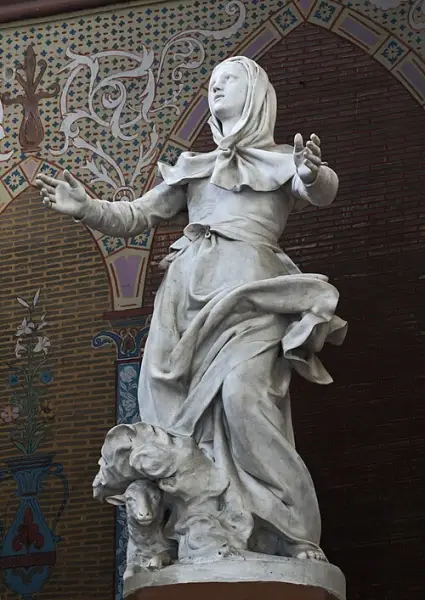
Germaine's feast is kept in the Diocese of Toulouse on June 15, and her iconography preserves the image of the shepherdess exactly as her village knew her: with a shepherd's crook or a distaff in her hand, accompanied by a watchdog or a sheep, or shown with flowers spilling from her apron. Her canonization in 1867 placed a girl who had owned nothing and commanded no one among the official saints of the universal church, and her appeal has always been strongest among the little and the overlooked — the abandoned, whose patroness she is honored as, and the disabled, who find in her deformed hand and lifelong sickness a companion who knew their condition from within. In art she stands beside the great saints of the Counter-Reformation countryside, a reminder that the era of heroic sanctity did not end with the martyrs. Her body, surviving desecration and quick-lime, rests at Pibrac, where the parish church of her burial became a place of pilgrimage. The story that ends in flowers has kept its freshness: a servant girl, driven from her father's house, who shared her bread and forgave her enemies, and whom the church of the nineteenth century raised to its altars as a reproach and an encouragement.
§ Relics and veneration
Timeline
- 1579
Is born to humble parents at Pibrac, a village about fifteen kilometers from Toulouse
§ Narrative
- 1601
Is found dead at dawn on her pallet of vine-twigs, at the age of twenty-two, as her father comes to call her
§ Narrative
- 1644
Her grave in the parish church of Pibrac is opened for a relative's burial and her body is discovered fresh and perfectly preserved
§ Relics and veneration
- 1661
The vicars-general of Toulouse view her remains and find them fresh and intact, leaving testamentary depositions of the fact
§ Relics and veneration
- 1700
Her remains are viewed again and found intact, and a first movement is begun to procure her beatification
§ Relics and veneration
- 1793
A revolutionary tinsmith named Toulza and three accomplices desecrate her casket, burying the remains in the sacristy under quick-lime and water
§ Relics and veneration
- 1845
Food is multiplied for the struggling Good Shepherd community at Bourges, one of the favors attested to her intercession
§ Relics and veneration
- 1850
The cause of beatification is resumed, supported by documents attesting more than 400 miracles and thirty postulatory letters from French bishops
§ Relics and veneration
- 7 May 1854
Pius IX proclaims her beatification on May 7
§ Relics and veneration
- 29 Jun 1867
Pius IX canonizes her on June 29, before a vast assembly of prelates gathered for the eighteenth centenary of Peter's martyrdom
§ Relics and veneration
The Record
- Patron of
- Abandoned people·Disabled people
- Symbols
- Shepherd's crook·Distaff·A watchdog or a sheep·Flowers in her apron
- Canonization
- Beatified 7 May 1854; canonized 29 June 1867 by Pope Pius IX
Prayer
Bibliography
Show 5 sources
- Mulcahy, Cornelius. "St. Germaine Cousin." The Catholic Encyclopedia Vol. 6. New York: Robert Appleton Company, 1909
- "St. Germaine Cousin", Catholic News Agency
- Monks of Ramsgate. "Germana Cousin". Book of Saints 1921. CatholicSaints.Info, 7 May 2016
- Clauzel, François (October 1897). "Le cardinal Desprez". Le Messager du Coeur de Jésus. Vol. LX. Toulouse. pp. 403–439
- Lacointa, Jules (1897). La vie de son Éminence le Cardinal Desprez, Archevêque de Toulouse (in French). Lille: La Société de Saint Augustin. p. 88ff
Profile text adapted from the Wikipedia article, licensed CC BY-SA 4.0.
Pray with this saint every day
Save St. Germaine Cousin to your favorites, read the full profile, and get feast-day reminders in the Saints app.
Get the Saints AppFree on the App Store for iPhone and iPad