
c. 634 – 740·Feast May 12
St. Germanus I of Constantinople
Ecumenical Patriarch and Defender of Sacred Images
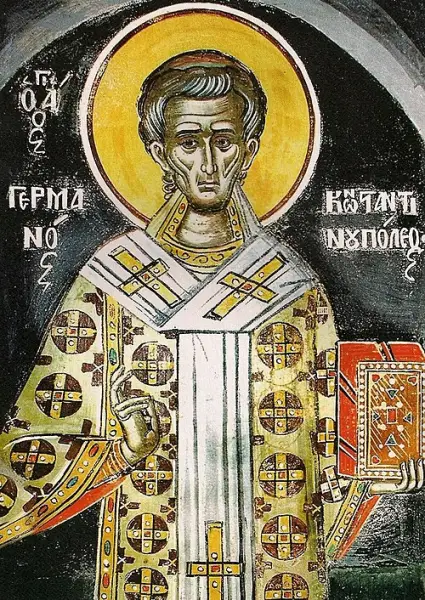
Overview
Germanus I guided the Church of Constantinople as its ecumenical patriarch from 715 to 730, the turbulent decades in which the Byzantine Empire first turned against the veneration of icons. Born around 634 to a patrician father, he bore the consequences of imperial politics from childhood: after his father's execution he was made a eunuch by the victors and confined to monastic life. He re-emerged as Bishop of Cyzicus and, having taken part in the Monothelite council of 712, was raised to the patriarchal throne on 11 August 715. As patriarch he restored the doctrine of Christ's two wills, pursued reconciliation with the Armenian Church, and helped negotiate a peaceful transfer of imperial power. When Emperor Leo III the Isaurian attacked the Church's use of sacred images, Germanus became their most prominent defender, preferring resignation in 730 to compliance with the imperial ban. He withdrew to his family residence and died around 740. The Second Council of Nicaea enrolled him among the saints in 787, and today both the Orthodox and Catholic Churches venerate him on 12 May.
The Complete Life
Born into Imperial Intrigue
Theophanes the Confessor records that Germanus was the son of a patrician named Justinian, a man entangled in the darkest politics of his age. Justinian was reputedly implicated in the assassination of Emperor Constans II and in the seizure of the throne by the usurper Mizizios. The conspiracy collapsed: Constantine IV, son of the murdered emperor, crushed his rival and punished every supporter of the usurpation. Among the victims of that reckoning was Justinian, who was put to death in 668, leaving Germanus a child of the defeated party.
The victors spared the boy's life but exacted a brutal price. Germanus survived the persecutions that destroyed his family's standing, yet he was made a eunuch by those who had triumphed over his father. In the Byzantine world such mutilation, while it foreclosed any secular career, often opened the path to ecclesiastical advancement. He was sent to a monastery, where the son of a condemned conspirator disappeared from public view. The years of obscurity that followed shaped the man who would later stand before emperors: he learned obedience, endurance, and the life of prayer long before he was called to govern a patriarchate.
§ Life
From Cyzicus to the Patriarchal Throne
Germanus re-emerged into public life as Bishop of Cyzicus, and his episcopate coincided with a fresh doctrinal storm. In 712 he took part in the Council of Constantinople, an assembly convened under Emperor Philippicus that issued decisions favoring Monothelitism and thereby set aside the canons of the Third Council of Constantinople of 680–681. The council simply followed the religious preferences of the emperor, and Germanus's share in its work belonged to this compromised episode of his career.
Providence moved quickly to correct the course of the Church. In 713 Anastasius II deposed Philippicus and undid his religious settlements; John VI, the patriarch who had backed the Monothelite cause, lost his office in turn. On 11 August 715 Germanus was elected to the vacant throne of Constantinople. He lost no time in setting the Church on orthodox foundations, organizing a new council that propagated Dyothelitism and anathematized prominent leaders of the defeated faction. His statesmanship extended beyond doctrine: when rebellion threatened Anastasius II, Germanus helped negotiate the emperor's surrender terms to Theodosius III, and he labored to improve relations with the Armenian Apostolic Church in the hope of reconciliation.
§ Life
Guardian of the Holy Images
The defining struggle of Germanus's patriarchate arrived with Emperor Leo III the Isaurian. Having in 722 pressed the empire's Jews and Montanists to accept baptism — a campaign that seemed to succeed — Leo then turned against the Church's sacred images, issuing a series of edicts against their worship between 726 and 729. Germanus, a convinced iconodule, understood what was at stake. In a letter written to two Iconoclast bishops before 726 he observed that whole towns and multitudes were already in considerable agitation over the question.
When the ban came, the patriarch refused to bend. His surviving letters from the period dwell less on theology than on a sober fear: as Patricia Karlin-Hayter has noted, he worried that the condemnation of icons would seem to prove the Church had been in error for generations, handing a weapon to Jews and Muslims who scoffed at Christian practice. Later tradition portrays him as even more resolute, winning a public debate against Constantine, Bishop of Nacoleia, a leading Iconoclast. For his opposition to the emperor's policy Germanus suffered exile from his see. Pope Gregory II, a fellow defender of images, praised his zeal and steadfastness — a verdict the centuries have confirmed.
§ Life
A Teacher of the Liturgy
Several of Germanus's writings have been preserved, and they reveal a mind formed by the worship of the great church rather than by polemic alone. His Historia Ecclesiastica circulated for many centuries in Greek and in Latin translation and remains frequently quoted by scholars, although the church historian Johann Peter Kirsch doubted that the work as it survives is genuinely his.
The work dearest to later generations is the text published in English in 1985 as On the Divine Liturgy, presented by its publishers as the account of the Eucharistic rite that carried quasi-official authority across the Byzantine Christian world for centuries. In it Germanus unfolds the mystical meaning of every gesture of the Eucharistic rite, teaching generations of believers to see in the liturgy a mirror of heavenly worship. Among his compositions was the hymn rendered into English by John Mason Neale as 'A Great and Mighty Wonder', though Neale mistakenly attributed it to Anatolius of Constantinople. So highly were his Marian texts esteemed that Pope Pius XII drew upon one of them in the apostolic constitution proclaiming the assumption of Mary into heaven a dogma of the Church — a remarkable afterlife for a patriarch of the eighth century.
§ Life
Retirement and Death
Germanus's resistance to the iconoclast policy ended his tenure on 17 January 730. He was replaced by Patriarch Anastasius, a man more willing to obey the emperor, and the great church passed into the hands of the emperor's partisans. The fallen patriarch did not face martyrdom in blood; instead he endured the quieter trial of dismissal, withdrawing from the public life of the capital.
He retired to the residence of his family, the same world of patrician households from which he had been torn as a child, and there lived out his remaining years. He died a few years after his deposition, at an advanced age, in 740. His body was laid to rest at the Chora Church, a sanctuary that would itself later stand at the center of Constantinople's devotion. The epitaph of his life was written not by the emperor who deposed him but by the council that came after: the Second Council of Nicaea, which restored the veneration of icons in 787, judged it fitting to enroll Germanus among the saints, honoring the shepherd who had given up his throne rather than surrender the Church's tradition.
§ Life
Enrolled Among the Saints
Germanus received no formal canonization process, for he belonged to the age in which the Church recognized her saints by the consensus of liturgical memory. The decisive act came in 787, when the Second Council of Nicaea, the very assembly that restored the icons he had defended, included Germanus in the diptychs of the saints — the public lists by which the Church of Constantinople named those whose intercession it trusted.
From that judgment flowed his continuous veneration in both East and West. Veneration of him has continued without interruption in the Orthodox East and the Catholic West alike, and both commemorate him on 12 May. Greek liturgical tradition keeps his feast with the synaxarion proper to a patriarch and confessor, and Roman Catholic sources such as the Catholic Encyclopedia, writing under his name in 1909, helped carry his memory to the wider church. Modern observers have added their own tributes: Pope Benedict XVI devoted a general audience to him in April 2009, presenting the exiled patriarch as a model of fidelity, while Orthodox publications continue to hail him as the defender of the veneration of holy images.
§ Life
A Lasting Influence
Germanus's influence has proved far larger than his fourteen years in office might suggest. Through On the Divine Liturgy he became the standard interpreter of Byzantine worship, shaping how generation after generation of Orthodox Christians understood the sacrifice they celebrated. Through his defense of the icons he supplied the patriarchal conscience of the early iconoclast era, and the triumph of 787 vindicated the position for which he gave up his see. His liturgical poetry entered the Church's hymnody, carried into the English-speaking world by John Mason Neale's translation.
His reach extended even into the modern papacy: Pope Pius XII wove one of Germanus's texts into the apostolic constitution that proclaimed Mary's assumption a dogma of the Church, an act that brought an eighth-century patriarch's voice into the defining Marian teaching of the twentieth century. Scholars continue to quote his ecclesiastical history, and new editions of his works — including an Italian translation published in 2020 — show that interest in him has not faded. For believers, however, his legacy is simpler: a bishop who loved the beauty of worship and, when commanded to betray it, chose obedience to tradition over obedience to power.
§ Influence
Timeline
- 634
Is born around this year, a son of the patrician Justinian
§ Introduction
- 668
His father Justinian, a patrician tied to the murder of Constans II, was executed under Emperor Constantine IV.
§ Life
- 712
Took part in the Council of Constantinople, which issued Monothelite decisions under Emperor Philippicus.
§ Life
- 713
Anastasius II deposed Philippicus and reversed the religious decisions of his reign.
§ Life
- 715
Assembled a council proclaiming Dyothelitism and anathematizing leaders of the opposing Monothelite faction.
§ Life
- 11 Aug 715
Elected Ecumenical Patriarch of Constantinople, succeeding John VI.
§ Life
- 722
Leo III pressed his campaign to have every Jew and Montanist in the realm receive baptism.
§ Life
- 726
Leo III began issuing edicts against the worship of images, opening the iconoclastic crisis.
§ Life
- 17 Jan 730
Resigned the patriarchal throne rather than accept the imperial ban on icons.
§ Life
- 740
Died at an advanced age after retiring to the residence of his family.
§ Life
- 787
The Second Council of Nicaea entered his name in the diptychs of the saints.
§ Life
In Their Own Words
Now whole towns and multitudes of people are in considerable agitation over this matter
No one, Lady all-holy, is saved except through thee, all-holy one
At the very invocation of thy holy name, thou dost turn aside from thy servants the attacks of that most evil enemy, and keep them safe and unharmed.
Every divine feast, when celebrated, fills the faithful with spiritual joy, drawing from treasures and sources that come from God.
Everyone can be satisfied in all things; but in the songs and feasts in her honour, the banquet is inexhaustible in its sweetness.
The Record
- Major works
- Historia Ecclesiastica·On the Divine Liturgy (English edition of 1985)·Hymn 'A Great and Mighty Wonder' (Μέγα καὶ παράδοξον θαῦμα)
- Canonization
- Pre-congregation; included in the diptychs of the saints by the Second Council of Nicaea in 787
Prayer
Bibliography
Show 8 sources
- Orthodox Church in America – Biography of St Germanus I the Patriarch of Constantinople
- Johann Peter Kirsch, "St. Germanus I", Catholic Encyclopedia, Vol. 6, New York, Robert Appleton Company, 1909
- Warren Treadgold, History of the Byzantine State, pp. 350, 352–353
- Cyril Mango, "Historical Introduction", in Bryer & Herrin, Iconoclasm, pp. 2–3, Centre for Byzantine Studies, University of Birmingham, 1977, ISBN 0-7044-0226-2
- Karlin-Hayter, Patricia (2002), The Oxford History of Byzantium - Iconoclasm, Oxford University Press
- "St. Germanus of Constantinople, Defender of the Veneration of Holy Images", National Catholic Register, 8 May 2009
- Cameron, Averil; Ward-Perkins, Bryan; Whitby, Michael (2000). The Cambridge Ancient History 14, Late Antiquity - Empire and Successors, 425–600 AD. Cambridge University Press. ISBN 0-521-32591-9
- GERMANO DI COSTANTINOPOLI, Storia ecclesiastica e contemplazione mistica, Traduzione, introduzione e note a cura di Antonio Calisi, Independently published, 2020, ISBN 979-8689839646
Profile text adapted from the Wikipedia article, licensed CC BY-SA 4.0.
Pray with this saint every day
Save St. Germanus I of Constantinople to your favorites, read the full profile, and get feast-day reminders in the Saints app.
Get the Saints AppFree on the App Store for iPhone and iPad