
c. 378 – c. 448·Feast July 31
St. Germanus of Auxerre
Bishop of Auxerre and Champion Against Pelagianism
Overview
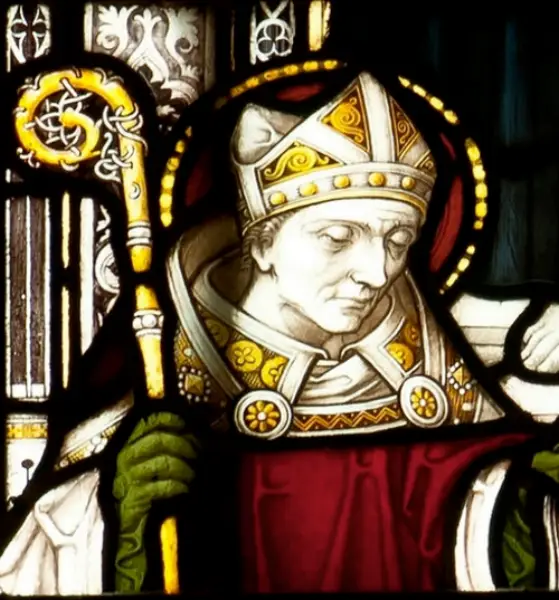
Germanus of Auxerre began life as one of the most brilliant lawyers and governors of late Roman Gaul and ended it as one of its most venerated bishops. Born around 378 into one of the noblest families of Gaul, he studied at Arles and Lyon and then in Rome, practiced law with distinction, and served the emperor as one of the six dukes governing the Gallic provinces. His conversion was dramatic: Bishop Amator, provoked by the duke's worldliness, tonsured him against his will, and when the bishop died Germanus was chosen to fill the see, being consecrated on 7 July 418. As bishop he gave his goods to the poor, practiced austerity, and founded a monastery on the Yonne. He is best remembered for his mission to Britain around 429, where he defeated the Pelagian teachers in public debate and helped establish the cult of Saint Alban. He died at Ravenna around 442–448, while pleading with the imperial government for mercy toward the people of Armorica, and his tomb at Auxerre remains a place of pilgrimage to this day.
The Complete Life
A Duke of Roman Gaul
His parents were Rusticus and Germanilla, and few houses in the Gaul of the late fourth century stood higher than theirs. Everything in his upbringing pointed toward a splendid secular career. He received the finest education available in the distinguished schools of Arles and Lyon, then traveled to Rome to study eloquence and civil law. There he practiced before the tribunal of the prefect for several years and won remarkable success; his high birth and dazzling abilities brought him into contact with the imperial court itself.
He married Eustachia, a lady held in high esteem in imperial circles, and the emperor made him a duke — one of six men charged with administering the provinces of Gaul. He took up residence at Auxerre, wealthy, accomplished, and a layman of great power. Yet hints of a different destiny already shadowed him. He hung hunting trophies on a tree that had once been the scene of pagan worship, and this act provoked the stern remonstrance of Bishop Amator. The clash between the duke's aristocratic habits and the bishop's zeal for the old sacred places set in motion the astonishing turn his life was about to take.
§ Early life
Tonsured Against His Will
Bishop Amator had tried in vain to soften his troublesome duke. One day, while Germanus was away, the bishop had the contested tree cut down and its trophies burned. Fearing the duke's fury — Germanus, it was said, wished to kill him — Amator fled and sought leave from the prefect Julius to bestow the monastic tonsure; leave was given. Feeling that his own death was near, the bishop returned. When the duke presented himself at the church, Amator had the doors barred and imposed the tonsure upon him against his will, commanding him to live as the man destined to be his successor, and immediately made him a deacon.
Amator died a short time later, and the astonished city did what the bishop had foreseen: the whole city joined in naming Germanus to the empty throne, and his consecration followed on 7 July 418. The gifts that had adorned his secular career now served the Church. He administered the diocese with great sagacity, distributed his goods among the poor, embraced severe austerities, and raised a great monastery in honor of Saints Cosmas and Damian beside the Yonne, to which he loved to steal away in quiet hours.
§ Early life
The Mission to Britain
Around 429, two decades after Roman rule had vanished from Britain, the bishops of Gaul picked Germanus and Lupus of Troyes for a crossing to the island. Word had reached the continent that Pelagianism flourished among the British clergy under the leadership of Agricola, a bishop's son, and the mission meant to crush the heresy and to give Rome assurance that the island's church still held fast to the Augustinian doctrine of grace. On the way the bishops passed through Nanterre, where Germanus noticed a young girl in the welcoming crowd and bade her live as one espoused to Christ; she became Saint Geneviève of Paris.
In Britain the two bishops confronted the Pelagian party at a public meeting before an enormous assembly. Though his opponents enjoyed popular support, Germanus triumphed by sheer superiority of rhetorical skill, and the healing of the blind daughter of a man of tribunician power confirmed his ministry. Tradition adds a martial crown to the mission: when Pictish and Saxon raiders threatened, the former general placed himself at the head of the native Christians and, standing on a grassy ledge above a valley near Mold in North Wales, cried 'Alleluia' three times. The echoing shout and the sudden appearance of the crowd sent the pirates fleeing in panic, and the 'Alleluia victory' passed into legend.
§ Visit to Britain
Alban and the Birth of a Cult
Hardly had the disputation with the Pelagians closed than Germanus journeyed to Alban's burial place — a tomb or basilica of some kind, sheltering the proto-martyr of Britain — to render thanks for the outcome. That night, he declared, Alban appeared to him in a dream and revealed the details of his martyrdom. When he awoke, Germanus ordered the account written down in tituli, perhaps to be engraved on walls or displayed on illustrated placards at a church site in Britain or at Auxerre.
Scholars have seen in this episode the seed of the entire Alban tradition: from the account Germanus set in motion, most scholars judge, sprang the Passio Albani — the master source for all later knowledge of Britain's proto-martyr — a work that almost certainly took shape among his own associates at Auxerre. Some historians have even concluded that Germanus himself was responsible for creating as well as promoting the cult, though others dispute this and argue for the antiquity of Alban's veneration. Before leaving the basilica, Germanus deposited relics of continental saints there and carried away a sample of the earth from the place of Alban's martyrdom, still marked with the martyr's blood — a gesture binding the churches of Gaul and Britain together.
§ Germanus and the Cult of Saint Alban
The Last Journey
Germanus may have returned to Britain a second time in the mid 430s or mid 440s, though some scholars regard the reported journey as a doublet of the first, mistakenly recorded by Constantius as a separate visit. Severus, bishop of Trier, shared that second journey, and in Britain the two met Elafius, a chief man of the land; the curing of Elafius's frail boy, so the story runs, settled the people's hearts for the Catholic cause. The Historia Brittonum, written around 829, attaches to this period a legend in which Germanus denounced Vortigern for incest and other wickedness, tracked him to a fortress on the Teifi, and kept a fast of prayer there through three days and nights until heavenly fire destroyed castle and king together — a tale without historical basis, but one that measures the awe in which the bishop was held in Wales.
His final journey took him not to Britain but to Italy. He died at Ravenna, the imperial capital, while petitioning the Roman government for leniency toward the citizens of Armorica, whom Aëtius had punished by unleashing the Alans to ravage their land. In their defense Germanus had once stood face to face with Goar himself, the Alans' king. The evidence for the date of his death is scanty: scholars have argued for 442, for 448, or for around 437, and the uncertainty is a reminder how much of his story survives only in hagiographic reflection.
§ Later life
Veneration at Auxerre and Beyond
Germanus belongs to the company of saints the Church honored from the moment of their deaths, long before formal canonization existed. His tomb became the heart of a great cult: the Abbey of Saint-Germain d'Auxerre rose around his burial place, and his shrine is venerated there still, in a church that now forms part of the municipal museum yet remains open for worship at stated times. A tradition of preaching a panegyric on the Sunday nearest to his July festival kept his memory alive through the centuries.
His cult spread across northern France, giving its name to the church of Saint-Germain l'Auxerrois facing the Louvre in Paris, and leaving traces at Charonne and at Nanterre in connection with Saint Geneviève. His crossing to Britain is commemorated in dedications at Siouville and Saint-Germain-les-Vaux in the Cotentin. The 2004 edition of the Roman Martyrology fixed his memorial officially, under July 31, as the bishop who withstood the Pelagian error in Britain and journeyed to win mercy for Armorica. In the calendar for Wales his feast is kept on August 3, and in Cornwall, Devon, Norfolk, Birmingham, and Essex parish churches still bear his name.
§ Cult
An Enduring Memory in Britain and Wales
Nowhere has Germanus's memory proved more durable than in the British Isles. An old priory church at St Germans in Cornwall carries his dedication and served in the late Saxon age as a bishop's seat; dedications at Edgbaston, Faulkbourne, Rame, Germansweek, and Wiggenhall St Germans mark the reach of his cult across England. Selby Abbey in North Yorkshire counts him among its patron saints; the house arose in 1069, tradition says, after a monk of Auxerre stole one of the saint's fingers and bore it to England. The finger was lost when the Reformation came, yet the abbey church still stands, a busy parish church.
Wales honors him as one of the shaping figures of its early Christianity, and medieval tradition often merged him with the Welsh Saint Garmon, commemorated in placenames from Capel Garmon to Llanarmon-yn-Iâl. Devotion also makes him the founder of the see of Sodor and Man, though the bishop meant may well be another man of that name. His dramatic life has never lost its appeal: Hilaire Belloc mocked the heretics he whacked with his episcopal staff, Saunders Lewis made his mission the subject of a Welsh radio play, and novelists and filmmakers from Jack Whyte to Valerio Massimo Manfredi have returned again and again to the Roman duke who became the apostle of post-Roman Britain.
§ In Great Britain
Timeline
- 378
Born into one of the noblest families of late fourth-century Gaul.
§ Early life
- 7 Jul 418
Consecrated bishop of Auxerre after being unanimously chosen to succeed Amator.
§ Early life
- 429
Chosen with Lupus of Troyes by a Gaulish assembly of bishops to combat Pelagianism in Britain.
§ Visit to Britain
- 429
Defeated the Pelagian clergy in public debate and gave thanks at the grave of Saint Alban.
§ Germanus and the Cult of Saint Alban
- 447
According to the Historia Brittonum, condemned Vortigern for his crimes during a contested second visit to Britain.
§ Later life
- 448
Dies at Ravenna while petitioning the imperial government for leniency toward Armorica; scholars date the death between 442 and 448.
§ Later life
In Their Own Words
Passing at Ravenna, a bishop who defended Britain against the Pelagian heresy and travelled to make peace for Armorica
Conspicuous for riches, brilliant in dress and surrounded by a fawning multitude
The Record
- Major works
- Monastery of Saints Cosmas and Damian on the banks of the Yonne·Commissioned written account of Saint Alban's martyrdom, a basis of the Passio Albani
- Patron of
- Patron of Selby Abbey, North Yorkshire·Patron of Saint-Germain l'Auxerrois in Paris
- Canonization
- Pre-congregation; listed in the Roman Martyrology of 2004 under July 31
Prayer
Bibliography
Show 9 sources
- "St Germanus the Bishop of Auxerre", Orthodox Church in America
- MacErlean, Andrew. "St. Germain." The Catholic Encyclopedia. Vol. 6. New York: Robert Appleton Company, 1909
- Butler, Rev. Alban, "St. Germanus, Bishop of Auxerre, Confessor", The Lives of the Saints, Vol. VII, 1866
- Thompson, E. A. (1984) Saint Germanus of Auxerre and the End of Roman Britain. Woodbridge: Boydell
- Wood, Ian (2009). "Germanus, Alban and Auxerre". BUCEMA Bulletin du centre d'études médiévales d'Auxerre. 13
- Barrett, Anthony A., "Saint Germanus and the British Missions", Britannia 40 (2009), 197–217
- Martyrologium Romanum, 2004, Vatican Press (Typis Vaticanis), page 425
- Baring-Gould, Sabine; Fisher, John (1911). The Lives of the British Saints, Volume 3. London: The Honourable Society of the Cymmrodorion. p. 77
- Hoare, F. R. (1965) The Western Fathers. New York: Harper Torchbooks
Profile text adapted from the Wikipedia article, licensed CC BY-SA 4.0.
Pray with this saint every day
Save St. Germanus of Auxerre to your favorites, read the full profile, and get feast-day reminders in the Saints app.
Get the Saints AppFree on the App Store for iPhone and iPad