
c. 475 – 541·Feast October 30
St. Germanus of Capua
Papal Legate Who Healed the Acacian Schism
Overview
Germanus of Capua was the bishop whose diplomacy ended the Acacian schism, the first great division between the churches of East and West. Born at Capua in the 470s, he sold his inheritance after his father's death and embraced the ascetic life before the citizens of Capua chose him as their bishop around 519. Almost at once Pope Hormisdas enlisted him for the delicate work of reconciliation with Constantinople: Germanus led the legation dispatched to Emperor Justin I, negotiated the acceptance of the libellus Hormisdae in the imperial palace, and spent a further year securing its reception across the East. The Liber pontificalis credits him with skillfully handling the Theopaschite controversy, the Easter question, and the reinstatement of bishops deposed under Anastasius I. He governed Capua until his death in early 541. Pope Gregory the Great records that Benedict of Nursia saw his soul carried to heaven as a ball of fire, and Gregory himself prayed for the saint's intercession on behalf of a soul in purgatory. His feast day in the Roman Martyrology is October 30.
The Complete Life
The Hidden Years at Capua
Nothing is known of Germanus's origins with certainty, and the sources preserve his youth only through the lens of a ninth-century hagiography. That account gives the names of his parents — his father Amantius and his mother Juliana — and places his birth at Capua in the 470s, in the decades when the western empire was dissolving and Campania passed under the rule of the Ostrogothic Kingdom.
The hagiography tells of a decisive renunciation. When his father died, Germanus — with his mother's approval — disposed of the family property and gave himself up to the ascetic discipline. The gesture placed him in the tradition of the wealthy young men of the Italian towns who abandoned property for prayer. His reputation for holiness evidently grew among his fellow citizens, for when Bishop Alexander died, the Capuans elected Germanus as their bishop. He at first refused the honor, a reluctance the biographer presents as genuine humility, before being persuaded to accept. Modern historians caution that this whole early narrative cannot be substantiated from other sources, yet it preserves the memory of a bishop beloved enough that his city later claimed his relics as treasures.
§ Early life and election as bishop
Chosen for the Hardest Embassy
Germanus became bishop of Capua in 519 or shortly before, at a moment when the papacy was preparing a third attempt to heal the Acacian schism, the breach that had kept the churches of East and West apart since 482. Two earlier embassies had come home empty-handed. The new mission, however, enjoyed circumstances no predecessor had known: the support of the Ostrogothic king Theoderic in Italy, and in Constantinople the goodwill of the new emperor Justin I and Patriarch John of Cappadocia.
Pope Hormisdas gathered his legates in Rome between January and March 519, and when the pope wrote to the emperor's nephew, Count Justinian, he explained that the members of the legation had been selected for their quality. Besides Germanus it included Dioscorus, deacon of Alexandria; a bishop called John; Felix, deacon of the Roman church; Blandus, a Roman priest; and the notary Peter. In the Liber pontificalis and in the pope's letters, Germanus is always named first — clear evidence that the bishop of the modest Campanian see was entrusted with leadership of the entire enterprise. The contemporary Liber pontificalis describes him simply as 'Capuan bishop', and this mention fixes the latest possible date of his election to the episcopal throne.
§ Mission to the East in 519–520
Constantinople, 519–520
The legation's route across the Balkans is known chiefly through letters. The envoys crossed the Adriatic to Aulon, passed through Lychnidus, and reached Thessalonica, where Germanus celebrated mass. Ten miles outside Constantinople the young Count Justinian — the future emperor Justinian I — met them and escorted them into the city, whose population welcomed the western bishops with cheering, as Germanus himself reported to Hormisdas in a letter dated 22 April 519.
In the days of Holy Week the envoys had audiences with the emperor and with the Senate apart; then on Holy Thursday all three powers — emperor, Senate, and patriarch — received them together in the palace, where they handed over the libellus Hormisdae, the paper carrying the pope's terms for ending the schism. Those terms the eastern side accepted. Germanus's party stayed on for another full year to win approval of the libellus city by city outside the capital, and on 9 July 520 Justin sent the pope a letter praising his envoys. The Liber pontificalis further credits Germanus with deftly managing the Theopaschite controversy, the disputed calculation of Easter, and the reintegration of bishops whom Anastasius I had deposed — a set of achievements that made his embassy the only one of the three to succeed.
§ Mission to the East in 519–520
A Soul Seen as Fire
The spirituality that shines through Germanus's story is one of renunciation crowned by service. The boy who sold his patrimony to live as an ascetic became the man the pope judged fit, by his quality, to represent the whole Church of the West at the most delicate court in Christendom. His mission combined doctrine and diplomacy: he negotiated the hard terms of the libellus Hormisdae, untangled the Theopaschite controversy over whether God could be said to suffer on the cross, and smoothed the return of bishops punished for their orthodoxy.
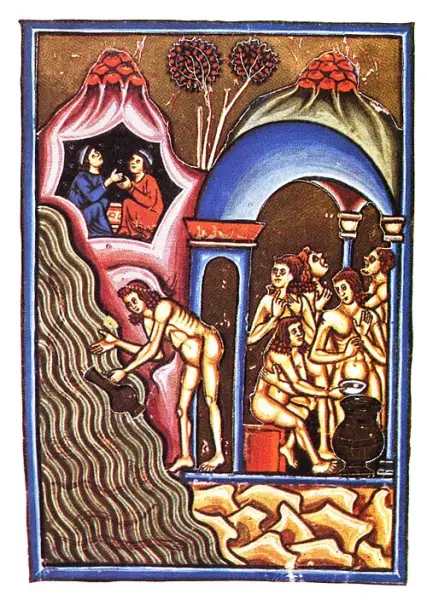
The most famous glimpse of his inner life comes not from his own writings, none of which survive, but from a vision. Pope Gregory the Great relates in his Dialogues that Benedict of Nursia, praying atop Monte Cassino, beheld Germanus's soul borne up to heaven by angels like a blazing globe, and discovered only afterward that the vision had matched the very hour of the bishop's death. That Gregory also prayed to Germanus to intercede for the deacon Paschasius, whose soul lingered in purgatory, shows that within a generation of his passing the bishop of Capua was already addressed as a friend of God whose prayers could move the fate of souls.
§ Later career, death and veneration
The Quiet Years and Death
After the triumph of his eastern mission, Germanus disappears almost entirely from the written record, and little is known of how he governed Capua in the two decades that followed. The tenth-century Chronicon Salernitanum preserves one memory of his episcopate: Capua's Constantinian basilica received a new patron, its dedication shifted from the Apostles to Saints Stephen and Agatha, whose relics he had won from the emperor as a personal reward — souvenirs, in effect, of his eastern embassy.
His eighth- or ninth-century biography adds that he kept the friendship of Sabinus, bishop of Canosa, another papal envoy against monophysitism who likewise stood close to Benedict of Nursia; Sabinus undertook his own mission to the East in 536. Germanus's own death can be placed in early 541, because an inscription records that the pontificate of his successor Victor began in that year. He thus died nearly a quarter century after his great embassy, having seen the reunion he negotiated outlive the emperor and pope who commissioned it. The frescoes of Peter of Eboli, painted centuries later, imagined him meeting the deacon Paschasius in the afterlife — a poetic witness to the intercession Gregory had described.
§ Later career, death and veneration
Saint of Southern Italy
Germanus received no formal canonization decree; he was raised to the altars by the devotion of the people he had served. Once he was gone, devotion to him as a saint spread across the whole of southern Italy and lasted through the early Middle Ages, and his feast of October 30 found its way into the Roman Martyrology, where it remains.
The geography of his cult is itself a history of the age. When Count Lando I relocated the city of Capua in 849 after the Saracen devastations, the saint's body traveled with his people to the new city. In late 873, after a campaign had driven back the Arabs troubling Capua, the emperor Louis II of Italy carried a portion of his relics to Monte Cassino; the village at the foot of the abbey hill, on the site of ancient Casinum, took the name San Germano from the saint's presence there. In 874 the empress Engelberga endowed her new monastery of San Sisto at Piacenza with another part of his relics. The Vita sancti Germani episcopi Capuani mentions none of these translations, which suggests it had been completed before 873 — a rare case where a text's silences allow historians to date it.
§ Later career, death and veneration
The Diplomat Who Made Peace Hold
Germanus's achievement deserves measurement against the failures that surrounded it. The Acacian schism had endured for thirty-seven years and had outlasted two papal embassies when Germanus led the third; within two years of his arrival in Constantinople the East had accepted the libellus Hormisdae and communion was restored. That the reunion proved durable owed much to the manner of its making — a legate chosen for quality, received with cheering crowds, patient enough to spend a year securing acceptance city by city beyond the capital.
His memory attached itself to places of enduring importance. The relics at Monte Cassino gave their name to San Germano, and his cult was celebrated by writers from Gregory the Great onward, who preserved both the fire-vision of Benedict and the prayer for Paschasius. Modern scholarship has kept pace with devotion: the Dizionario Biografico degli Italiani devotes a full entry to him, the Encyclopedia of Ancient Christianity includes an article under his name, and a 1999 Italian congress at Venafro studied him as an 'ecumenical ambassador' and a model of sanctity for the Cassinate. For the churchman of any age, Germanus of Capua stands as proof that diplomacy, honestly exercised in service of truth, can be a path to holiness.
§ Later career, death and veneration
Timeline
- 519
Elected bishop of Capua on the death of Bishop Alexander, after first refusing the honor.
§ Early life and election as bishop
- 519
Joined and led the legation sent by Pope Hormisdas to Emperor Justin I at Constantinople to end the Acacian schism.
§ Mission to the East in 519–520
- 22 Apr 519
Reported to Pope Hormisdas that the people of Constantinople had received the legates with cheering.
§ Mission to the East in 519–520
- Mar 519
Presented the libellus Hormisdae to the emperor, Senate, and patriarch on Holy Thursday, who accepted its conditions for reunion.
§ Mission to the East in 519–520
- 9 Jul 520
Emperor Justin wrote to Pope Hormisdas commending Germanus and his fellow legates after a further year in the East.
§ Mission to the East in 519–520
- 541
Died at Capua; an inscription dates the start of his successor Victor's pontificate to that year.
§ Later career, death and veneration
- 849
His body was moved when Count Lando I of Capua relocated the city of Capua.
§ Later career, death and veneration
- 873
Emperor Louis II took some of his relics to Monte Cassino after a campaign against the Arabs.
§ Later career, death and veneration
- 874
A further share of his relics went to the Piacenza monastery of San Sisto, endowed by Empress Engelberga.
§ Later career, death and veneration
The Record
- Major works
- Re-dedication of the Constantinian basilica of Capua to Saints Stephen and Agatha, after depositing relics he obtained from the emperor
- Canonization
- Pre-congregation; venerated as a saint in southern Italy throughout the early Middle Ages
Prayer
Bibliography
Show 7 sources
- Marazzi, Federico (2000). "Germano, santo". Dizionario Biografico degli Italiani. Vol. 53: Gelati–Ghisalberti. Rome: Istituto dell'Enciclopedia Italiana. ISBN 978-88-12-00032-6
- Marone, Paola (2014). "Germanus of Capua". In Angelo Di Berardino (ed.). Encyclopedia of Ancient Christianity. Vol. 2. IVP Academic. pp. 124–125
- Watkins, Basil (2016). The Book of Saints: A Comprehensive Biographical Dictionary (8th rev. ed.). Bloomsbury
- Blaudeau, Philippe (2004). "A Stereotype of the Roman History of Monophysism? About the Violent Episode of Thessalonica (September 519)". Hortus Artium Medievalium. 10: 205–210. doi:10.1484/j.ham.2.305308
- Johnson, Mark J. (2009). "The Constantinian Churches of Campania: Texts and Contexts". Apolline Project Vol. 1. Università degli Studi Suor Orsola Benincasa and Brigham Young University. pp. 247–262
- Carcione, F., ed. (1999). Germano di Capua (m. 541 ca): ambasciatore ecumenico a Costantinopoli e modello di santità per il Cassinate. Venafro
- Lentini, A. (1963). San Germano, vescovo di Capua. Montecassino
Profile text adapted from the Wikipedia article, licensed CC BY-SA 4.0.
Pray with this saint every day
Save St. Germanus of Capua to your favorites, read the full profile, and get feast-day reminders in the Saints app.
Get the Saints AppFree on the App Store for iPhone and iPad