
c. 612 – 675·Feast February 21
St. Germanus of Granfelden
First Abbot of Moutier-Grandval and Martyr
Overview
Germanus of Granfelden was a Frankish nobleman's son who abandoned the world of Trier for the monastic network of Columbanus and died a martyr in the Jura mountains. Born around 612, the second son of the senator Optardus, he was educated under Bishop Modoald of Trier and at seventeen sought out Arnulf of Metz, already living as a hermit, who gave him the tonsure. He passed through the monasteries of Remiremont and Luxeuil, where Abbot Waldebert ordained him priest, and around 640 was sent to organize and govern the young monastery of Granfeld — Moutier-Grandval, founded by Duke Gundoin of Alsace. For thirty-five years he ruled it with wisdom, embedding it in the Columbanian family of houses. When the Dukes of Alsace sought to subdue the Sornegau, Germanus and his prior Randoald went to negotiate with Duke Adalrich near Delémont; on their way back they were slain by the duke's supporters. Their tombs became centers of pilgrimage, their relics were translated to Delémont in troubled times, and the two martyrs are still honored there on February 21.
The Complete Life
A Senator's Son of Trier
Germanus came of age in one of the great cities of Merovingian Gaul. Optardus, one of Trier's wealthy senators, was his father, and Germanus was the second of his sons. The family's reach touched both court and church: the eldest brother chose life as a courtier, while the youngest, Numerianus, in time took the see of Trier from Bishop Modoald. Optardus entrusted the boy's education to Modoald himself, so that the future abbot grew up under the eye of a bishop in a household where faith and power were intertwined.
Whatever worldly prospects such a birth promised, Germanus rejected them early. At the age of seventeen he resolved to take up the monastic life, a decision that set him on the road out of Trier. He sought out Arnulf of Metz, the former bishop who had abandoned his see for a hermitage on a mountain in his own domains in the Vosges — the same Arnulf whom the Arnulfing dynasty would later claim as its ancestor. Arnulf received the young man, gave him the monastic tonsure, and then, judging that his formation should continue elsewhere, sent him onward to Remiremont, a monastery newly established — Numerian, come to share his brother's life, traveling with him. The pattern of his life was set: restless in pursuit of greater perfection, always ready to move on toward a stricter rule.
§ Life
In the School of Luxeuil
Remiremont proved only a first stage. Driven by a desire for greater perfection, Germanus left with his brother and some of the religious for Luxeuil, the great Columbanian monastery in the Burgundian Jura, where Abbot Waldebert received him into the community. Waldebert conferred priestly ordination on him, and under the rule that Columbanus had planted and his successors had tamed, Germanus absorbed the demanding spirituality of prayer, labor, and discipline that animated the monasteries stretching across Gaul.
His formation complete, the abbot gave him his most difficult commission. Around 640 Waldebert dispatched him to put in order and to head the house of Granfeld — Moutier-Grandval of the broad valley — newly founded in the Jura by Gundoin, Duke of Alsace. It was the work of a trusted man: to take a raw foundation in contested frontier country and shape it into a functioning house of God. His later history with Remiremont, Luxeuil, and Grandval reveals his deep embedding in the network of Columbanian establishments, and the ease with which he kept the friendship of Modoald, Arnulf, and Gundoin points to a monk at home among the aristocratic patrons of the Arnulfing cause. Few abbots of his generation stood at so many crossroads of prayer and politics.
§ Life
Thirty-Five Years at Grandval
Germanus governed Moutier-Grandval as its first abbot for thirty-five years, from about 640 until his death in 675. The monastery sat in the valley of the Birse in territory that changed hands among ambitious dukes, and its abbot became, by necessity, a mediator between the monastery's people and the powers around them. According to legend, the trouble centered on the Sornegau, a district whose inhabitants the Dukes of Alsace could not keep from revolt. The situation worsened under Adalrich — the Eticho of Alsatian tradition — who wanted to subdue the region around Delémont as well.
When confrontation came, Germanus did not send deputies. Together with his prior Randoald of Grandval he traveled to meet the duke for negotiations near Courtételle, southwest of Delémont, unarmed and apparently confident that discussion could avert bloodshed. The talks concluded, and the two churchmen began the journey home. It was on that road that the partisans of the duke fell upon them and slew them — two old men cut down, as their cult would remember it, for standing between a violent lord and the people of his valleys. The following night the religious of Grandval collected the bodies of their abbot and prior and buried them, first at Saint-Ursanne and then at Moutier-Grandval itself, in the church they had served.
§ Life
The Columbanian Way
The spiritual DNA of Germanus's life came from Luxeuil. The Columbanian movement had transformed monasticism in the Frankish kingdoms, and Germanus's trajectory through Remiremont, Luxeuil, and Grandval traces precisely the route by which that movement expanded: a nobleman's son enters a royal-founder's house, advances to the great abbey of the network, and is then dispatched to plant its discipline on the frontier. Waldebert, who ordained and sent him, had himself steered Luxeuil through its growth into an order of daughter houses.
The Passio sancti Germani took shape around 695 from the pen of Bobolène, a priest who belonged, in all likelihood, first to Grandval and afterwards to Luxeuil; it preserves the memory of the abbot as his own monks knew it: a man of aristocratic origin who chose the strictest available rule, governed for a generation, and finally accepted death rather than abandon his people. The account was composed at the request of two religious brothers, Chadoal and Aridius, who had been contemporaries of the abbot — witnesses, not antiquarians. The manuscript of the Vitae et passiones diversorum sanctorum that carries the text survives as Codex Sangallensis 551 in the abbey library of Saint Gall, and its images can be consulted today through the e-codices digital library — an unusually well-documented thread binding a seventh-century martyr to the present.
§ Vita
Martyrdom on the Road from Courtételle
The last recorded act of Germanus's life was an act of peacemaking. The monastery he had built stood in the path of Duke Adalrich's ambition, and the abbot, now in his sixties and after thirty-five years of government, set out with his prior Randoald to negotiate near Courtételle. The sources transmit the meeting as legend, but its outline is credible: an aging abbot using the moral capital of a lifetime to protect the people of the Sornegau and the lands around Delémont from a duke's reprisals.
The negotiations ended and the two men began the return journey to Grandval. On the way, supporters of the duke attacked and killed them both. The monastery's chroniclers did not hesitate about the meaning of the event: Germanus and Randoald had died as martyrs, victims of the violence their peacemaking sought to prevent. That same night their religious brothers went out, recovered the bodies, and laid them to rest — first at Saint-Ursanne, then at Moutier-Grandval, where the tombs of the abbot and his prior remained together. The journey home that ended in blood became the founding scene of their cult: the road from Courtételle, the meeting with the duke, and the two churchmen falling together entered the memory of the Jura as its oldest martyr story.
§ Life
Martyrs of the Jura
Germanus and Randoald were regarded as martyrs from the moment of their deaths, and their veneration grew without any formal process, in the manner of the early medieval Church. Wonders were said to occur at their grave, and the spot drew pilgrims as the shrine of the region. Their cult spread through the entire diocese of Basel and across the province of Besançon, carried by the reputation of the two abbots who had died at a duke's command.
The medieval Church marked its confidence in the saints with stone and ceremony. In 1477 the remains of the martyrs were transferred to a place of honor beneath the high altar of the abbey church. Their shared feast was fixed on February 21, the day still observed in their honor. When the progress of Protestantism and a fire — which left nothing standing of the abbey, by then a collegiate church — forced the canons to withdraw, they bore both saints' relics away to Delémont in the Jura, and there the martyrs are honored to this day. The Orthodox Churches of the East also count Germanus among its pre-schism saints, with modern Orthodox calendars commemorating him and Randoald together on the same February feast.
§ Veneration
A Living Cult in the Canton of Jura
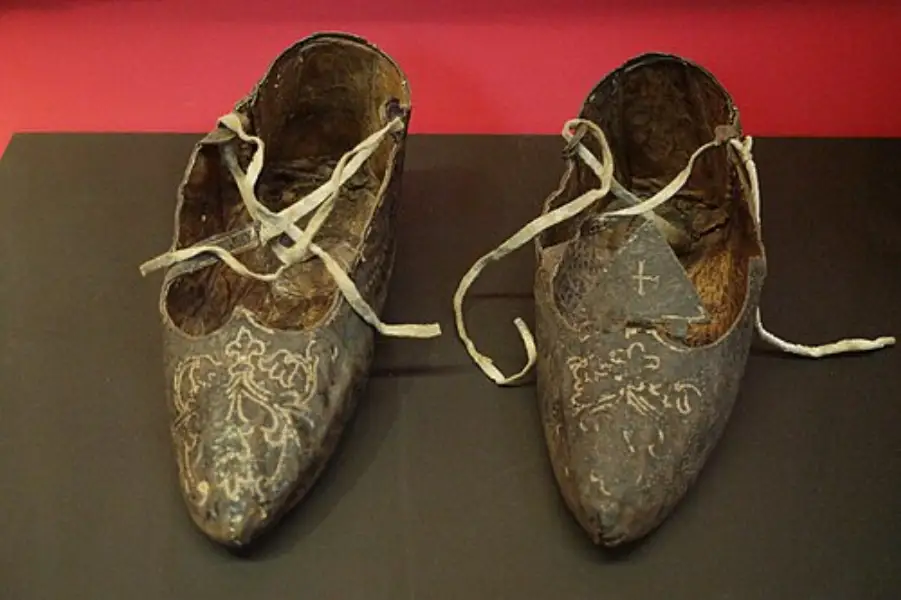
Few early medieval saints remain as present in their home region as Germanus of Granfelden. His memory has never dimmed in the heavily Catholic canton of Jura, where church after church bears his dedication, and Delémont safeguards two relics of unusual antiquity and intimacy. In the Musée jurassien d'art et d'histoire is kept his crosier, one of the oldest surviving bishops' and abbots' staffs anywhere in Europe, studied in a dedicated monograph by Sarah Stékoffer. The Musée de Cluny in Paris preserves the shoes of St Germanus, displayed as testimony to the material survival of a seventh-century abbot.
His story has been carried by the historiography of two nations and two disciplines: the Biographisch-Bibliographisches Kirchenlexikon records him in German scholarship, the Historical Dictionary of Switzerland keeps his entry current, and Yaniv Fox's study of Columbanian monasticism situates him in the political world of the Arnulfings. Alban Butler's eighteenth-century Lives and the Orthodox Saints of the Pre-Schism See of Rome continue to retell his martyrdom for new generations of readers. At Moutier itself the Catholic parish names Germanus and Randoald among its patron saints, and each February 21 the valleys where he walked remember the abbot who died on the road home.
§ Veneration
Timeline
- 612
Born at Trier to Optardus, a wealthy senator of the city, as his second son.
§ Life
- 640
Sent by Abbot Waldebert of Luxeuil, around this year, to organize and govern the monastery of Moutier-Grandval, recently founded by Duke Gundoin of Alsace.
§ Life
- 675
Met Duke Adalrich of Alsace near Courtételle for negotiations with his prior Randoald, and was slain on the way back by the duke's supporters.
§ Life
- 675
His religious collected the bodies the following night and buried them, first at Saint-Ursanne and then at Moutier-Grandval.
§ Life
- 695
Bobolène, a priest probably of Moutier-Grandval, wrote the Passio sancti Germani recounting his life, around this year.
§ Vita
- 1477
The remains of the martyrs were transferred beneath the high altar of the abbey church.
§ Veneration
The Record
- Major works
- Moutier-Grandval Abbey, which he organized and governed for thirty-five years
- Symbols
- Crosier·With Saint Randoald
- Canonization
- Pre-congregation; venerated as a martyr in the Catholic and Eastern Orthodox Churches
Prayer
Bibliography
Show 10 sources
- Presbyter Bobulenus, "Passio sancti Germani", Vitae et passiones diversorum sanctorum, Codex Sangallensis 551, pp. 106–125, doi:10.5076/e-codices-csg-0551, St. Gallen, Stiftsbibliothek
- Sauser, Ekkart (1998). "Germanus von Münster-Granfelden". In Bautz, Traugott (ed.). Biographisch-Bibliographisches Kirchenlexikon (BBKL). Vol. 14. Herzberg: Bautz. cols. 1241–1244. ISBN 3-88309-073-5
- Hutchison-Hall, John. "21st February: Germanus and Randoald". Orthodox Saints of the Pre-Schism See of Rome. Retrieved 14 April 2023
- Stékoffer, Sarah (1996). La crosse mérovingienne de Saint Germain, premier abbé de Moutier-Grandval (Suisse). Porrentruy: Office du patrimoine historique, Société jurassienne d'émulation. p. 39. ISBN 2-88436-005-0
- Fox, Yaniv. Power and Religion in Merovingian Gaul: Columbanian Monasticism and the Formation of the Frankish Aristocracy. Cambridge University Press, 2014, p. 192. ISBN 9781107064591
- Baring-Gould, Sabine. The Lives of the Saints. J. Hodges, 1878, p. 361
- Butler, Alban. The Lives of the Fathers, Martyrs, and Other Principal Saints, Volumes 1-3. D. & J. Sadlier, 1846, p. 440
- Boillon, Claude. "Saints Germano and Randoaldo", Santi e Beati, February 19, 2018
- "Germain (saint)", Historisches Lexikon der Schweiz
- "Nos Saint-Patrons", Paroisse catholique romaine de Moutier
Profile text adapted from the Wikipedia article, licensed CC BY-SA 4.0.
Pray with this saint every day
Save St. Germanus of Granfelden to your favorites, read the full profile, and get feast-day reminders in the Saints app.
Get the Saints AppFree on the App Store for iPhone and iPad