
died 480·Feast May 2
St. Germanus of Normandy
Missionary of the Cotentin Invoked Against Fevers
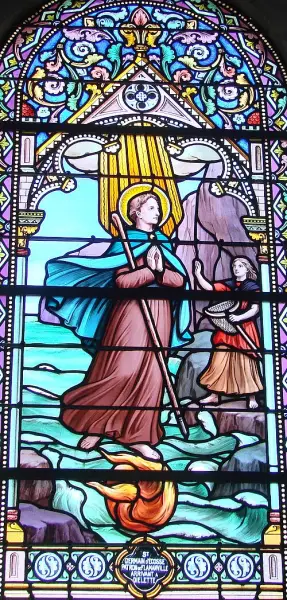
Overview
Germanus of Normandy, known in French as Germain le Scot — Germanus the Scot — is a saint honored above all in the Cotentin peninsula of Normandy. He was a disciple of Germanus of Auxerre, the great fifth-century bishop, from whom he took his baptismal name, binding the young missionary to the master who had crossed to Britain against the Pelagians. By tradition he crossed the English Channel to Normandy, where legend says he arrived near Flamanville, and his life in the region gathered stories of wonder: he is said to have traveled upon the sea borne by a wheel, and to have destroyed a seven-headed dragon at Trou Baligan. He died around the year 480, and his cult endured in the villages of the Norman coast, where the church of Saint-Germain de Flamanville still displays stained glass showing his arrival at Diélette. Popular religion made him a recourse for the fever-struck and for mothers watching sick children, and his feast is kept on May 2 by Catholics, Anglicans, and Eastern Orthodox alike.
The Complete Life
Disciple of the Bishop of Auxerre
The one firm thread in Germanus's story is his formation at the side of Germanus of Auxerre. The saint of Normandy was a disciple of the great bishop from whom, the sources state plainly, he took his baptismal name — a practice that made the disciple a living continuation of his master's memory. The elder Germanus was famed for his mission to Britain against Pelagianism around 429, and a follower formed in that school belonged to the generation of evangelizers who carried the faith through the disintegrating world of the fifth-century West.
His byname, Germain le Scot — Germanus the Scot — preserves the memory that he came from the Celtic world across the Channel, the world of Ireland and the Irish missions. Tradition places his crossing to Normandy by way of the sea, and legend embroiders it: he is said to have crossed the English Channel upon a wheel, arriving in Normandy near Flamanville. Behind the marvel lies the memory of a Celtic missionary settling among the fishermen and farmers of the Cotentin peninsula, where his cult took root and never died. He died around the year 480, the only date his cult has preserved.
§ Germanus of Normandy
The Wheel, the Dragon, and the Sick of Normandy
Normandy remembers Germanus through two vivid images. Artists customarily give him two emblems: a wheel, in memory of his strange crossing of the Channel mounted upon one, and a dragon, in memory of the seven-headed beast he was said to have destroyed at Trou Baligan. Both symbols belong to the common language of medieval hagiography — the saint mastering the forces of sea and evil — but in the Cotentin they are attached to places still named in the story, and the arrival of the saint at Diélette is painted in stained glass in the church of Saint-Germain de Flamanville, where he is shown coming ashore.
His practical patronage grew from the same soil. Families sought his help against fevers and against the sicknesses that struck their children — the terrors most familiar to the families who kept his feast, and he belongs to the company of healing saints of Normandy recorded by modern students of popular devotion. His cult is shared by three traditions: he is venerated in the Roman Catholic Church, the Anglican Communion, and the Eastern Orthodox Church, all of which keep his feast on May 2. For a saint about whom so little can be said with certainty, that triple commemoration is itself a testimony — the villages of the Cotentin never let his memory go.
§ Germanus of Normandy
The Record
- Patron of
- Against fevers·For the illnesses of children
- Symbols
- Wheel·Dragon
- Canonization
- Pre-congregation; venerated especially in Normandy
Prayer
Bibliography
Show 2 sources
- "Saint Germanus of Normandy". Saints.SQPN.com. Retrieved 22 December 2013
- Les Saints qui guérissent en Normandie, Gancel, 1998, ISBN 2-7373-2293-6
Profile text adapted from the Wikipedia article, licensed CC BY-SA 4.0.
Pray with this saint every day
Save St. Germanus of Normandy to your favorites, read the full profile, and get feast-day reminders in the Saints app.
Get the Saints AppFree on the App Store for iPhone and iPad