
c. 480 – c. 560·Feast May 16
St. Germerius
Bishop of Toulouse and Clovis's Beneficiary
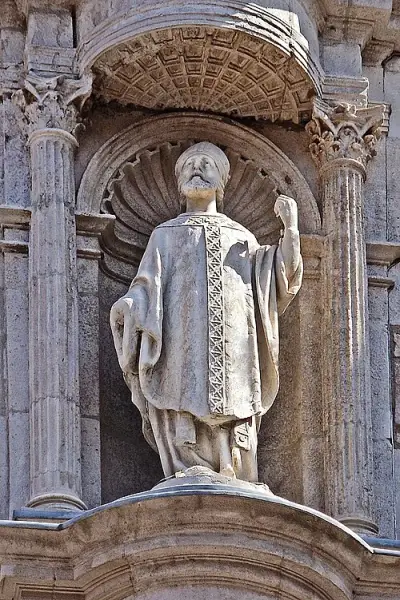
Overview
Germerius, honored in French as Saint Germier, held the see of Toulouse for fifty years, 510 to 560, across the very decades in which Clovis turned the Franks to Christianity. Born around 480 — a native of Angoulême, or, in another version of his story, of Jerusalem — he came to Gaul as a pilgrim from the Holy City and was ordained a deacon. An angelic instruction bade him go to Paris, promising that he would be made a bishop there at the age of thirty, and the promise was fulfilled in his elevation to the see of Toulouse. His legend binds him closely to Clovis I: summoned to the royal palace on his way to his diocese, he celebrated the Eucharist for the king and the princes and took their confessions, and when Clovis asked what reward he desired, the bishop asked only for as much land at Ducorum as his cloak could shadow — receiving instead an estate six miles around, confirmed by written charter. There he founded two churches and the monastery of Saint-Germier, and there he died about 560. The abbey of Lézat claims him as its patron, though historians doubt whether he ever lived at all.
The Complete Life
From Jerusalem or Angoulême to Paris
The life of Germerius opens in uncertainty even about his homeland: Angoulême claimed him as a son, while another tradition made him a pilgrim out of Jerusalem. There he was ordained a deacon and given over to the service of the Church in the generation when the Frankish kingdom was becoming Christian.
His advancement came, his biographers insist, not by ambition but by revelation. An angel's message directed his steps to Paris, with the pledge that upon reaching thirty he would there be consecrated a bishop. Germerius trusted the word and went, and it proved true: he received the church of Toulouse, one of the great sees of the south. Historians approach such narratives with caution, and the question whether Germerius actually existed has been openly raised; the tale as preserved belongs to the tradition by which monasteries explained and defended their possessions. But the shape of the story is coherent: a deacon of the early sixth century, marked out for the episcopate in the Frankish capital, dispatched to a diocese in the southwest just as Clovis made Christianity the religion of his house.
§ Germerius
The Cloak and the Charter of Clovis
The heart of Germerius's legend is his encounter with King Clovis I. Summoned to the royal palace as he traveled toward Toulouse, the bishop offered the Eucharist to Clovis and the young princes and took their confessions — a scene that makes the new Frankish Christianity concrete, the convert king kneeling before a southern bishop. Clovis then asked for the bishop's prayers and offered whatever reward Germerius might ask. The bishop's answer became proverbial in the tradition of the abbey that preserved it: he desired land near Toulouse, no more of it than the shade his mantle cast upon the earth at Ducorum.
Clovis surpassed the request, making over the whole countryside for six miles about Ducorum and confirming the donation in a charter guaranteeing its freedom; he then begged the bishop to remain twenty days more at court, and Germerius agreed. The king added other gifts, including vestments and whatever else the liturgy required. On his lands two sanctuaries rose — one under Saint Martin's invocation, the other under Saint Saturninus's. The Martin church is placed either at Ox, a village a little southwest of Muret, or at Roziniac; and Germerius set up the monastery of Saint-Germier as heir to the whole of this property. The version is preserved explicitly in the life published by the abbey, making clear that its estates came from the king himself.
§ Germerius
Patron of Lézat and Question of History
Germerius died at Ducorum around the year 560, closing a fifty-year episcopate at Toulouse. His cult endured above all through the institutions that claimed his foundation: the abbey of Lézat looked to him as its own patron, and its monks counted the estate of Saint-Germier and the churches of Ox and Roziniac among their possessions, and his image appears in the church of Notre-Dame de la Dalbade in Toulouse, painted alongside Saint Sebastian. His feast is kept on May 16 in both the Roman Catholic and Eastern Orthodox Churches.
Modern historians treat his story with reserve. There is some question whether he actually existed at all; the narrative of the angel, the Paris ordination, and the king's charter reads as the typical founding legend by which a religious community anchored its lands in the age of Clovis. Yet even as legend, the story preserves something true about its world: the entanglement of bishops with the converted monarchy, the gift of estates as the price and fruit of pastoral care, and the memory of a saint whose cloak, spread upon the ground, was thought to sanctify more ground than any charter could measure.
§ Germerius
Timeline
- 480
Born around this year, a native of Angoulême or, in another telling, of Jerusalem.
§ Germerius
- 510
Became bishop of Toulouse, having been made a bishop at Paris at the age of thirty.
§ Germerius
- 560
Died at Ducorum after fifty years as bishop of Toulouse.
§ Germerius
The Record
- Major works
- Church dedicated to Saint Martin (identified with Saint-Martin in Ox or Saint-Martin of Roziniac)·Church dedicated to Saint Saturninus·Monastery of Saint-Germier
- Patron of
- Patron saint of the abbey of Lézat
- Canonization
- Pre-congregation; venerated in the Roman Catholic and Eastern Orthodox Churches
Prayer
Bibliography
Show 3 sources
- "May 16", Latin Saints of the Orthodox Patriarchate of Rome
- Remensnyder, Amy G. Remembering Kings Past. Cornell University Press, 1995. ISBN 0-8014-2954-4
- "St. Germerius"
Profile text adapted from the Wikipedia article, licensed CC BY-SA 4.0.
Pray with this saint every day
Save St. Germerius to your favorites, read the full profile, and get feast-day reminders in the Saints app.
Get the Saints AppFree on the App Store for iPhone and iPad