
1486 – 1537·Feast February 8
St. Gerolamo Emiliani
Founder of the Somaschi and patron of orphans
Overview
Gerolamo Emiliani was an Italian humanitarian and the founder of the Congregation of Regular Clerics, the religious community better known as the Somaschi Fathers. Born in Venice in 1486 to Angelo Emiliani and Eleonore Mauroceni, he lost his father in adolescence and ran away at fifteen to become a soldier. In 1508 he fought in the defense of Castelnuovo against the League of Cambrai and, while commanding a fortress in the Treviso mountains, was taken prisoner. He read his escape as a grace won through the Mother of God and, to pay the vow he had made, walked as a pilgrim to her shrine at Treviso, leaving his chains there as an offering. He later served Venice as podestà of Castelnuovo di Quero before returning home to oversee the education of his nephews, giving his leisure to theological study and charitable works. During the plague and famine of 1528 he nursed the sick and fed the hungry at his own expense, opening a house for orphaned children near the church of St. Rose. He extended his labors to Verona, Brescia, Bergamo, and Milan, establishing hospitals and orphanages and, at Bergamo, a hostel for repentant prostitutes. With two priests he founded the Congregation of Regular Clerics in 1532, headquartered at Somasca. He died there on 8 February 1537, having caught the plague while nursing its victims.
The Complete Life
A Venetian Childhood and a Soldier's Youth
Gerolamo Emiliani was born in Venice in 1486, his parents being Angelo Emiliani, known familiarly as Miani, and Eleonore Mauroceni. His childhood unfolded in one of the great maritime republics of Europe, in a family of standing, though the surviving record tells little else of his earliest years. His father died while Gerolamo was still a teenager, leaving the boy without a guiding hand at a formative age. Restless and untethered, he ran away from home at fifteen to join the army. Military life suited his energies. In 1508 he took part in the defense of Castelnuovo against the forces of the League of Cambrai, an episode that fell in the period before Pope Julius II aligned himself with the Venetians. His competence earned him appointment as governor of a fortress in the Treviso mountains, a post he defended until enemy forces captured him. Up to that point, the man who would become a father to countless orphans had given little thought to God, caring nothing for religion in his daily life. Imprisonment, however, became the hinge on which his whole existence turned, for what followed his escape would remake him entirely and send him down a road no one who knew the young soldier could have predicted.
§ Biography
Chains Left at a Shrine
Emiliani attributed his escape from captivity to the intercession of the Mother of God. In fulfillment of a vow, he made his way as a pilgrim to her shrine at Treviso and hung his chains there as an offering of gratitude. The careless soldier had been changed into a man of serious piety. Venice soon called on his administrative gifts again: he was named podestà, a Venetian magistrate, of Castelnuovo di Quero, though he held the post only a short time. He then returned to his native city to supervise the education of his nephews, a responsibility that appears to have turned his heart permanently toward the young. Every hour he could spare from that duty he gave to theological study and to charitable works among the poor of Venice. Sources differ about whether he ever received ordination: recent editions of Butler's Lives of the Saints state plainly that he was ordained a priest, while the Martyrologium Romanum makes no such claim. What is certain is that the former man-at-arms now spent himself without reserve for the sick, the hungry, and the abandoned, persuading others of means to do the same.
§ Biography
Father of the Abandoned
The year 1528 brought plague and famine to northern Italy, and orphans multiplied in the streets of Venice. Emiliani seemed to be everywhere at once. He nursed the sick and fed the hungry, meeting the cost from his own purse, and rented a house near the church of St. Rose where, assisted by pious laymen, he ministered to the needs of homeless children. The hospital for incurables that Gaetano dei Conti di Thiene had established was likewise placed in his hands. His energy did not stop at the city's boundaries. In 1531 he went to Verona and persuaded its citizens to build a hospital. In Brescia, Bergamo, Milan, and other towns of the north he put up orphanages, some for boys and some for girls. At Bergamo he added a hostel for women who had lived as prostitutes and wished to begin their lives again. Blessed John Paul II would later honor him with a striking title — a lay animator of the laity — capturing how he drew ordinary believers into the service of the suffering. Through his good offices, hospitals and orphanages arose in town after town of northern Italy, each one a refuge where none had stood before.
§ Biography
A Rule Written for Orphans
The rule Emiliani composed for his community reveals the man. He named the care of orphans, the poor, and the sick as the congregation's principal work, and he insisted that the dwellings, food, and clothing of the brothers should bear the mark of religious poverty, so that those they served would never feel themselves beneath their benefactors. When two priests, Alessandro Besuzio and Agostino Bariso, joined his labors, the little company took formal shape in 1532 as the Congregation of Regular Clerics. Its motherhouse stood at Somasca, a secluded hamlet in the comune of Vercurago lying between Milan and Bergamo, and from that place the members took the name Somaschi. Emiliani placed the society under the patronage of the Virgin, of the Holy Spirit, and of the Archangel Raphael, and he nurtured a particular devotion to the guardian angels, seeing in every rescued child a soul entrusted to heavenly custody. In 1540 Pope Paul III approved the congregation under its official title, Clerici Regulares S. Majoli Papiae Congregationis Somaschae, and the community spread throughout Italy, carrying his distinctive brand of practical mercy to new cities and new generations of children left with no one else to care for them.
§ Congregation of Regular Clerics
Death in the Act of Mercy
Somasca remained the center of Emiliani's final years, a quiet settlement in the hills of the comune of Vercurago where the motherhouse stood and from which his works radiated across the north of Italy. His death came, fittingly, in the very act that had defined his conversion. When epidemic disease broke out, he went to assist the sick, as he had done since the terrible famine year of 1528, and in doing so he contracted the plague himself. He died at Somasca on 8 February 1537, aged about fifty, less than five years after giving canonical form to the congregation that would carry his work forward. He did not live to see its papal approval in 1540, nor its spread through the towns of the peninsula, but the community already bore the deep impress of his rule and his spirit. The sanctuary that stands at Somasca today keeps his remains in a silver shrine of the seventeenth century, and the faithful still come to the place where the former soldier, magistrate, and founder ended his days among the poor he would not abandon.
§ Congregation of Regular Clerics
From Beatification to the Calendar
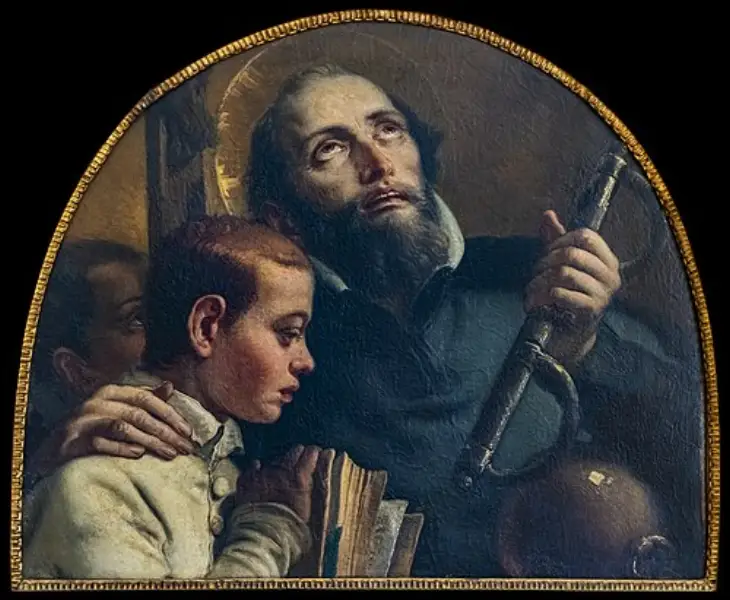
Recognition of Emiliani's holiness came late but decisively. Pope Benedict XIV beatified him on 23 April 1747, and Pope Clement XIII canonized him on 16 July 1767. Because his cult received formal confirmation so long after his death, he had no place in the Tridentine calendar of 1570. His insertion into the Roman calendar came in 1769, with 20 July given him as his date; eight years after the canonization, the Office and Mass composed in his honor received approval. In 1969, in the course of the general liturgical reform, Pope Paul VI moved his feast to 8 February, the anniversary of his death, where the Church now keeps his memory each year. His principal shrine is the St. Girolamo Emiliani Sanctuary at Somasca in the comune of Vercurago, where his remains rest in a silver reliquary of the seventeenth century. A depiction by Giandomenico Tiepolo in the Cappella di Zianigo of Ca' Rezzonico in Venice preserves his likeness for the city of his birth. In 1928 Pope Pius XI completed the picture by proclaiming him heavenly patron of orphans and of abandoned children throughout the Catholic world.
§ Veneration
An Enduring Work of Mercy
The congregation Emiliani founded did not remain a local effort. Approved by Pope Paul III in 1540 under the name Clerici Regulares S. Majoli Papiae Congregationis Somaschae, the Somaschi spread throughout Italy, continuing the specific work their founder had written into their rule: the care of orphans, the poor, and the sick. In Milan, an orphanage that traced its origins to his initiative became known as the Martinitt, an institution remembered in the city's long history of charitable care. His manner of engaging laypeople in the service of the suffering drew the attention of later popes: Blessed John Paul II called him a lay animator of the laity, and in 2011 Pope Benedict XVI addressed a message to the Order of Clerics Regular of Somasca marking half a thousand years since the prodigious liberation of their founder — the prison escape at Treviso from which everything began. In 1928 Pope Pius XI declared him the heavenly patron of orphans and of abandoned children, the very constituency he had served at the cost of his life. Hospitals, orphanages, and houses of refuge across northern Italy remain the enduring monument of his decades of mercy.
§ Patronage
Timeline
- 1486
Born in Venice, son of Angelo Emiliani and Eleonore Mauroceni.
§ Biography
- 1508
Fought in the defense of Castelnuovo against the League of Cambrai and was captured while holding a fortress in the Treviso mountains.
§ Biography
- 1528
During the year of plague and famine, began nursing the sick and sheltering orphaned children in Venice at his own expense.
§ Biography
- 1531
Traveled to Verona and persuaded its citizens to build a hospital.
§ Biography
- 1532
Founded the Congregation of Regular Clerics, with its motherhouse at Somasca.
§ Congregation of Regular Clerics
- 8 Feb 1537
Died at Somasca after contracting the plague while assisting the sick during an epidemic.
§ Congregation of Regular Clerics
- 1540
Congregation approved by Pope Paul III under its official name and spread throughout Italy.
§ Congregation of Regular Clerics
- 23 Apr 1747
Beatified by Pope Benedict XIV.
§ Veneration
- 16 Jul 1767
Canonized by Pope Clement XIII.
§ Veneration
- 1769
Inserted into the Roman calendar with a feast assigned to 20 July.
§ Veneration
- 1928
Named patron of orphans and abandoned children by Pope Pius XI.
§ Patronage
- 1969
Pope Paul VI moved his feast to 8 February, the anniversary of his death.
§ Veneration
In Their Own Words
lay animator of the laity
The Record
- Major works
- Congregation of Regular Clerics (Somaschi Fathers), founded 1532·Orphanages for boys and girls at Brescia, Bergamo, Milan and other northern Italian towns·Hospital at Verona, induced from the citizens in 1531·Hostel for repentant prostitutes at Bergamo
- Patron of
- orphans and abandoned children
- Canonization
- Beatified by Pope Benedict XIV on 23 April 1747; canonized by Pope Clement XIII on 16 July 1767.
Prayer
Bibliography
Show 9 sources
- "St. Jerome Emiliani". Catholic Encyclopedia.
- "Catholic Archdiocese of Sydney – Events". sydneycatholic.org. 28 September 2023.
- Foley O.F.M., Leonard. "St. Jerome Emiliani", Saint of the Day, Lives, Lessons, and Feast. Franciscan Media.
- Guerin, Paul. Les Petits Bollandistes: Vies des Saints (Bloud et Barral: Paris, 1882), Vol. 8.
- "Message to the Order of Clerics Regular of Somasca on the 500th anniversary of the prodigious liberation of their founder St. Jerome Emiliani (July 20, 2011)". Benedict XVI.
- Thurston, Herbert (1956). Butler's Lives of the Saints (Revised ed.). Notre Dame: Christian Classics. p. 150. ISBN 0870610481.
- "St. Jerome Emiliani: A Different Kind of Saint". Somascan Fathers and Brothers.
- Calendarium Romanum. Libreria Editrice Vaticana, pages 87 and 130.
- Herbermann, Charles, ed. (1913). "St. Jerome Emiliani". Catholic Encyclopedia. New York: Robert Appleton Company.
Profile text adapted from the Wikipedia article, licensed CC BY-SA 4.0.
Pray with this saint every day
Save St. Gerolamo Emiliani to your favorites, read the full profile, and get feast-day reminders in the Saints app.
Get the Saints AppFree on the App Store for iPhone and iPad