
died 1569
St. Geronimo
Arab convert martyred in concrete at Algiers
Overview
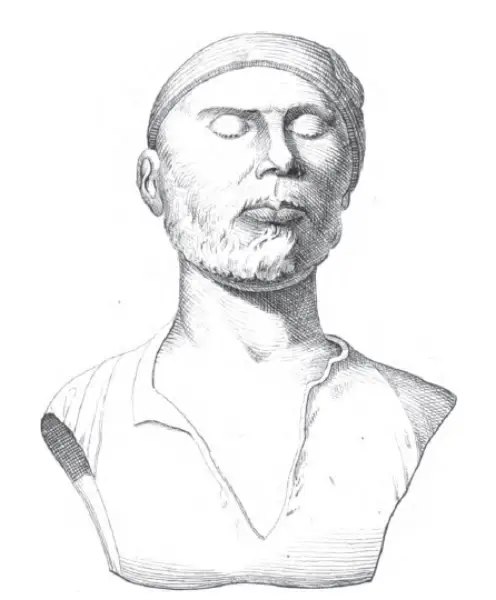
Geronimo, according to the account set down by the Spanish Benedictine Diego de Haedo, was an Arab youth who had accepted Christianity and received baptism under the name of Jerome. In 1569 he was seized by a Moorish corsair and carried off to Algiers, where his captors pressed him to abandon the Christian faith. He refused without wavering, and the authorities sentenced him to death. His hands and feet were tied, and he was cast living into a mould prepared for a block of concrete; the concrete block that held him was then set into an angle of the Twenty-four Hours Fort, whose construction was still under way. The story might have perished with him had Haedo not recorded it in his topographical history of Algiers, printed in 1612. In 1853, when the fort came down, a skeleton was said to have been found in the very angle Haedo had described, and the find was regarded as confirming the old account. Plaster of Paris, poured into the cavity left by the body, was said to preserve the features of the young man, the cords that bound him, and the very texture of his clothing. His bones were laid to rest at St. Philippe, where the Ketchaoua Mosque now stands.
The Complete Life
A Youth Who Chose Christ
The figure at the center of this story emerges from Haedo's pages as an Arab youth, young enough that his age is itself part of the pathos of the account, who had accepted the Christian faith and received in baptism the name Geronimo, that is, Jerome. What drew him to Christianity, whether family, witness, study, or grace working through circumstance, the record does not say; it preserves only the fact of conversion, which in his world was the most consequential decision a man could make. To accept baptism as an Arab in the sixteenth century was to cross one of the age's sharpest divides, and the story that follows shows that those on the other side of the divide regarded his crossing as treason to be undone. In 1569 a Moorish corsair captured him and brought him to Algiers, the port from which the corsairs of the Barbary coast ravaged the Mediterranean. There, in a city where his original faith was the law and his new one a liability, the youth was given every reason — and eventually every inducement — to go back on his baptism. He did not take them, and that refusal became his witness.
§ Geronimo (martyr)
Sealed in Stone
In Algiers the captors and authorities of Geronimo tried to persuade him to renounce Christianity. He would not. His refusal was steady, and it exhausted their patience: he was condemned to death. The manner of his execution was singular and terrible. His hands and feet were tied, and he was thrown, still living, into a mould that had been prepared for a block of concrete. The liquid mass closed over him, hardened, and became his tomb; the block that enclosed his body was then mortared into one angle of the Twenty-four Hours Fort, a fortification then rising at Algiers. In this way the young convert was quite literally incorporated into the walls of the city that had refused his faith — a stone in its defenses, a hidden cornerstone of a kind the builders never intended. The account, transmitted by the Spanish Benedictine Diego de Haedo, has the character of a legend handed down rather than a record witnessed, as the encyclopedia itself is careful to note. But the cruelty it describes was of a kind the corsair city practiced, and the memory it preserved proved durable enough to be tested, centuries later, against the stones themselves.
§ Geronimo (martyr)
The Angle That Held a Skeleton
The martyrdom passed into writing in 1612, when Haedo published his topographical history of Algiers and set forth the legend of the youth in the concrete. There the story rested for more than two centuries. Then in 1853 the Twenty-four Hours Fort came down, and workmen, as Samuel M. Zwemer relates the story, came upon a skeleton in the very angle Haedo's text had singled out. The discovery was regarded as confirming the old incident, and it was treated with the care owed to relics. Craftsmen poured liquid plaster of Paris into the cavity the body had left, and the resulting cast preserved a perfect model of the young man's features, of the cords binding him, even of the weave of his clothing. His bones were laid to rest at St. Philippe, where the Ketchaoua Mosque now stands, and the plaster cast was reported to be kept in what was then the museum of Parc du Galland, at Mustapha Superior, Algiers. Whatever else can be said of the story, its afterlife is remarkable: a death intended to erase a man left, instead, an impression of his face that outlasted the fort built to hold it.
§ Geronimo (martyr)
Timeline
- 1569
Captured by a Moorish corsair and taken to Algiers.
§ Geronimo (martyr)
- 1612
Diego de Haedo, a Spanish Benedictine, published his topographical history of Algiers recording the martyrdom.
§ Geronimo (martyr)
- 1853
The Fort of the Twenty-four Hours was demolished and a skeleton was found in the angle specified by Haedo.
§ Geronimo (martyr)
- 1853
His bones were laid to rest at St. Philippe — today the site of the Ketchaoua Mosque — and a plaster model of the body was made.
§ Geronimo (martyr)
The Record
- Canonization
- No formal canonization is recorded in the source; he is honored as San Geronimo, and the finding of his remains in 1853 was regarded as confirming his cult.
Prayer
Bibliography
Show 2 sources
- Zwemer, Samuel M. (F.R.G.S.) (1920s). Call to Prayer. London: Marshall Brothers. p. 14ff.
- Morell, John Reynell (1854). Algeria: The Topography and History, political, social and natural of French Africa. London.
Profile text adapted from the Wikipedia article, licensed CC BY-SA 4.0.
Pray with this saint every day
Save St. Geronimo to your favorites, read the full profile, and get feast-day reminders in the Saints app.
Get the Saints AppFree on the App Store for iPhone and iPad