
died 465·Feast May 5
St. Gerontius of Milan
Archbishop of Milan who rebuilt a ravaged church
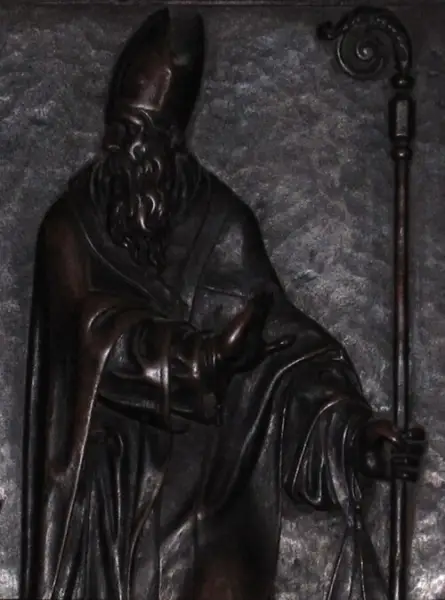
Overview
Gerontius (Italian: Geronzio) was Archbishop of Milan from 462 until his death on 5 May 465, and is honored as a saint in the Catholic Church. Almost nothing is known of his origins or of the inner life of his episcopate, but the shape of his service is clear. He had been a pupil of his predecessor, Bishop Eusebius, who proposed him as successor, and the Milanese clergy and people elected him to the see in about 462. He led the Church of Milan in the years immediately following the devastating invasion of the Huns of 452, when the cities of northern Italy were still counting their losses. The early sixth-century writer Ennodius, bishop of Pavia, records that Gerontius shone with generosity and charity in those years of rebuilding, and that during his episcopate he set about rebuilding many of the secondary churches the Huns had destroyed. He died on 5 May 465 after barely three years in office, and was laid to rest in the city's Basilica of St. Simplician. His feast is kept on the day of his death. A late and unhistorical tradition links him to the Milanese family of Bascapé, a pedigree the modern scholar does not confirm.
The Complete Life
The Pupil Chosen to Succeed
The record of Gerontius begins, as the records of many early bishops do, with a single relationship: he was the pupil of Eusebius, Archbishop of Milan, and it was Eusebius himself who suggested his student's name as the next occupant of the see. That recommendation, preserved by the tradition of the Milanese Church, says something about the pupil. A bishop does not ordinarily hand his church to a man he has not tested, and Eusebius, who had governed Milan through the darkest decade of the fifth century, knew better than most what the office demanded. In about 462 the clergy and people of Milan elected Gerontius archbishop on that recommendation, and he succeeded the saint whose own name his burial place would one day carry, for the cathedral baptistery city of Ambrose and Simplician looked to its archbishop for both governance and holiness. No source preserves the date or place of his birth, his family, or his formation beyond that decisive apprenticeship; a late tradition that made him a member of the Milanese family of Bascapé has no historical basis and tells us only that later generations wished to claim him. What can be said is that he was formed inside the Church of Milan and judged faithful within it.
§ Life
Charity in the Years of Reconstruction
Gerontius took office in the shadow of catastrophe. A decade before his election, in 452, the armies of Attila had swept into northern Italy, and the invasion of the Huns left Milan and its surrounding towns devastated; among the losses were many of the city's secondary churches, the parish and mortary buildings that served ordinary Christian life. It was precisely there, in the unglamorous work of restoration, that the new archbishop made his mark. Ennodius, bishop of Pavia and the most important Latin writer of the early sixth century, testified that Gerontius stood out for his open-handed generosity and charity in the hard years of rebuilding. While the great basilicas still stood, it was the lesser churches — those that belonged to neighborhoods, to the poor, to the daily round of sacraments — that waited longest for help, and Gerontius went about rebuilding them one by one through his episcopate. The work was quiet, expensive, and endlessly interrupted, the work of a shepherd who understood that a city's faith recovers through its small sanctuaries before its monuments. Three years were all his office allowed him, but the sources record no other bishop of that generation in Milan whose name is so directly tied to the city's physical recovery.
§ Life
Death and Burial by St. Simplician
Gerontius died in office on 5 May 465, after an episcopate of barely three years. His remains were interred in Milan's Basilica of St. Simplician, the church named for the bishop who had succeeded Ambrose at the end of the previous century — a burial that placed the healer of the Hunnic devastation beside one of the city's most revered early shepherds and bound his memory to the oldest strata of Milanese sanctity. The Church of Milan fixed his feast on 5 May, the anniversary of his death, and it has kept that date ever since, honoring him among the long line of saintly archbishops that runs from Barnabas through Ambrose to the present. Beyond these facts the tradition is nearly silent, and even its one embellishment is of late date and doubtful worth: a claim, offered without historical basis, that Gerontius belonged to the Milanese family of Bascapé. The scholars who compiled the catalogs of the Milanese episcopate in the twentieth century, Ruggeri and Cazzani among them, could add nothing to Ennodius's testimony of charity. His is the memory of a ruler whose whole recorded virtue is generosity — a saint of the reconstruction, remembered where he was buried, in the heart of the city he rebuilt.
§ Life
Timeline
- 452
The invasion of the Huns devastated the churches of Milan, the destruction Gerontius would spend his episcopate repairing.
§ Life
- 462
Elected Archbishop of Milan on the recommendation of his predecessor, Bishop Eusebius.
§ Life
- 5 May 465
Died in office; his remains were interred in the Basilica of St. Simplician at Milan.
§ Life
The Record
- Major works
- Rebuilding of the secondary churches of Milan destroyed by the Huns in the invasion of 452
- Canonization
- Pre-congregation; honoured as a saint in the Catholic Church from antiquity, with a feast on 5 May.
Prayer
Bibliography
Show 2 sources
- Ruggeri, Fausto (1991). I Vescovi di Milano. Milano: NED. p. 16. ISBN 88-7023-154-2. (in Italian)
- Cazzani, Eugenio (1996). Vescovi e arcivescovi di Milano. Milano: Massimo. pp. 29-30. ISBN 88-7030-891-X. (in Italian)
Profile text adapted from the Wikipedia article, licensed CC BY-SA 4.0.
Pray with this saint every day
Save St. Gerontius of Milan to your favorites, read the full profile, and get feast-day reminders in the Saints app.
Get the Saints AppFree on the App Store for iPhone and iPad