
died 501·Feast May 9
St. Gerontius of Cervia
First bishop of Cervia slain on the Via Flaminia
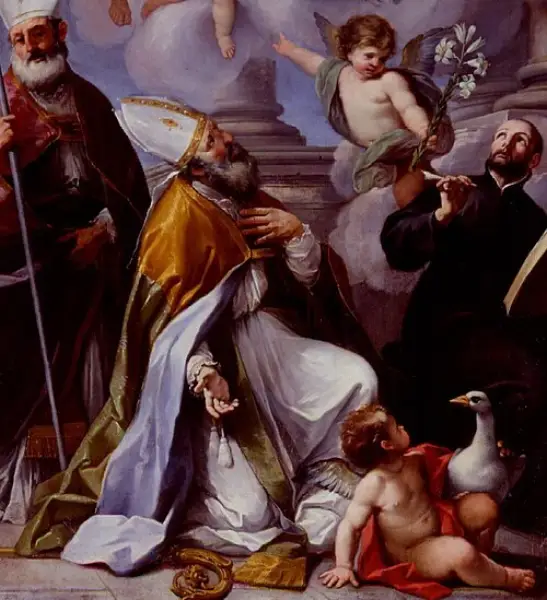
Overview
Gerontius of Cervia, also called Gerontius of Ficocle, was the first known Bishop of Cervia, the Adriatic see whose early history begins with his name. He died in 501, and the circumstances of his death made him a martyr. Returning from Rome in the company of Viticanus, Bishop of Cagli, after a council held in 501 to consider the accusations brought against Pope Symmachus, bandits fell upon the two travelers, and Gerontius was slain on the Via Flaminia at Cagli, near Ancona. The legend surrounding the killing speaks of heretics rather than common robbers — perhaps Goths, or, as later writers judged more probable, Heruli belonging to the army of Odoacer — suggesting that he died for the faith and the unity of the Church rather than merely at the mercy of highwaymen. His remains are venerated at Cagli, the place of his death. He was honored from the beginning as a martyr, his feast was fixed on 9 May, and Christian art gave him a curious emblem: a goose. The little that survives of him is thus a complete silhouette — a pioneer bishop, a churchman engaged in the gravest crisis of the Roman see, and a victim of the violence that trailed the falling Western Empire along its own roads.
The Complete Life
The First Shepherd of Cervia
Gerontius holds a pioneer's place in the history of the Adriatic coast: he is the first Bishop of Cervia whose name the records keep. To be the first known bishop of a see is to stand at the head of a line whose beginnings are otherwise lost, and it means that whatever else time has taken, the founding ministry itself remains attached to his memory. The city of Cervia, known in its earliest Christian arrangements by the related name of Ficocle, was a small but real center of the Italian Church at the close of the fifth century, an age when the episcopate demanded stamina, prudence, and courage. The old Roman world was giving way, and its roads — the arteries that bound the provinces to Rome and to one another — had grown perilous. A bishop of such a town was not a courtier but a working pastor, responsible for his flock's worship and welfare amid the disorders of the time. Gerontius's participation in the business of the wider Church, which the record of his last journey shows, indicates a bishop who took his place among his fellow bishops and did not confine his care to his own walls.
§ Life
Murder on the Road from Rome
In 501 Gerontius traveled to Rome for the council summoned to treat the accusations made against Pope Symmachus, one of the bitterest disputes of the age, and he began the journey home in the company of Viticanus, Bishop of Cagli. On the Via Flaminia, at Cagli near Ancona, the two bishops were assaulted, and Gerontius was killed by bandits. So much the record states plainly. The legend that grew around the event colors it further: the killers were said to be heretics rather than common thieves — Goths perhaps, or likelier still Heruli from the host of Odoacer, the barbarian general who then ruled Italy. If the legend is right, the bishop died not as an unlucky traveler but as a target, marked by enemies of the faith whose violence gave his death the character of martyrdom. Either way, the fact of his end is fixed: a churchman returning from the service of the Roman see, cut down on the ancient consular road within sight of home territory. The brevity of the account conceals the exhaustion of the journey, the weight of the council's business, and the danger every prelate of that generation accepted whenever he took to the road for the Church.
§ Life
A Martyr Remembered at Cagli
The Church received Gerontius among its martyrs, and his veneration took root at the scene of his death: his remains are honored at Cagli, the town on the Via Flaminia where he fell. His feast was assigned to 9 May, and his cult entered the calendars and the acta of the saints, preserved in the learned collections of the seventeenth and eighteenth centuries that carried his name to later generations. Christian art fixed his emblem as a goose, an attribute whose origin the surviving record does not explain but which made him recognizable in the image-cycles of the Italian churches. As the first known bishop of Cervia, he also became a figure of the city's deepest identity, the man at whose name its Christian history begins. The scholars who studied the Italian dioceses in the nineteenth and twentieth centuries — Cappelletti and Lanzoni among them — returned to his case again and again, for it touches the origins of a see, the crisis of Pope Symmachus, and the violence of Odoacer's Italy all at once. A martyr's death on the road home, a relic at Cagli, a feast in May, and a goose in art: these are what memory kept of him.
§ Life
Timeline
- 501
Attended the Roman council held to treat the accusations made against Pope Symmachus.
§ Life
- 501
Slain by brigands on the Via Flaminia at Cagli, close to Ancona, as the two bishops journeyed home.
§ Life
The Record
- Symbols
- a goose
- Canonization
- Pre-congregation; venerated as a martyr from the earliest times, with a feast on 9 May.
Prayer
Bibliography
Show 5 sources
- Cappelletti, Giuseppe (1844). Le chiese d'Italia dalla loro origine sino ai nostri giorni. Volume 2. Venice: G. Antonelli.
- Lanzoni, Francesco (1927). Le diocesi d'Italia dalle origini al principio del secolo VII (an. 604). Faenza: F. Lega.
- Benigni, Umberto. "Cervia." The Catholic Encyclopedia. Vol. 3. New York: Robert Appleton Company, 1908.
- Daniel Papenbroch, Acta Sanctorum Maii Tomus secundus (Antwerp 1738), pp. 461-464.
- Odden, Per Einar. "Den hellige Gerontius av Cervia (-502)". Den katolske kirke.
Profile text adapted from the Wikipedia article, licensed CC BY-SA 4.0.
Pray with this saint every day
Save St. Gerontius of Cervia to your favorites, read the full profile, and get feast-day reminders in the Saints app.
Get the Saints AppFree on the App Store for iPhone and iPad