
c. 628 – 659·Feast March 17
St. Gertrude of Nivelles
Merovingian abbess and foundress of Nivelles
Overview
Gertrude of Nivelles (c. 628 – 17 March 659) was a Merovingian abbess who, with her mother Itta of Metz, founded the Abbey of Nivelles, a double monastery in what is now Belgium. Born into the highest Frankish nobility — her father was Pepin of Landen, mayor of the palace and kingmaker of Austrasia — she was presented with a dynastic marriage at the age of ten and refused it, vowing to take no earthly spouse but Christ. After her father's death she took the veil, shielded by her mother from the suitors who pursued the family's wealth, and entered the religious life at Nivelles. When Itta died in 652, Gertrude assumed sole government of the monastery, known in her own lifetime and since for her learning, her charity to the sick, elderly, poor, orphans, widows, captives, and pilgrims, and her welcomed circle of Irish monks, among them Foillan and Ultan. She sent envoys to Rome and across the sea for relics, holy books, and teachers of chant and scripture. Exhausted by fasting, prayer, and a life of charity, she resigned her office, was promised by a pilgrim — commonly thought to be Ultan — that she would die the next day, and did so on 17 March 659, aged about thirty, buried in a pilgrim's old veil and her own hair shirt. Canonized in 1677, she is patroness of Nivelles, travelers, gardeners, and, in modern devotion, cats.
The Complete Life
Born at the Summit of Frankish Power
Gertrude was born around 628 at Landen, in the kingdom of Austrasia, into a family so prominent that her biographer could write that all Europe knew the loftiness of her lineage. Her father was Pepin of Landen, called Pippin the Elder, a nobleman of east Francia who had been instrumental in persuading King Clothar II to crown his son Dagobert I as king of Austrasia. Her mother was Itta of Metz, a woman of palace standing who was likely acquainted with Amandus, bishop of Maastricht. On Dagobert's accession to his father's throne the court removed to Neustria, and Pepin's household — the child Gertrude included — traveled with it, so that her childhood at the royal court became her schooling in politics. Around her extended the web of alliances that would soon become Carolingian: Arnulf of Metz, her father's close ally, bound himself to the family by marrying his son Ansegisel to Gertrude's sister Begga, a union whose descendants ran through Pepin of Herstal and Charles Martel to Charlemagne himself. Her brother Grimoald would fight Otto for the mayoralty of Sigebert's palace and win control of all Austrasia. She was, by birth, a pawn of the most valuable kind — and she declined the role from the beginning.
§ Family and childhood
The Banquet and the Refusal
The first scene of Gertrude's biography is a dinner party. Her father hosted a banquet when she was ten years old, an occasion distinguished enough that the king himself accepted the invitation — a mark of the family's standing. At the feast the king put it to the girl whether she might be willing to wed an Austrasian duke's son, a match that would serve worldly ambition and mutual alliance alike. Gertrude's answer became famous: she lost her temper and rejected the proposal with an oath, declaring that she would have neither the duke's son nor any earthly spouse but Christ the Lord. The chronicler's decision to record a girl's fury at all was unusual for the era, and at least one scholar reads the passage as a deliberate portrait of her character; later saints' lives would imitate the motif of the betrothal to Christ that her story helped establish. The stakes were real, for in her world a king or a father could compel such a marriage, and scholars agree that the feelings of a noble daughter weighed little. Only her father's death — which came after he had returned east in 640 with Gertrude at his side — and her mother's drastic protection saved her vow from the dynastic machinery that surrounded her.
§ Marriage proposal
Foundress of Nivelles
After Pepin's death, the widow Itta pondered daily what would become of herself and her daughter, and on the advice of Bishop Amand she ordered the building of a monastery to which they could retire. The Vita is candid about the motive: Itta shaved her daughter's hair in the crown-shaped tonsure that marked her for religious service, to prevent violent abductors from tearing the girl away by force, and the foundation of Nivelles stopped the flow of suitors who hoped to ally themselves with the family's wealth by marrying her. Nivelles was a double monastery, one community for men and another for women, founded with no small opposition from the royal family, in a period troubled by the usurper Otto's bid against the Pippinids. Historians place the foundation between 647 and 650, and note that for widowed noblewomen of the age such a monastery was less an eccentricity than a recognized strategy of protection and piety. When Itta died at about sixty in 652, twelve years after her husband, Gertrude assumed the monastery's government single-handed, entrusting the family's business to administrators she could rely on from among the brothers, and ruled as abbess until illness forced her to yield the office to her niece Wulfetrud.
§ Foundress
Learning, Charity, and the Irish Guests
The Vita paints the abbess as an intelligent and scholarly young woman who devoted herself to the sick, the elderly, and the poor, who knew much of scripture by memory, stored up books of divine law, and unfolded for those who listened the secret reaches of allegorical meaning. Upon becoming abbess she dispatched envoys who brought back from Rome and from lands beyond the sea relics of the saints, holy books, and seasoned men to teach the divine law and practice the chant for herself and her people — scholars identify the men as Britons and Irish, evidence of Rome's pull on the Frankish Church long before Charlemagne. She built churches and cared for orphans, widows, captives, and pilgrims, and she welcomed foreigners of every rank, especially the Irish monks who had been traveling to evangelize since the sixth century. Among her guests were Foillan and Ultan, brothers of the buried Fursey, on their way from Rome toward Peronne; when Foillan was later betrayed and murdered at a stranger's house, it was Gertrude who found his body seventy-seven days afterward, on the anniversary of Fursey's death, and brought it honor. The first miracle told of her came as she prayed at the altar of Pope Sixtus II: a flaming, translucent sphere descended above her and filled the whole basilica with light for about half an hour — what her biographer called a visitation of the True Light.
§ Monastic life
The Foretold Day
Gertrude led a devout life to the end, though her body paid for it: the sources portray her as worn out by a lifetime spent in charity, fasting, and prayer, and the Cambridge Medieval History records that too much abstinence and keeping of vigils left her sorrily exhausted with serious illness while still young. Having relinquished her office as abbess, she spent her remaining strength in intense prayer and secretly wore a hair shirt against her skin. Feeling death approach, she asked a pilgrim from the monastery of Fosses — commonly believed to be Ultan, brother of Foillan — when she would die. He answered that she would die the next day, 17 March, the feast of Saint Patrick, and that Bishop Patrick, blessed of God, stood ready with his chosen angels to welcome her into joy. So it fell out: she died the following day, 17 March 659, at about thirty years of age, after praying through the night and receiving communion. She had asked that her body be arrayed for burial in a worn veil some wandering pilgrim had left behind, together with her own hair shirt, and she died in poverty. Shortly after her death, the monk Rinchinus and the writer of the Vita alike remarked a sweet scent in the room where her body lay.
§ Death
Cult and Commemoration
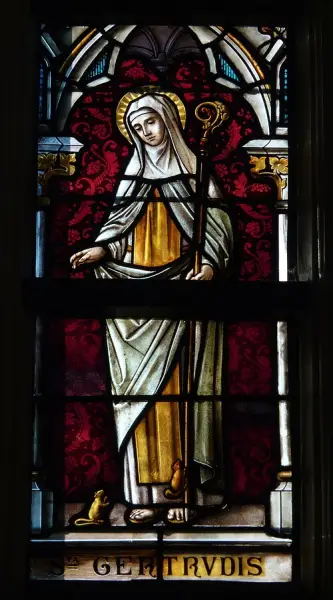
Veneration of Gertrude rose quickly in the monastery she had governed and spread far beyond it. She was formally canonized by Pope Clement XII in 1677, and she is venerated today in both the Catholic Church and the Eastern Orthodox Church, a rare double citizenship of holiness. Her principal shrine is the Collegiate Church of Saint Gertrude at Nivelles, in Walloon Brabant, Belgium, where the great reliquary made between 1272 and 1298 endured a strange twentieth-century passion: in 1940 a German bomb smashed it into 337 fragments, which craftsmen afterwards rebuilt. The Church keeps her feast on 17 March, the day of her death. Her cult gathered patronages as it traveled: she is patroness of the city of Nivelles and of Geertruidenberg, Breda, and Bergen-op-Zoom in North Brabant, and she was chosen as patron by the Order of the Holy Cross, the Crosiers, whose church at Maastricht preserves a large sixteenth-century mural of eight scenes from her life and legend, including her saving a house from fire. Iconography arms her with a crosier and, from the fifteenth century onward, with the rats and mice against which her help was invoked.
§ Veneration
From Gertrudenminne to Cat Lady
Gertrude's afterlife in European culture is unusually long and oddly varied. The legend of her rescue of sailors on a storm-tossed sea made her a patron of travelers; medieval pilgrims drank a cup called the Sinte Geerts Minne, or Gertrudenminne, before setting out on any journey. Her care for the monastery garden won her the invocation of gardeners, and her protection was asked against rats, mice, pestilence, and mental illness — a role reaching back to the early fifteenth century and the years of the Black Death, radiating out of southwestern Germany into the Netherlands and Catalonia. At Nivelles itself the Le Tour Sainte-Gertrude continues a procession in which costumed pilgrims accompany a cart bearing her relics, recalling the rounds the abbesses once made beyond the walls to meet farmers, the poor, and the sick; in May 2004 it was proclaimed an Oral and Intangible Heritage Masterpiece of the French Community, and the city's centuries-old Collège Sainte-Gertrude keeps her name. Her Vita, written between 663 and 670 by a near-contemporary witness, remains one of only three sources surviving from seventh-century Austrasia and a cornerstone for the ancestry of Charlemagne. Even her newest patronage is documented: the fashionable designation of Gertrude as patron of cats dates only from the 1980s, first appearing in a 1981 catalogue of the Metropolitan Museum of Art.
§ Veneration
Timeline
- 628
Born at Landen into the family of Pepin of Landen and Itta of Metz.
§ Family and childhood
- 639
King Dagobert I died; the succession of Clovis II in Neustria and Sigebert III in Austrasia reshaped the court world of her childhood.
§ Family and childhood
- 640
Her father Pepin returned to the east taking her with him, and died soon after, freeing her to take the veil.
§ After her father's death
- 647
Itta founded the double monastery of Nivelles, sheltering Gertrude from suitors; many scholars date the foundation between 647 and 650.
§ Foundress
- 652
On Itta's death, Gertrude took over the monastery and bore the whole burden of governing it alone.
§ Foundress
- 17 Mar 659
Died at Nivelles on the day a pilgrim, commonly thought to be Ultan, had foretold, after praying all night and receiving communion.
§ Death
- 663
The anonymous Vita Sanctae Geretrudis was composed in the years between 663 and 670 by a near-contemporary witness.
§ Vita Sanctae Geretrudis and the Additamentum Nivialense de Fuilano
- 1272
The shrine containing her relics was made, in use from 1272 to 1298.
§ Miracles
- 1677
Canonized by Pope Clement XII, according to the article.
§ Veneration
- 1940
A German bomb smashed her original reliquary into 337 fragments, which were afterwards rebuilt.
§ Miracles
- May 2004
Le Tour Sainte-Gertrude was proclaimed an Oral and Intangible Heritage Masterpiece of the French Community.
§ Veneration
In Their Own Words
she would have neither him nor any earthly spouse but Christ the Lord
She saw descending above her a flaming pellucid sphere such that the whole basilica was illuminated by its brightness
she may pass joyously because blessed Bishop Patrick with the chosen angels of God... are prepared to receive her
The Record
- Major works
- Abbey of Nivelles, double monastery co-founded with Itta of Metz·Monastery of Fosses (Berbrona), built with Itta and Grimoald for Foillan's Irish monks·Churches raised at Nivelles for the care of orphans, widows, captives and pilgrims
- Patron of
- Nivelles, Geertruidenberg, Breda and Bergen-op-Zoom·gardeners·pilgrims and travelers·poor people·widows·cats·against rats, mice and pestilence
- Symbols
- crosier·rats, mice and cats
- Canonization
- Canonized by Pope Clement XII in 1677, according to the source; venerated in both the Catholic and Eastern Orthodox churches.
Prayer
Bibliography
Show 9 sources
- Butler, Alban. "Saint Gertrude, Virgin and Abbess of Nivelle". Lives of the Fathers, Martyrs, and Principal Saints, 1866.
- Ott, Michael (1909). "St. Gertrude of Nivelles". In Herbermann, Charles (ed.). Catholic Encyclopedia. Vol. 6. New York: Robert Appleton Company.
- Wood, Ian N. (1994). The Merovingian Kingdoms, 450-751. London: Longman. ISBN 978-0-582-21878-9.
- Wemple, Suzanne Fonay. Women in Frankish Society: Marriage and the Cloister, 500-900. Philadelphia: University of Pennsylvania Press, 1981.
- Peyroux, Catherine (1998). "Gertrude's Furor: Reading Anger in an Early Medieval Saint's Life". In Rosenwein, Barbara H. (ed.). Anger's Past: The Social Uses of an Emotion in the Middle Ages. Ithaca, N.Y.: Cornell University Press. pp. 36-55.
- McNamara, Jo Ann and John E. Halbord with E. Gordon Whatley. Sainted Women of the Dark Ages. Durham, N.C.: Duke University Press, 1992.
- Donnay-Rocmans, Claudine (1979). La Collégiale Sainte-Gertrude de Nivelles. Gembloux: Duculot. ISBN 978-2-8011-0262-6.
- Madou, Mireille. De heilige Gertrudis van Nijvel. Brussels, 1975.
- Vita Sanctae Geretrudis; Additamentum Nivialense de Fuilano.
Profile text adapted from the Wikipedia article, licensed CC BY-SA 4.0.
Pray with this saint every day
Save St. Gertrude of Nivelles to your favorites, read the full profile, and get feast-day reminders in the Saints app.
Get the Saints AppFree on the App Store for iPhone and iPad