
1256 – c. 1302·Feast November 16
St. Gertrude the Great
Benedictine mystic of the Sacred Heart
Overview
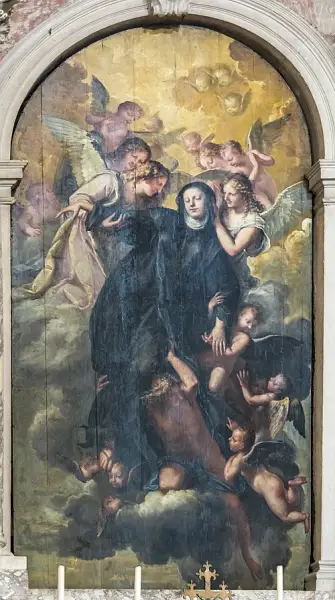
Gertrude the Great, also called Gertrude of Helfta, was a German Benedictine nun who became one of the most celebrated mystics of the thirteenth century. Born on the feast of the Epiphany in 1256, allegedly in Thuringia, she was placed in the monastery school of St. Mary at Helfta as a small child and spent her whole life within its walls. Educated in scripture, the Fathers of the Church, and rhetoric, she first pursued secular learning with great energy. In 1281 a series of visions of Christ redirected her studies toward theology and contemplative prayer, and she began to compose spiritual works. Her principal book, the Herald of Divine Love, recounts these experiences and helped establish devotion to the Sacred Heart of Jesus among the sisters of Helfta, who practiced a nuptial mysticism in which the soul was received as the bride of Christ. She died at Helfta around 1302. Honored by an equivalent canonization approved by Pope Innocent XI in 1677, she received the title 'the Great' from Pope Benedict XIV and was named patroness of the West Indies in 1609.
The Complete Life
A Child Given to Helfta
Gertrude was born on January 6, 1256, the feast of the Epiphany, reportedly in Thuringia within the Holy Roman Empire. Almost nothing is recorded of her family. At about the age of five she was placed in the monastery school of St. Mary at Helfta, a house governed by Abbess Gertrude of Hackeborn. Whether her parents offered her to the cloister as a child oblate, or whether, orphaned early, she arrived by other circumstances, cannot now be determined. In the Herald she implies that her mother and father were already dead when she came to write it, which has led scholars to think she entered the school as a parentless child. The abbess entrusted the girl to her own younger sister Mechtilde, who supervised her formation. The education she received was unusually broad: she came to know Scripture intimately, absorbed the Church Fathers, above all Augustine of Hippo and Gregory the Great, and studied contemporary masters such as Bernard of Clairvaux, Hugh and Richard of St. Victor, and William of St. Thierry. Her surviving Latin is fluent and rhetorically accomplished, evidence of the rigor of Helfta's curriculum and of the exceptional learning permitted to its women.
§ Life
The Vision That Changed Everything
At Helfta Gertrude at first gave herself wholeheartedly to secular learning, delighting in eloquence and in the breadth of her studies. In 1266 she took her place among the professed sisters of the community. The turning point came in 1281, in her twenty-fifth year, when the first of those visions of Christ that were to visit her until death arrived — and her priorities were overturned. Where she had pursued knowledge for its own sake, she now gave herself to scripture, theology, and the disciplined practice of personal prayer and meditation. She regarded the change as a correction of long neglect, and she wrote of it with striking candor, attributing her earlier course to vanity and to letters that served no higher end. From this time she also bore what she described as invisible stigmata, marks of the Lord's suffering perceived inwardly rather than on her body. Her gifts did not abandon the schoolroom; rather, learning was consecrated to contemplation. Under Mechtilde's continued guidance she became the foremost writer of her house, and together the two women shaped the distinctive mystical school for which Helfta is remembered.
§ Life
The Heart of Christ
The center of Gertrude's interior life was devotion to the Sacred Heart of Jesus. Her Herald of Divine Love records with great warmth her visions of the Lord's heart, which the nuns of Helfta understood as a fountain of redemption flowing from the wound in Christ's side. On the feast of St. John the Evangelist she told of leaning her head against the wound in the Savior's side, hearing his heart beat within — an image of extraordinary intimacy that became emblematic of her spirituality. With her teacher and friend Mechtilde she practiced what later writers have called nuptial mysticism: the affective and imaginative entering into the soul's identity as the bride of Christ, united to him in covenant love. Her mysticism was thoroughly liturgical, woven out of the psalms, the Mass, and the hours of the Divine Office celebrated in choir, and the sisters of her house made this devotion central to their common vision. Prayer, for Gertrude, was not an escape from community but its deepest expression. In the Spiritual Exercises she left a sequence of structured meditations that reveal a disciplined, scriptural imagination directing the soul through repentance toward union with the wounded Christ she had learned to love.
§ Devotion to the Sacred Heart
Writer of the Herald
Gertrude's literary output was considerable, though not all of it survives. Her masterpiece, the Legatus Memorialis Abundantiae Divinae Pietatis, known in English as the Herald of Divine Love or the Herald of God's Loving-Kindness, is a work in five books. Book 2, the core of the whole, she wrote herself, beginning on Maundy Thursday in 1289; books 3, 4, and 5 were taken down by fellow sisters during Gertrude's own lifetime, likely in part from her dictation; and book 1 was composed as an introduction shortly before or after her death, most likely by another nun of Helfta. Alongside the Herald she compiled a collection of Spiritual Exercises, a sequence of meditations of lasting value. The prayers gathered under the title Preces Gertrudianae are a later assembly and cannot all be hers. Scholars also suspect that she had a hand in the Book of Special Grace, the record of revelations attributed to Mechthild of Hackeborn. Through these writings the theology of the divine heart cultivated at Helfta passed to later centuries, and Gertrude stands among the few medieval women whose written works went on to shape the devotion of the whole Church.
§ Works
Last Years at Helfta
The sources say little of Gertrude's final two decades beyond the continuation of the visions that began in 1281 and the literary labor they inspired. Book 2 of the Herald was begun in 1289, and further books were taken down by her companions during her lifetime, so that her closing years were occupied with recording and ordering what she had received. She died at Helfta, near Eisleben in the County of Mansfeld, around the year 1302, aged about forty-six. No account of her illness or burial survives, and the memory of her would soon have to live on in her books, for only five manuscripts of the Herald outlasted the Middle Ages. The earliest of these was copied in 1412, and of the five just two are complete, a narrow margin by which her voice reached posterity. That her work survived at all owes much to the sisters who wrote beside her and to the copyists of the following century who judged the record of her visions worth preserving.
§ Life
Equivalent Canonization
Gertrude was never solemnly canonized by papal bull, yet her cult received the Church's sanction by other means. Rome approved in 1606 an office — prayers, readings, and hymns — honoring her, a recognition then counted as the equivalent of canonization. In 1609, on the petition of King Philip IV of Spain, she was named patroness of the West Indies, and Peru still keeps her feast with great festivity. Her feast, first assigned to November 15, was extended to the Latin Church by Pope Clement XII. The General Roman Calendar and the Roman Martyrology now mark it on November 16, while the particular calendars of the German-language area and of Hungary keep it on November 17. In 1677 Pope Innocent XI granted an equipollent canonization, confirming her cult by decree rather than by judicial process. The title 'the Great' was conferred on her by Pope Benedict XIV, marking her off from Gertrude of Hackeborn and honoring the profundity of her theological and spiritual vision. In 2022 she and Mechtilde were inscribed on the calendar of saints of the Episcopal Church in the United States, their feast assigned to November 21.
§ Veneration
A Mystic for the Centuries
Gertrude's reputation after death moved through narrow channels before flooding the early modern Church. Only five manuscripts of the Herald survived the later Middle Ages, the earliest written in 1412 and only two complete; yet in the sixteenth century her works re-emerged in Latin, Italian, and German editions. The Discalced Carmelites proved eager readers: Francisco Ribera, confessor to Teresa of Avila, urged her to take Gertrude as a spiritual guide, and in the golden age of Spanish women mystics the Jesuit Alonso de Andrade brought out a life of the Helfta nun that supplied Teresa with a medieval forerunner. Seventeenth-century France, seeking an antidote to Jansenism, embraced her warm theology of the divine heart, and her influence crossed to the European colonies of Latin America. In the nineteenth century Dom Prosper Gueranger, restorer of Benedictine monasticism in France, drew on her writings, and his Congregation of Solesmes produced most of the scholarly work done on Gertrude in that century. Her name is honored today by the Monastery of St. Gertrude in Cottonwood, Idaho, home to a community of professed Benedictine sisters, by numerous parishes dedicated to her across the world, and by Catholic schools for young women in Richmond, Virginia, and Bell Gardens, California.
§ Later reputation and influence
Timeline
- 6 Jan 1256
Born on the feast of the Epiphany, allegedly in Thuringia within the Holy Roman Empire.
§ Life
- 1261
Entered the monastery school of St. Mary at Helfta at about five years of age.
§ Life
- 1266
Joined the monastic community at Helfta, entrusted to the care of Mechtilde.
§ Life
- 1281
Experienced the first of a lifelong series of visions that turned her from secular studies toward scripture and prayer.
§ Life
- 1289
Began writing Book 2 of the Herald of Divine Love on Maundy Thursday.
§ Works
- 17 Nov 1302
Died at Helfta, near Eisleben, on November 17, at about forty-six years of age.
§ Introduction
- 1412
Earliest surviving manuscript of the Herald of Divine Love was copied.
§ Later reputation and influence
- 1606
Rome approved in her honor a liturgical office, complete with prayers, readings, and hymns.
§ Veneration
- 1609
Declared Patroness of the West Indies at the petition of King Philip IV of Spain.
§ Patronage
- 1677
Received an equipollent canonization from Pope Innocent XI.
§ Veneration
- 2022
Added, with Mechtilde, to the Episcopal Church calendar of saints with a feast on November 21.
§ Veneration
The Record
- Major works
- Legatus Memorialis Abundantiae Divinae Pietatis (The Herald of Divine Love)·Spiritual Exercises·Preces Gertrudianae (later compilation, not entirely hers)·Book of Special Grace (probable partial authorship)
- Patron of
- Patroness of the West Indies
- Symbols
- cross·radiant heart·image of the Sacred Heart of Jesus·crosier·copy of the Rule of St. Benedict
- Canonization
- Equipollent canonization by Pope Innocent XI in 1677; a liturgical office in her honor had been approved by Rome in 1606 as the equivalent of canonization.
Prayer
Bibliography
Show 7 sources
- Gertrude of Helfta (1993). The Herald of Divine Love. Classics of Western Spirituality. Translated and edited by Margaret Winkworth, preface by Louis Bouyer. New York: Paulist Press.
- Gertrude the Great of Helfta (1989). Spiritual Exercises. Translated, with an Introduction, by Gertrud Jaron Lewis and Jack Lewis. Cistercian Fathers series no. 49. Kalamazoo: Cistercian Publications.
- Gertrud the Great of Helfta (1991). The Herald of God's Loving-Kindness, books 1 and 2. Translated, with an Introduction, by Alexandra Barratt. Cistercian Fathers series no. 35. Kalamazoo, MI: Cistercian Publications.
- Gertrud the Great of Helfta (1999). The Herald of God's Loving-Kindness, book 3. Translated, with an Introduction, by Alexandra Barratt. Cistercian Fathers series no. 63. Kalamazoo, MI: Cistercian Publications.
- Gertrude the Great, Saint (1861). Preces Gertrudianae: Prayers of St. Gertrude and St. Mechtilde of the Order of St. Benedict. Translated by Thomas Alder Pope. Burns and Lambert.
- Doyère, P. (2003). 'Gertrude (the Great), St.' In New Catholic Encyclopedia, Vol. 6 (2nd ed.). Detroit: Thompson/Gale; Catholic University of America.
- Jones, Claire Taylor (2014). 'Hostia jubilation: Psalm Citation, Eucharistic Prayer, and Mystical Union in Gertrude of Helfta's Exercitia spiritualia'. Speculum 89 (4): 1005–1039.
Profile text adapted from the Wikipedia article, licensed CC BY-SA 4.0.
Pray with this saint every day
Save St. Gertrude the Great to your favorites, read the full profile, and get feast-day reminders in the Saints app.
Get the Saints AppFree on the App Store for iPhone and iPad